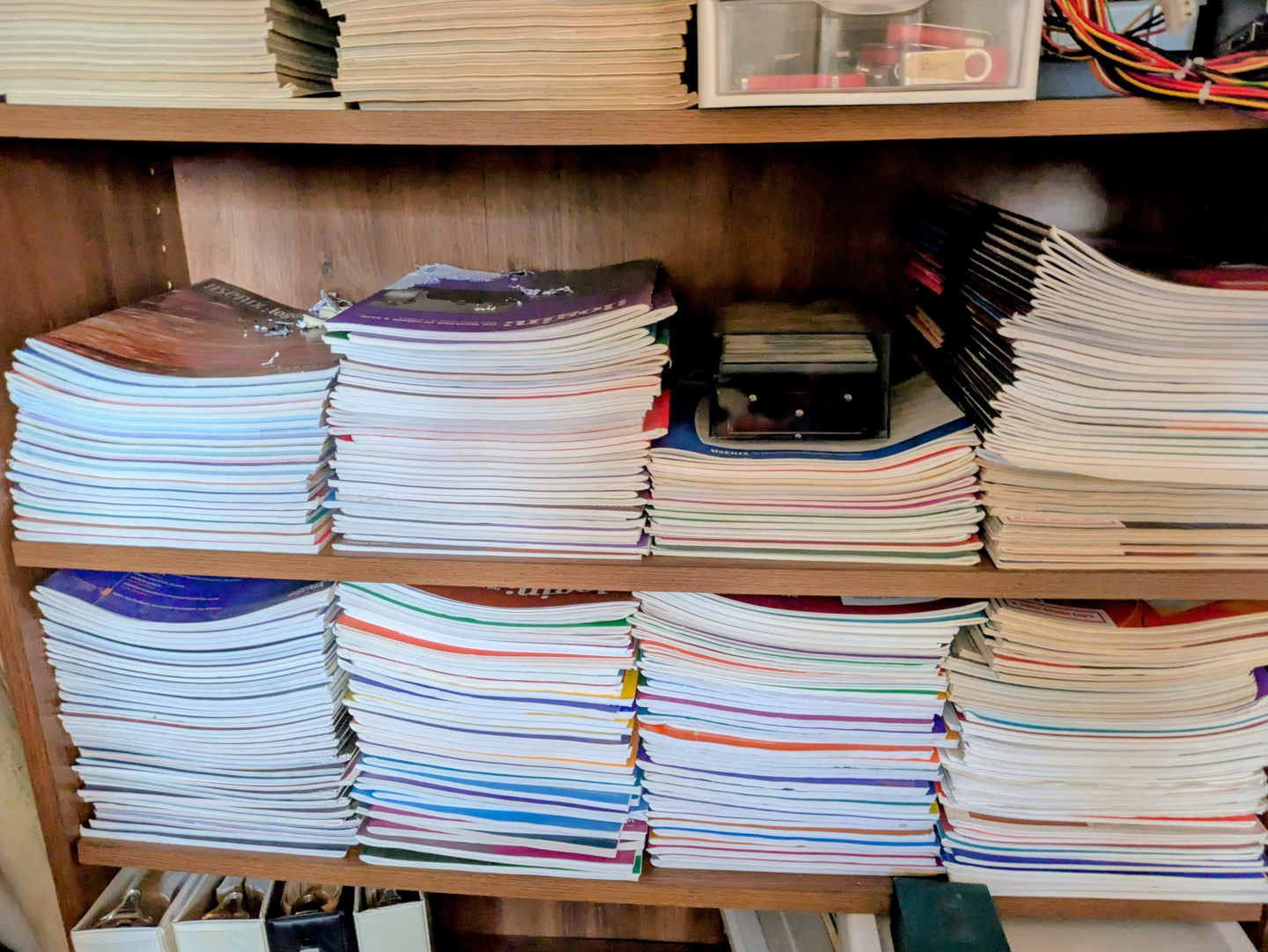
Today marks my last day as the editor of ;login:. The USENIX Board has decided that having a magazine is not on purpose for an organization that runs scientific conferences related to computer science. You can read the Board's full explanation in the blog post for the 2024 Open meeting. While I mostly agree with the Board's decision, there are other factors involved, not the least that at 75, it is time for me to step down. In this short article, I will share a little of my history with ;login: with you.
In 1996, Ellie Young, then the Executive Director of USENIX, approached me during a USENIX conference. She asked me if I would like to be the editor of ;login:, and that she had also asked the editor of Unix Review magazine, Andrew Binstock. I was definitely interested, as I liked working with USENIX and was excited about being able to edit a technical Unix magazine with almost no advertising. I had worked with Unix World Magazine, where more than half the staff employed dealt with advertising, and 64% of the magazine's content was advertising, a not unusual amount.
Rob Kolstad was the current editor, and he had no interest in giving up his position, even if he treated editing ;login: as a hobby. Rob continued being the editor until April of 2005 when he discovered he had no content for the June 2005 issue. The Board decided to let me edit ;login:, starting with that issue.
I had written a proposal for editing ;login: in 1996, and when I changed to my :login: directory in 2005 and typed "vi proposal", there was my original proposal. I made some minor changes, emphasizing that I would focus on articles relating to conferences as a well of promoting conference attendance. The Board agreed. Young told me that part of my editor's duties included attending all conferences and workshops. That made sense to me if I was going to cover USENIX conferences, and getting to attend the conferences and many workshops with my expenses covered was exciting to me. My own work as a Unix and security instructor had been diminishing as Windows (actually hacking Windows) became more popular, and I thought I'd enjoy editing ;login:.
And for the most part, I have enjoyed editing ;login:. There were parts I didn't like or found difficult to do, mainly running the collection of graduate students that summarized conference presentations and reading page proofs. In 2016, the Board decided to end the publication of summaries, as most presentations were now videoed. That simplified my editing task in one way—there's nothing quite like having over a dozen reluctant summary authors to deal with every issue—but made life more difficult in another. I now had to come up with more feature articles.
I had high standards for articles that rested on two things. First, the topic of articles must be relevant to the USENIX community, and for articles based on conference papers, that part was relatively easy. The second thing was much more difficult: how to pick research that would be interesting to a broader set of people than just those who routinely attended the particular conference. I needed to do that for two reasons: I wanted to share interesting research beyond a conference's community and I needed to have hundreds, if not thousands, of people reading the published articles. As USENIX was not paying authors, their payment came in the form of the greater recognition for their research that a well-written article could bring. And, over time, I became very successful at this. Clem Cole, past Board president, told me that I was an analyst in that I had a real skill at picking interesting research. On a side note, it was common for me to pick the same papers for articles that would go on to win best paper awards—not always, but it seemed I had an additional ability to choose papers that award committees also liked.
I am not sure what I will be doing in retirement. In a way, I was like Rob Kolstad, treating ;login: as an interesting (and paying) hobby: something that I liked to do and found extremely interesting. I wonder how well I will manage to keep up with computer science research going forward without the stimulus of having article authors to find. But I do remain curious about new research in all of the areas that USENIX conferences cover.
I really appreciated getting to meet and work with the authors of articles and summaries, and attending USENIX conferences. I found the attendees friendly and helpful, and plan to continue to stay in touch with some of the thousands of people I met over the decades. I thank all of you for your assistance, for writing, and allowing me to edit ;login: for so many years. I also appreciated working with the USENIX staff, who made the process of producing print ;login: easy, as well as running conferences smoothly. I want to thank Steve Gilmartin, a poet, for copy editing ;login: when it was in print.
Good bye for now...
Rik Farrow