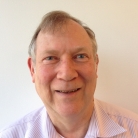
"Called. Don. Knuth. I. have. a. student. for. you." After a stroke two years ago, Fred's mobility was diminished and his speech was firm but halting. Fred Brooks was describing how he changed my life 53 years ago. Hundreds of people have similar stories of Fred changing their lives. My wife and I and Pat Hanrahan (Toy Story graphics Oscar) were visiting Fred and Nancy at their home in early November 2022. Fred had told me of the call years before, but was now telling Pat. You could tell from his eyes that he was following the wide-ranging conversation perfectly and he occasionally added a few words.
I went to the University of North Carolina as a Master's student 1969-70 specifically to take Fred's computer architecture course. He picked me to be the class T.A. As a mentor, Fred was gracious, gentle, supportive, and clear. He loved teaching. He guided headstrong young people with simple statements or as nudges, largely allowing them to freely move along at their own pace and in their desired direction.
For example, Fred took me aside after one class and suggested I slow down in answering questions, to allow the others in the class to answer. He was the first person to tell me that — gently but something I needed to hear and (mostly) took to heart. As TA, I did one mimeograph handout [if you are under 50, look it up] of System/360 microcode that Fred later suggested was nearly unreadable unless you already knew what it said. He let me grade class homework with my made-up check, check-minus, and X marks, only asking me at the end of the term how to map those into letter grades. I said A, B, F; he turned them into something more gentle.
He supported the people around him. Each student gave a brief end-of-term presentation on some computer design. Fred carefully set aside time to go over each presentation with the student beforehand and make suggestions.
Fred took it upon himself to help people even when it meant sending them elsewhere to find a better match. Partway through the first term, I mentioned to him that I really had only one other student to talk to deeply about computer architecture. In response, he quietly called Don Knuth a few days later and I ended up accepted in the Stanford PhD program for the following year. Many years later, when I suggested finishing my Master's thesis (never started because I transferred to Stanford), Fred immediately replied "I should be delighted to sponsor you. ... I'll start looking into the bureaucratic complexities; you start on the document." When my partial draft was mediocre as thesis material, he suggested a better match: "Publish your paper in Annals of the History of Computing." As it turned out, I have never followed up.
Fred lead by example, quietly showing people how to lead exemplary lives outside of academia.
Fred was an evangelical in the active sense of encouraging others to the Christian faith, but never in a pushy or preachy way. He simply made his beliefs clear and invited others along. I was one of his disappointments in that, but it had no bearing on our long relationship.
In 1965,when IBM offered a $100,000 (about $900,000 in 2022 dollars) grant to help grow the new department, Fred insisted that the grant be spread evenly between UNC-Chapel Hill, Duke University, and North Carolina State University. This established a pillar of computer science in the Research Triangle. From its beginning, the Computer Science Department built hardware and software and shared faculty and students to support other UNC departments. In the 1990s, he set aside work on his computer architecture book for over a year while he quietly worked with Governor Jim Hunt improving the state's community colleges, to support and attract more technology companies to North Carolina.
When he stepped down as department Chair, he very deliberately took a sabbatical in England, giving the new Chair a free hand to establish his own direction.
Fred was self-aware and enjoyed irony. He once apologized for being late to class, explaining that his flight had been delayed by a broken F.A.A. System/360 flight-scheduling computer. He once introduced me as the department's "Most distinguished non-graduate" (since I transferred out). When my wife and I had quietly donated to secure the building naming rights, Fred wrote in thanks that he was speechless, and commented on how rare that was.