• Donate
  • Log In
Home
  • About
    • About
      • About Us
      • Our Board of Directors
      • Board Meeting Minutes
      • Board Elections
      • Updates & Announcements
      • Our Staff
      • Governance & Financials
      • Lifetime Achievement Award
  • Events
    • Events
      • Upcoming
      • Past
      • Conference FAQ
      • Conference Policies
      • Code of Conduct
      • Calls for Papers
      • Author Resources
      • Grant Opportunities
      • Best Papers
      • Test of Time Awards
  • Join & Support
    • Join & Support
      • Become a Member
      • Ways to Give
      • Our Supporters
      • Student Opportunities
      • Sponsorship Opportunities
  • Archive
    • Archive
      • Proceedings
      • Multimedia
      • ;login: Archive
      • Short Topics in System Administration Series
      • Journal of Education in System Administration (JESA)
      • Journal of Election Technology and Systems (JETS)
      • Computing Systems Journal
  • Search

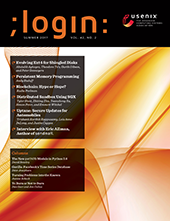
Evolving Ext4 for Shingled Disks

Author(s): 

Abutalib Aghayev, Theodore Ts’o, Garth Gibson, and Peter Desnoyers

Multi-terabyte hard disks today use Shingled Magnetic Recording (SMR), a technique that increases capacity at the expense of more costly random writes. We introduce ext4-lazy, a small change to the popular Linux ext4 file system that eliminates a major source of random writes—the metadata writeback—significantly improving performance on SMR disks in general, as well as on conventional disks for metadata-heavy workloads in particular. In this article, we briefly explain why SMR disks suffer under random writes and how ext4-lazy helps.

Download Article: 
PDF icon Evolving EXT4 for Shingled Disks (PDF)
Article Section: 
FILE SYSTEMS AND STORAGE
;login: issue: 
Summer 2017, Vol. 42, No. 2
USENIX logo
  • Contact USENIX
  • Privacy Policy

© USENIX 2025
EIN 13-3055038

Website designed and built by Giant Rabbit LLC
Powered by Backdrop CMS

We need contributions from individuals like you.

USENIX conferences directly influence the development of computing systems and products used worldwide. Contribute today to support this vital work for the next 50 years.

Secure the Future of USENIX

Donate
Close