It appeared to be a date like any other. On a Friday night, Deborah and Kenneth went for a dinner date at an Italian place downtown. They had chatted briefly on a dating app and decided that getting to know someone is much easier in-person. However, throughout the date Deborah didn't feel any spark, it seems they both had less in common than she initially thought. That happens. They amicably parted ways and went home. However, the next day, Kenneth appeared in front of Deborah's house to aggressively ask her what he did wrong. She never told him her address, but he somehow found out how to find her. What Deborah didn't realize: Kenneth had hidden a location tracker in her jacket when she wasn't looking.
This is a form of tech-facilitated abuse — a growing problem [1]. Stalking with the help of technology isn't a new concept. GPS trackers and other spy devices have been commercially available for decades. However, they were hard to obtain, often requiring a venture to the dark web. They were more expensive, bulky, and less usable. There is also a mental burden to overcome before buying a dedicated stalking device.
However, design and availability matter. Location trackers have gotten smaller, cheaper, more precise, and more usable through their native support on smartphones. These new types of location trackers are small devices similar in size to a coin or credit card. Their batteries last months or years, making them convenient for tracking keys, wallets, luggage, or other belongings. They are so small and power-efficient because they rely on a network of other devices to determine and relay their location. Manufacturers that use these networks don't need to integrate GPS and cellular connectivity, saving cost and lowering power consumption as well as device footprint. With this convenient set of features, state-of-the-art location trackers can be misused to locate and track people without consent by sneakily putting a tracker on them.
When Apple introduced its AirTag location trackers, they knew they would be misused for stalking [2]. They added two main features to the ecosystem to protect people from AirTag-based stalking: audible alarms and messages that pop up on iPhones. If AirTags are outside the owner's range for a sufficiently long time, they emit a chirping sound when moved. This alarm could be the first indication to other people that something unusual is afoot. Additionally, people with iPhones receive a notification about an unknown device following them, usually when they arrive at home or work. Since last year, these notifications have also been available on Android phones. These notifications support all kinds of location trackers that rely on Google or Apple's location-tracking network.
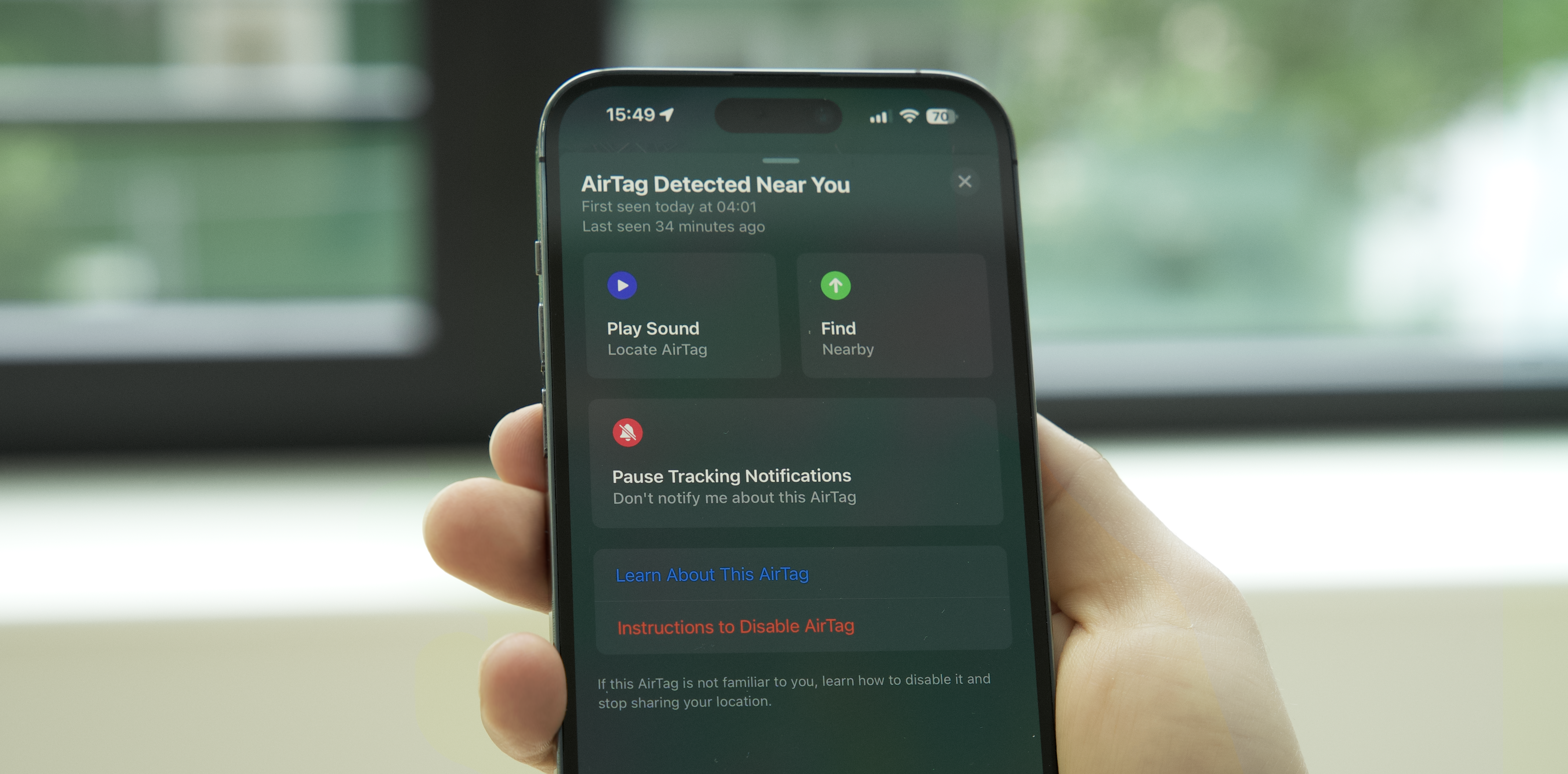
Ideally, Deborah receives a notification on her phone about the location tracker that Kenneth hid in her jacket, which looks similar to the one shown below.

Knowing the situation, she can now react: Find the location tracker, deactivate it by removing the battery, or innocently “forget” the tracker at a place that isn't her home.
Our study, published at USENIX Security [3], examined how well these anti-stalking mechanisms work in real-world conditions. Are these notifications delivered reliably and timely? Do people who don't expect a safety-critical notification understand the potential danger they are in? Are the available tools effective in helping people find and deactivate location trackers?
To investigate the anti-stalking features of Apple AirTags, we performed two studies to evaluate their effectiveness in the real world. We chose AirTags as the best-case example because their feature suite was considered among the most robust at the time of writing, and they operate within the largest tracking network.
In the first study, we gave 50 participants an active AirTag to take with them. Our goal was to determine whether each participant would reliably receive a tracking notification and how long it would take. Half used iPhones, and the other half had compatible Android phones. This allowed us to compare performance across operating systems and hardware configurations.
The second study required a more creative approach as we wanted to see how people would react to a tracking notification if they weren't expecting to receive one. To achieve this, we conducted a deception study giving participants a visually disguised AirTag in the context of a study about activity tracking. Participants took the hidden tracker with them, not knowing its real purpose, and most of them received a tracking notification within the next 24 hours. After this experience, participants told us about their thoughts and reactions during an interview. We then asked these participants to find a hidden AirTag in a car that we prepared so they could share their thoughts about the locating features.
Ethical research is always a top priority in our research. Thus, we ensured the privacy and safety of our participants during each part of this project. This started with setting up the trackers so that we couldn't access their location, and we included multiple opportunities for participants to ask questions and drop out, among many other precautions.
One of the first considerations when thinking about the possibility of being tracked with an AirTag is whether you would realize it in time. A tracking notification on iOS and Android is supposed to help with that. In practice, this is likely the first time potential victims become aware that a tracker is moving with them. However, this requires the notification to reliably appear in the first place.
In the first part of our study, we ran an experiment with 50 participants to test this reliability. We found that the tracking notification for a foreign AirTag is reliably delivered on all tested iOS devices. Unfortunately, only 14 out of 25 participants with an Android phone received the alert, making them more susceptible to prolonged stalking. It is important to note that these numbers were collected under relatively ideal conditions. All tested phones supported the warning notification. They were set up and configured such that the notification could appear, and participants consistently carried the tracker with them. If someone used an unsupported or no phone, or disabled settings such as Bluetooth and location services, they would never receive a warning notification. In such cases, potential victims would have to discover the tracker themselves, possibly with the help of the chirping sound AirTags occasionally play.
The time it takes for the notification to be delivered varies greatly, and in most cases, it is delivered after someone reaches their home. This isn't a coincidence — it is a deliberate feature to reduce false positives on all the smartphones and surrounding trackers they encounter on a regular basis. Unfortunately, this has the unintended consequence of letting a potential stalker know where you live before you receive a warning.
Imagine receiving a tracking notification, and the title reads “AirTag Found Moving With You.” The text below says, “The owner can look up its location.” What does this tell you? Assume you didn't know what AirTag meant. Also, what does it mean for this thing to move with me? Is that bad?
We used a deception study to explore whether users would understand the warning and know how to react to it. The 19 participants of this part of the study unknowingly carried an AirTag that would trigger a tracking notification on their phones. Then, they would have to decide how to respond. In an interview shortly after, they shared their experience. We found that technology understanding played a crucial role in how effective their reactions were.
If someone exhibited less technical knowledge, they often took ineffective actions. For example, one participant mentioned switching off their phone to protect themselves, but this wouldn't stop the tracker from functioning. Participants with a higher understanding of the technology performed more effective actions. They would typically try to locate the tracker by playing the chirping sound and then consider disabling or disposing of it. Anyone can be a victim of stalking, so an understanding of this technology shouldn't be a requirement to be adequately protected.
The phrasing and presentation of the notification also caused confusion with some of our participants. The user interface never explicitly states the potential threat, leaving users to infer the risk on their own. If they cannot do so, they may disregard the warning and keep being surveilled. Companies may want to refrain from mentioning threats to avoid associations with stalking and similar misuse of their products. Nevertheless, it would likely help potential victims to know their situation, especially if they have no prior knowledge of this topic.
Lastly, we wanted to see how difficult it would be to find a reasonably well-hidden tracker and where the challenges lie. We asked our participants to find an AirTag we hid in the trunk of a car. During the finding process and a short interview after, they told us how well the built-in locating features worked for them. We used an iPhone and the pre-installed Find My app shown below for this task. Some participants didn't know which feature did what and how they worked. Most functions lack a description in favor of short labels like “Play Sound.” This led to confusion where participants wouldn't know whether the sound was coming from their phone or the hidden tracker. Many participants struggled with hearing the faint chirping sound at all.
The visual interface to display direction and distance to an AirTag worked well for those who had it available and found it. Still, it caused confusion when the connection to the tracker was unreliable, or when the interface toggled between showing a direction or only an approximate distance. While our participants reported having no impairments, many explained that they would have had a much harder time finding the tracker if they were hard of hearing or had low vision.
Location trackers such as AirTags are a modern convenience that helps many find their lost or misplaced items by utilizing a crowd-sourced tracking network.
While this is technologically impressive, it also enables their misuse. The convenience of these devices makes stalking more accessible for abusers while making it harder for potential victims to protect themselves. While the built-in protection mechanisms of AirTags offer a solid foundation and help reduce harm in many instances, they fail to protect everyone. Too much of the burden falls on potential victims. As a result, people now face yet another threat they must be aware of and defend against. This task shouldn't fall on individuals, but on the companies that release and profit from this technology.
The motto “Move fast and break things” has guided the product development approach for many Silicon Valley tech companies. Still, perhaps it is time to acknowledge the real-world consequences of many technologies and reconsider this approach. The warning notifications must be easy to understand and convey urgency so potential victims can accurately assess the risk. The user interface must also guide users to safe responses by offering more assistance and clear descriptions in favor of a minimal and sleek design. Our paper offers more actionable recommendations and urges companies to take responsibility by improving their products so people can feel safe from this threat. We shouldn't allow ourselves to introduce new technologies to the world for dealing minor inconveniences at the cost of serious societal consequences.