
Caching bolsters the performance of virtually every computer system today by speeding up data access and reducing data movement. By storing frequently accessed objects on a small but comparatively fast storage device, future requests for that cached data can be processed rapidly. When the capacity of a cache is much smaller than the complete dataset, choosing what objects to store in the cache, and which to evict, becomes an important, hard, and fascinating problem.
In this article, we present a new cache eviction algorithm called SIEVE that is simpler than the state-of-the-art algorithms while achieving superior efficiency and thread scalability.
Caching is a vital tool for optimizing the performance of slow backends. A good cache should (1) serve as many requests as possible from the cache, and (2) serve as many requests as possible in a time interval. The former is often measured by miss ratio — the fraction of requests that cannot be served from the cache; while the latter is often measured by throughput — the number of requests the cache can serve per second.
When the cache fills up, writing new data requires discarding some old data. The algorithm that decides which data to evict is called a cache eviction algorithm. Least-recently-used (LRU) is the most common eviction algorithm used in production systems. An LRU implementation often uses a doubly linked list to maintain the last-access ordering between objects. Upon each cache read, the requested object is moved to the head of the list. To insert an object when the cache is full, the object at the tail of the list is evicted. LRU is simple and effective because data access often exhibits temporal locality — recently accessed data are more likely to be accessed again soon.
While it is the most common eviction algorithm, LRU leaves a lot of efficiency on the table compared to an offline optimal caching algorithm. Over the past sixty years, many new cache eviction methods have been designed with the goal of achieving a lower miss ratio. Many of these algorithms descend from LRU — often using one or more LRU lists. For example, ARC internally employs four LRU lists, two of which store recently and frequently accessed data, and two of which track recently evicted data.
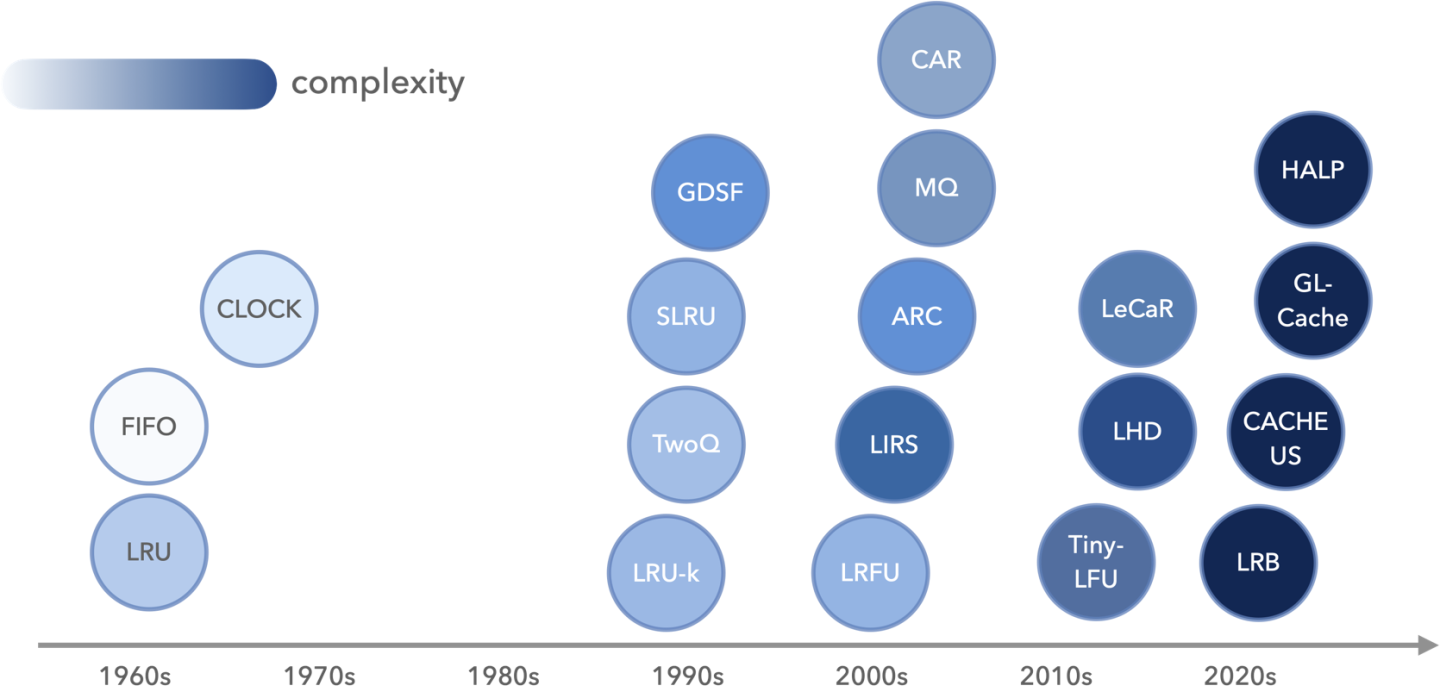
While a range of algorithms have been proposed to improve efficiency, they have become increasingly complex over time. As a result, these algorithms are difficult for systems builders to implement and debug, and most of them have never been adopted in real systems.
Moreover, LRU and LRU-based algorithms suffer from a scalability problem. Because each cache read modifies the head of a doubly linked list, which is guarded by a lock, an LRU cache cannot exploit the many cores in modern CPUs
Can we yearn, then, for a cache algorithm that is not just efficient and scalable, but also simple enough to be practical? History suggests the pursuit is unlikely to bear fruit, and a richer trove of data than researchers have previously had available lends us hope.
While the very mention of caching may conjure images of traditional block and page caches, the web cache deployments that power our online life have grown meteorically over the past decade. In the data center, for instance, key-value caches are widely deployed at scale (for example, petabytes at Google) to temporarily store computed results, such as SQL query results and machine learning predictions. On the edge of the Internet, Content Delivery Networks (CDNs) deliver images and videos to end-users quickly and cheaply.
The data access patterns of these web caches, specifically in key-value and CDN workloads, differ markedly from traditional page cache workloads. For instance, whereas loops and scans of address ranges are common access patterns in block cache workloads, they are very rare in web cache workloads. Instead, the objects in web cache workloads invariably exhibit skewed and long-tailed popularity distributions that follow a power-law distribution.

Our recent study found that most objects in web cache workloads are never reused before being evicted. Following an industry convention, we call these objects one-hit wonders. The metric one-hit-wonder ratio measures the fraction of objects being one-hit wonders in a request sequence. We found that shorter request sequences often show higher one-hit-wonder ratios. The figure above shows an example request sequence, where the full sequence has seventeen requests for five objects. There is only one one-hit wonder in the sequence and the one-hit-wonder ratio is 20%. However, if we consider only the window of requests between one and eight then there are four objects being requested and the one-hit-wonder ratio is 50%.
Why do we care about short request sequences? The reason is simple — a cache has limited capacity, so it will not observe the full request sequence before it begins to evict objects. The implication of this observation is that most of the objects in the cache are not reused before eviction. Therefore, we should not keep these objects around in the cache for a long time. But how do we know what items are worth keeping?
We view a cache as a list logically ordered by eviction preference — items would be evicted in that preference order. Promotion and demotion are two internal operations used to maintain the object ordering in a cache. Traditional LRU-based algorithms use eager promotion, which moves an object to the head of the list upon each request. Meanwhile, they rely on passive demotion to move objects down the list.
However, the LRU approach has two drawbacks. First, eager promotion requires taking a lock on each cache hit, which limits the throughput and scalability of the cache. Second, as we have shown, many objects in the cache are one-hit wonders, yet passive demotion allows them to stay in the cache for a long time and waste precious space better used by others. The problem gets amplified in the big data era where a huge volume of data is being generated while most data are rarely accessed again.
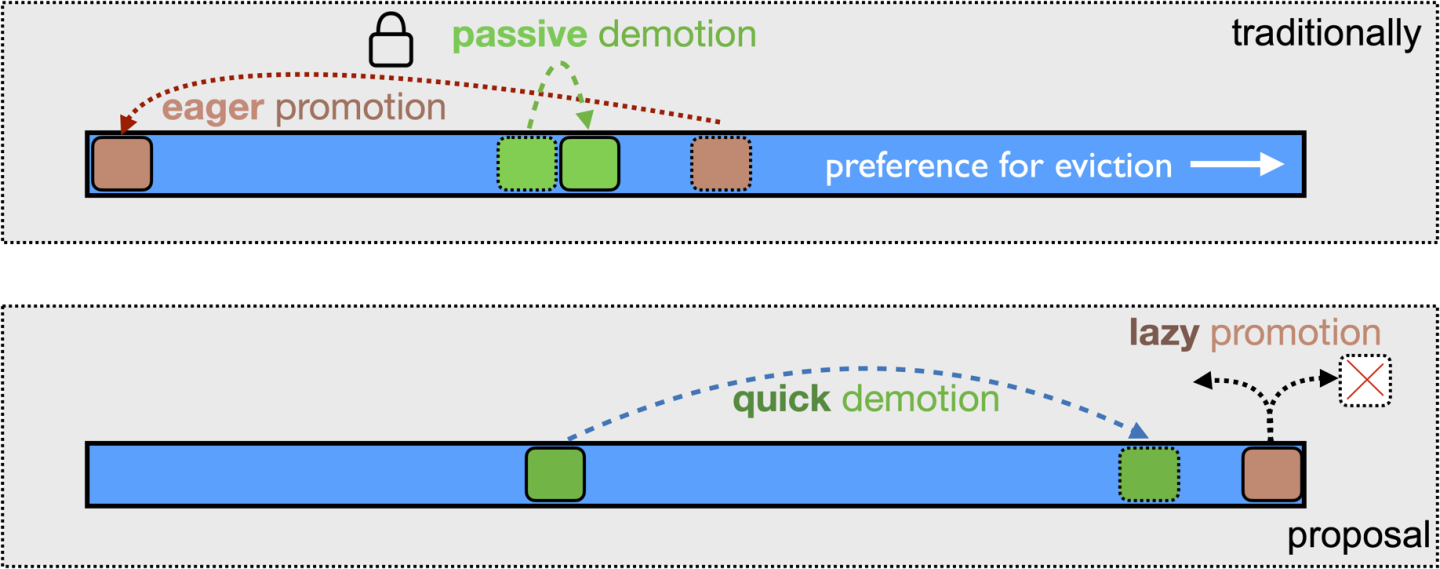
We argue that an efficient cache eviction algorithm should use lazy promotion and quick demotion. Lazy promotion decides whether to promote cached objects or not only at eviction time, aiming to retain popular objects with minimal effort. An example of lazy promotion is adding reinsertion to FIFO (First-in-first-out). Lazy promotion can improve (1) throughput due to less computation and lock contention and (2) efficiency due to more information about an object at eviction.
Quick demotion removes most objects quickly after they are inserted. This is critical because most objects are not reused before eviction. Our previous work leverages this idea and designed S3-FIFO, a cache eviction algorithm that only uses FIFO. S3-FIFO is an efficient cache algorithm that scales better than state-of-the-art eviction algorithms, but, while simple, is still more intricate than the litmus test of algorithms like LRU. Below, we introduce SIEVE, the simplest approach we have found to effectively achieve both lazy promotion and quick demotion for cache replacement.
SIEVE Design
Data structure. SIEVE requires only one FIFO list and one pointer called a “hand”. The list maintains the insertion order between objects. Each object in the list uses one bit to track the visited status. The hand points to the next eviction candidate in the cache and moves from the tail to the head of the list. Note that unlike some existing algorithms, e.g., LRU, FIFO, and CLOCK, in which the eviction candidate is always the tail object, the eviction candidate in SIEVE is an object that can be in the middle of the list.
SIEVE operations. A cache hit in SIEVE sets the visited bit of the accessed object to true. For a popular object whose visited bit is already set, cache hits do not perform any metadata update. During a cache miss, SIEVE examines the object pointed by the hand. If it has been visited, the visited bit is reset, and the hand moves to the next position (the retained object stays in the original position of the list). It continues this process until it encounters an object that has not been visited, and it evicts the object. After the eviction, the hand points to the previous object in the list. While an evicted object is in the middle of the queue most of the time, a new object is always inserted into the head of the queue. In other words, the new objects and the retained objects are not mixed together. We illustrate SIEVE operations in Figures 3 and 4.
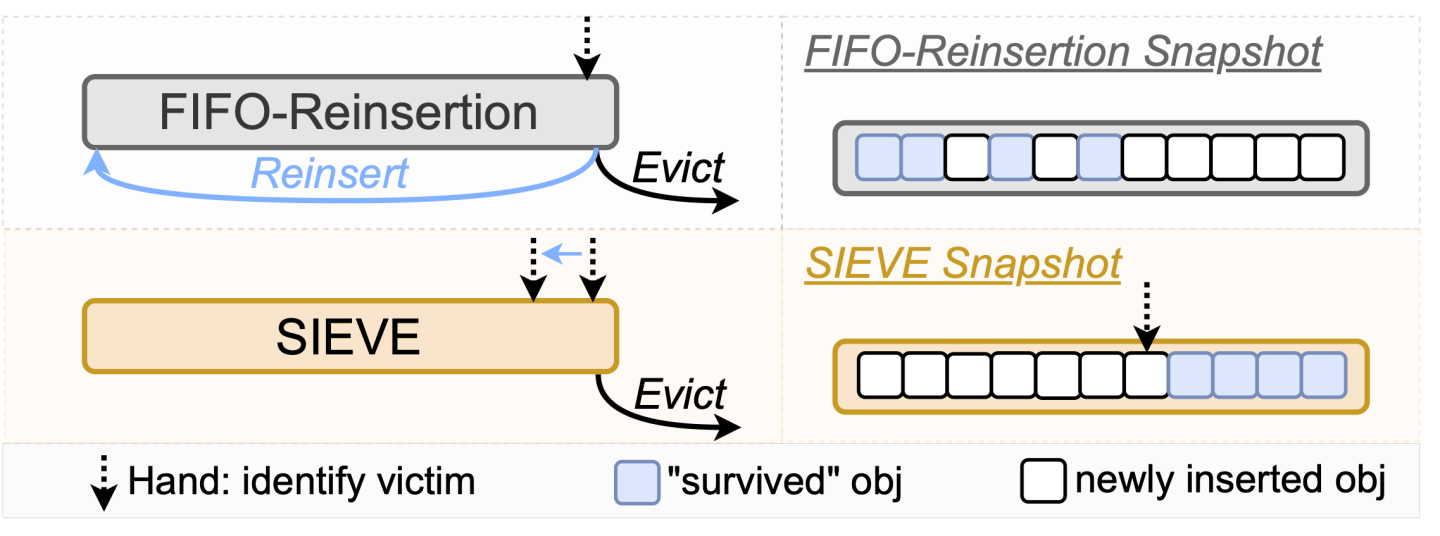
At a glance, SIEVE looks similar to FIFO-Reinsertion, also known as CLOCK and Second Chance, which also uses a bit to track popularity. However, SIEVE differs in where a retained object is kept. SIEVE keeps the object in the original, old position. FIFO-Reinsertion, in contrast, inserts the object at the head, together with newly inserted objects, as depicted in Figure 4. The moving hand permits SIEVE to perform quick demotions. When the hand moves to the head, new objects that have not been revisited are quickly evicted. We describe the algorithm in more detail below.
Evaluation
You may wonder how much a simple algorithm like SIEVE can outperform LRU. We used open-source traces from Twitter, Meta, Wikimedia, Tencent, and two proprietary CDN datasets to evaluate the algorithms. We list the dataset information in Table 1. It consists of 1559 traces that together contain 247,017 million requests to 14,852 million objects. We implemented SIEVE and state-of-the-art eviction algorithms in libCacheSim to compare their efficiency. We have also implemented SIEVE in Meta Cachelib to compare its throughput and scalability with optimized LRU. We replayed the traces as a closed system with instant on-demand fill.
| trace collection | collection time | # traces | cache type | # request (million) | # object (million) |
|---|---|---|---|---|---|
| CDN1 | 2021 | 1273 | object | 37,460 | 2,652 |
| CDN2 | 2018 | 219 | object | 3,728 | 298 |
| Tencent Photo | 2018 | 2 | object | 5,650 | 1,038 |
| Wiki CDN | 2019 | 3 | object | 2,863 | 56 |
| Twitter KV | 2020 | 54 | KV | 195,441 | 10,560 |
| Meta KV | 2022 | 5 | KV | 1,644 | 82 |
| Meta CDN | 2023 | 3 | object | 231 | 76 |
Miss ratio serves as a key performance indicator when evaluating the efficiency of a cache system. However, when analyzing different traces (even within the same dataset), the miss ratios can vary significantly, making direct comparisons and visualizations infeasible. Therefore, we calculate the miss ratio reduction relative to FIFO.
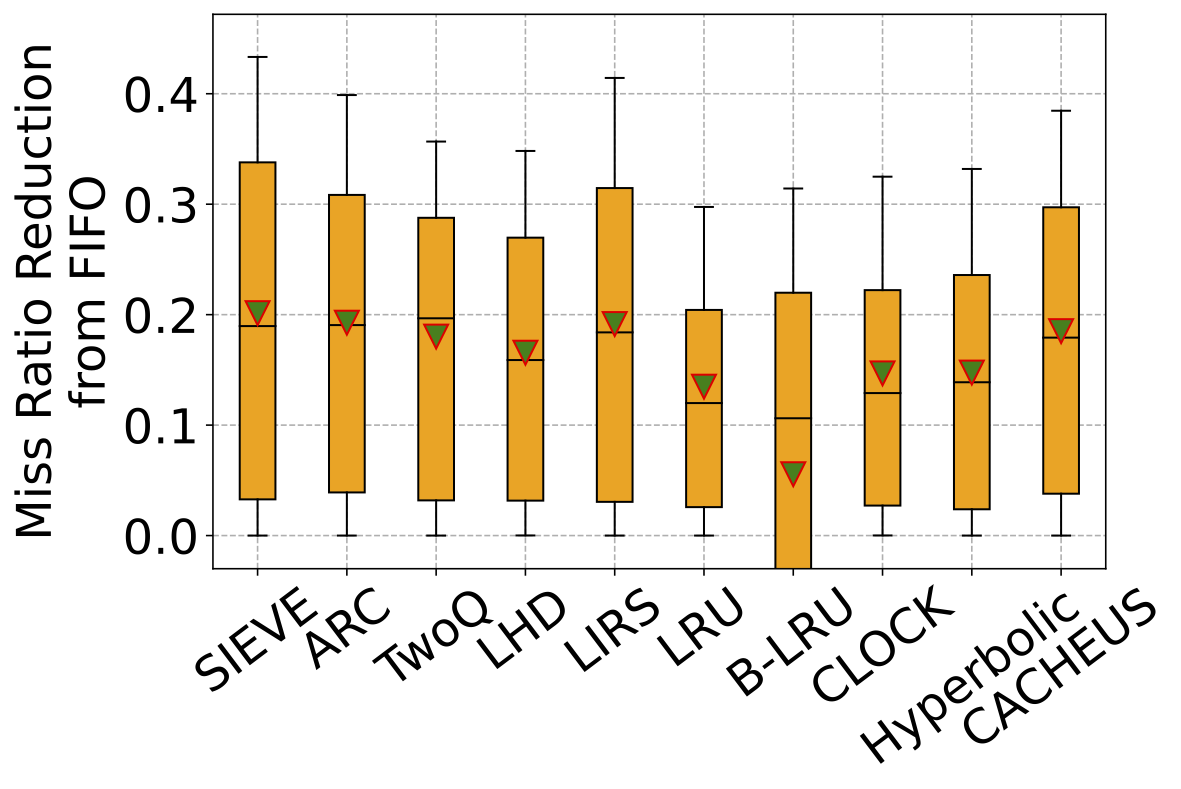
Efficiency. Figure 5 shows the miss ratio reduction (from FIFO) of different algorithms across traces. SIEVE demonstrates the most significant reductions across nearly all percentiles. For example, SIEVE reduces FIFO’s miss ratio by more than 42% on 10% of the traces (top whisker) with a mean of 21%. As a comparison, all other algorithms have similar or smaller reductions on this dataset. For example, CLOCK/FIFO-Reinsertion, which is conceptually similar to SIEVE, can only reduce FIFO’s miss ratio by 15% on average. Compared to advanced algorithms, e.g., ARC, SIEVE reduces ARC miss ratio by up to 63.2% with a mean of 1.5%. Note that, more than 1000 traces were used in the evaluation, so a small move of the box (e.g., the mean value) is non-trivial. We refer interested readers to investigate further figures in our NSDI'24 paper.
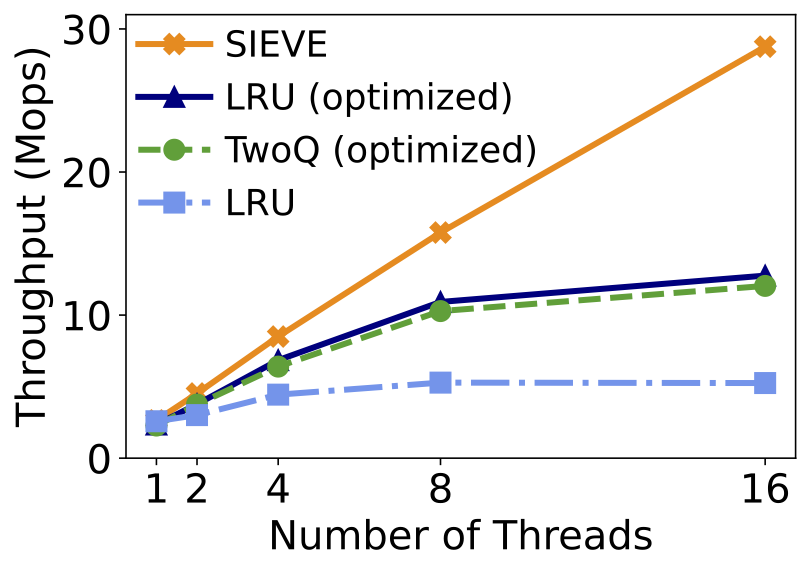
Scalability. Besides efficiency, throughput is the other important metric for caching systems. Figure 6 shows how throughput grows with the number of trace replay threads using a production trace from Meta. Because scalability is important for production systems, Meta engineers spent a significant amount of effort to improve the scalability of LRU-based algorithms. For example, objects that were promoted to the head of the queue in the last 60 seconds are not promoted again. Moreover, Cachelib uses a lock combining technique to elide expensive coherence and synchronization operations to boost throughput. Therefore, the optimized LRU and TwoQ show impressive scalability results compared to strict LRU. Compared to these LRU-based algorithms, SIEVE does not require “promotion” at each cache hit. Therefore, it is faster and more scalable. At a single thread, SIEVE is 16% faster than the optimized LRU. At 16 threads, SIEVE shows more than 2× higher throughput than the optimized LRU and TwoQ on the Meta trace.
| Cache library | Language | Lines of change |
|---|---|---|
| groupcache | Golang | 21 |
| mnemonist | Javascript | 12 |
| lru-rs | Rust | 16 |
| lru-dict | Python + C | 21 |
Simplicity. SIEVE not only achieves better efficiency, higher throughput, and better scalability, but it is also very simple. We chose the most popular cache libraries/systems from five different languages: C++, Go, JavaScript, Python, and Rust, and replaced LRU with SIEVE. Although different libraries/systems have different implementations of LRU, e.g., most use doubly-linked lists, and some use arrays, we find that switching from LRU to SIEVE is very easy. Table 2 shows the number of lines (not including the tests) needed to replace LRU — all implementations require no more than 21 lines of code changes.
Why does SIEVE work?
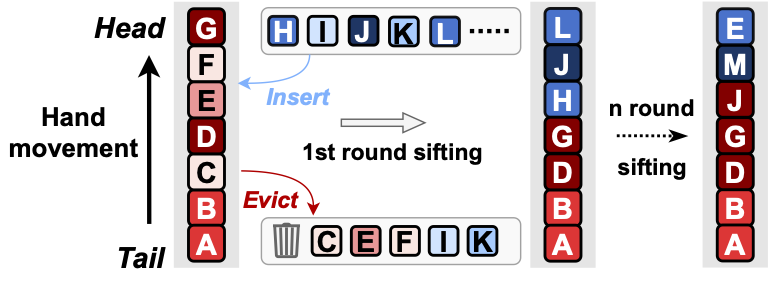
You may wonder why this algorithm is called SIEVE. The reason is that the “hand” in SIEVE functions as a sieve: it sifts through the cache to filter out unpopular objects and retain the popular ones. We illustrate this process in Figure 7. Each column represents a snapshot of the cached objects over time from left to right. As the hand moves from the tail (the oldest object) to the head (the newest object), objects that have not been visited are evicted. For example, after the first round of sifting, objects at least as popular as A remain in the cache while others are evicted. The newly admitted objects are placed at the head of the queue. During the subsequent rounds of sifting, if objects that survived previous rounds remain popular, they will stay in the cache. In such a case, since most old objects are not evicted, the eviction hand quickly moves past the old popular objects to the queue positions close to the head. This allows newly inserted objects to be quickly assessed and evicted, putting greater eviction pressure on unpopular items (such as “one-hit wonders”) than LRU-based eviction algorithms.
In this article, we discuss the skewed access pattern in web cache workloads and how to design new cache eviction algorithms. We illustrate two properties of efficient cache eviction algorithms: lazy promotion and quick demotion. SIEVE is a new cache eviction algorithm that leverages these two ideas, while maintaining simplicity and scalability. It uses a FIFO queue with a moving hand to retain popular objects in place and remove unpopular objects quickly.


