
   |
John Bruno, Eran Gabber, Banu Özden and Abraham Silberschatz
Bell Laboratories, Lucent Technologies
600 Mountain Ave.
Murray Hill, NJ 07974
{jbruno, eran, ozden, avi}@research.bell-labs.com
In this paper, we introduce a new operating system abstraction called reservation domains, and describe its implementation in Eclipse, an experimental operating system that provides a testbed for Quality of Service (QoS) support for applications.
Reservation domains enable explicit control over the provisioning of system resources among applications in order to achieve desired levels of predictable performance. In general, each reservation domain is assigned a certain fraction of each resource (e.g., 25% CPU, 50% disk I/O, etc.). Eclipse implements reservation-domain scheduling of multiple resources. It currently supports CPU and disk and physical memory (working set size) scheduling.
Eclipse implements a new scheduling algorithm, Move-to-Rear List Scheduling (MTR-LS), that provides a cumulative service guarantee, in addition to fairness and delay bounds. Cumulative service guarantee is necessary for ensuring predictable aggregate throughput for applications that require multiple resources. Preliminary experiments indicate that MTR-LS provides good QoS in overloaded systems. In particular, MTR-LS favors less-greedy processes.
The Eclipse operating system is based the Plan9 from Bell Labs, and can run any Plan9 application without modification. Eclipse emphasizes the use of per-process name space, and it can schedule any I/O device or user level file system without any change to device driver or file system code.
New multimedia applications, which require support for real-time processing, are pacing the demand for operating system support for Quality of Service (QoS) guarantees. The desire to support multiple real-time applications on a single platform requires that the operating system have the ability to provision system resources among applications in a manner that achieves the desired levels of predictable performance. Moreover, computer networks are starting to provide QoS guarantees with respect to packet delay and connection bandwidth. These QoS guarantees are of little use if they cannot be extended to applications executing at the endpoints. Current general-purpose multiprogrammed operating systems do not provide QoS guarantees since the performance of a single application is, in part, determined by the overall load on system. As a result, many users prefer to use stand-alone systems with limited dependency on shared servers in order to achieve some semblance of QoS by indirectly controlling the system workload. Real-time operating systems are capable of delivering performance guarantees such as delay bounds, but require that applications be modified to take advantage of the real-time features.
Our goal is to provide QoS guarantees in the context of a general-purpose multiprogrammed operating system, without modification to the applications, by giving the user the option to provision system resources among applications in order to achieve the desired performance levels.
This paper introduces a new operating system abstraction called reservation domains, which is intended to provide predictable QoS by controlling resource provisioning. The basic idea behind reservation domains is to isolate the performance of reservation domains from each other. In particular, time-sensitive processes can coexist with batch processes on the same system.
We discuss the importance of cumulative service guarantee, which complements other QoS parameters such as delay and fairness. Informally, guaranteed cumulative service means that the scheduling delays encountered by a process on various resources do not accumulate over the lifetime of the process. In other words, a process that is competing for resources will execute at a predictable rate, which is determined by the fraction of the resources that is reserved for that process, regardless of the intensity of the competition for the resource.
We continue with the description of a new scheduling policy called Move-To-Rear List Scheduling (MTR-LS), that provides cumulative service guarantees, as well as fairness and delay bounds.
Next we describe the Eclipse operating system, which is a testbed for operating system support for QoS. Eclipse implements reservation domains and MTR-LS scheduling. Eclipse can schedule multiple resources independently. The current implementation can schedule CPU, disk I/O and physical memory (working set). Experimental results indicate that MTR-LS outperforms the standard Plan9 priority scheduler and a weighted round-robin scheduler. We also include an excerpt from the Eclipse implementation of MTR-LS, which illustrates the simplicity of the implementation.
The remainder of this paper is organized as follows. In Section 2 we discuss related work. Section 3 introduces the concept of a reservation domain. Section 4 presents the QoS parameters of interest. Section 5 presents the MTR-LS scheduling policy and its properties. The implementation of the Eclipse operating system is described in Section 6. Section 7 presents the results of our preliminary experiments with Eclipse. Finally, Section 8 describes our future work and conclusions. The Appendix contains a code excerpt from the Eclipse implementation of MTR-LS.
Stride scheduling [16] and lottery scheduling [17] attempt to provide each process with a share of the server in proportion to its corresponding weight (number of ``tickets''). Start-time fair queuing [4] and earliest eligible virtual deadline first [13] guarantee fairness bound. Class based queuing (CBQ) [15] uses bandwidth reservations to schedule packets on shared data links. Processor capacity reserves [7] provides each process with its reserved share and delay guarantees. The SMART scheduler [8] provides predictable performance for real-time applications, which may executed concurrently with non real-time applications. SMART allows processes to specify their scheduling constraints, and provides dynamic feedback to applications when the constrains cannot be met. The Rialto operating system [5] provides resource reservations similar to Eclipse. However, both SMART and Rialto schedule only CPU. The Nemesis operating system [6] provides accurate accounting of resource consumption by running the application and most of the kernel code in the same address space. Nemesis is similar to Eclipse by providing predictable performance via allocation of CPU and disk I/O to domains. However, Nemesis employs a radically different OS structure, which necessitates rewriting of most applications and device drivers. The above algorithms and systems were not designed with our cumulative service measure in mind, so it is not surprising that the properties they do enjoy are not sufficient to guarantee cumulative service effectively.
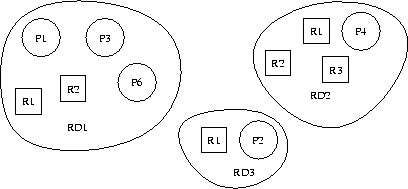
In order to incorporate QoS into operating systems, we introduce the notion of a reservation domain. A reservation domain is a collection of processes and corresponding resource reservations. A computer system may run several reservation domains and provide several types of resources (e.g., CPU, disk, network, physical memory), which are reserved and scheduled independently. The processes that belong to a particular reservation domain are guaranteed to receive at least their reserved portions of the domain's associated resources. Figure 1 illustrates a system that runs three reservations domains: RD1, RD2 and RD3. Each domain contains an explicit resource reservation for the resources R1, R2 and R3. One or more processes may run within a single reservation domain.
Reservation domains are designed to combine the advantages of real-time, time-sharing, and stand-alone systems. Benefits of reservation domains, which are impossible to achieve with priority based scheduling or real-time scheduling algorithms, are:
A variety of applications can benefit from reservation domains. For example, soft-real-time applications can use bounded response times, hosting applications can benefit from provisioning the system resources, and long running OLAP (on-line analytical processing) applications can use protection between reservation domains to complete their tasks in a timely manner without impacting current workload. Reservation domains can also benefit PC users, who would like to run several applications concurrently, when the applications are written with the assumption that they run on a dedicated machine.
The reader who is familiar with QoS parameters and with [2] may skip this section. In this section we introduce three Quality of Service (QoS) parameters: cumulative service, delay bound and fairness. Cumulative service is a new QoS parameter, while delay bound and fairness are well known, and many scheduling algorithms do provide them. We start with an example that shows the need for the cumulative service guarantee. The definition of fairness and delay bounds will be given at the end of this section.
Example 1:We assume that the system runs one I/O bound process together with n infinite loops. The system employs a weighted round-robin scheduler, similar to the one described in Section 6.2. The I/O bound process issues I/O requests sequentially. It requires 1 msec. of CPU in order to issue the next I/O request. Each I/O request requires 23 msec. to complete. There is no contention on the I/O device. We reserve 0.5 of the CPU to the I/O bound process. We expect that each iteration of the I/O bound process will last 2 + 23 msec., where 2 msec. is the expected execution time of the CPU phase of each iteration (1 msec. on an idle machine is equivalent to 2 msec. elapsed time when the process is reserved 0.5 of the CPU). Thus the expected execution rate of this program is 1000/25 = 40 iterations per second.
However, whenever the I/O bound process arrives at the CPU, it is
appended to the end of the ready processes queue,
so it has to wait for at least n time slices before it can run.
Thus the actual execution time of each iteration is
 +23 is the time slice length.
For example, for n=10 and
=10
+23 is the time slice length.
For example, for n=10 and
=10
Note that the round-robin scheduler provides fairness and delay bounds,
since all processes are scheduled within n+1 time slices.
However, the execution rate of the I/O bound process can be arbitrarily low,
since round-robin does not provide a cumulative service guarantee.

We will need the following definitions for the rest of the section:
A system is considered to be a collection of resources (servers). Each resource is
modeled by a ``service rate'' and a ``preemption interval''
 .
is the minimum time that the resource
must run before a preemption can occur. A resource with a zero
preemption interval can preempt a process at any time.
.
is the minimum time that the resource
must run before a preemption can occur. A resource with a zero
preemption interval can preempt a process at any time.
A process is considered to execute an ordered set of of phases, where a phase is a resource-duration pair, (s, t), where s is one of the system resources and t is the amount of time it would take resource s to complete the phase running alone on the resource. The phases of a process are not known in advance. The identity of the next phase is known only after executing the previous phase.
Even though we are interested in the performance of our system over all resources, it turns out that, due to the definition of the cumulative service guarantee, it is sufficient to study the performance at a single resource. From the point of view of resource s, a process is denoted by an ordered set of phases that alternate between resource s and elsewhere. The ``elsewhere'' resource represents the phases of processes at resources other than s.
The motivation for reservation domains is
to isolate the each reservation domain from the others.
We would like to guarantee
a lower
bound on the performance of a reservation
domain,
which is independent of other reservation domains.
Let  be the fraction of a resource allocated to a reservation
domain Di.
Ideally,
each reservation
domain Di should receive at least fraction of
the resource whenever Di has a process requiring the resource
(a.k.a., whenever Di is busy).
We refer to the minimum service time received in the idealized service
model as
virtual service time.
We denote the virtual service time received by reservation domain
Di in any real time
interval
be the fraction of a resource allocated to a reservation
domain Di.
Ideally,
each reservation
domain Di should receive at least fraction of
the resource whenever Di has a process requiring the resource
(a.k.a., whenever Di is busy).
We refer to the minimum service time received in the idealized service
model as
virtual service time.
We denote the virtual service time received by reservation domain
Di in any real time
interval ![$[\tau, t]$](img10.gif) by
by
 .
Similarly,
we denote the
real service time (running on the resource)
received by reservation domain
Di in any real time
interval by
.
Similarly,
we denote the
real service time (running on the resource)
received by reservation domain
Di in any real time
interval by
 .
Note that
.
Note that
 =
.
=
.
Realizable scheduling policies require that we run at most
one process at a time on the resource.
This means that if there is more than one process waiting to run on
the resource, then one or both of the processes will
experience (queuing) delay.
We define  be the
cumulative real waiting time (blocked by other domains'
processes
running on the resource)
obtained
by domain Di
in the interval .
By definition,
be the
cumulative real waiting time (blocked by other domains'
processes
running on the resource)
obtained
by domain Di
in the interval .
By definition,
 +
either by running or waiting.
+
either by running or waiting.
In the idealized model,
receiving
virtual service time
takes at most real time.
With
realizable scheduling policies, in order to provide a performance
as good as the one in the idealized model,
the total real time
+
to receive
virtual service time should
be less than or equal to
.We express the real system's ability to match the performance
of the idealized system
in terms of a cumulative service guarantee [2].
Definition
1:We say that a scheduling policy provides
a cumulative service guarantee
if there exists a constant K
such that for all domains Dj
and  ,
we have
,
we have
 ... broken formula...
Although the definition of cumulative service guarantee is in terms of a single resource, it implies a ``global'' cumulative service guarantee (using cumulative virtual service time and cumulative real time over all resources) in the multi-resource case where there is a constant number of resources [2]. Guaranteeing cumulative service is vital for applications that require multiple resources and arrival of a phase on a resource depends on the departure of previous phases. Cumulative service guarantee is necessary to ensure a predictable aggregate throughput over all the resources for such applications.
We will define the delay guarantee for the case when at any given time there is only one process within a reservation domain. For the more general case, when there can be multiple concurrent processes within a domain, the delay a phase experiences also depends how the reservation domain schedules its phases. This case requires elaborate treatment, and will not be covered in this paper.
Definition
2:A scheduling policy provides
delay bound if,
for a phase of any domain Dj,
the real waiting time plus service time to complete the phase
takes at most
a constant amount more than  , where d is the
duration of the phase.
, where d is the
duration of the phase.
The fairness parameter measures the ability of the system to ensure that domains that are simultaneously contending for the same resource will ``share'' that resource in proportion to their reservations, independent of their previous usage of the resource [3]. That is, a fair scheduling policy does not penalize a domain that utilized an idle resource beyond its reservation when other domains become busy on that resource.
The definition of fairness is based on another idealized service model called processor sharing [11]. Under processor sharing, each domain receives a service proportional to its fraction on a resource. Since ideal processor sharing cannot be implemented in practice, fairness is defined as:
Definition
3:A scheduling policy is
fair
if there exists a constant F such that
for any time interval during which
a pair of domains, Di and Dj,
both continuously require the resource,
we have
 ...broken formula....
Reservation domains
specify their QoS requirements by providing a service fraction for each system resource.
Admission control ensures that the sum of the service fractions of all domains
do not exceed certain
prescribed limits. Admission control is necessary for
delay and cumulative service guarantees.
It is not required for fairness.
This section presents the Move-To-Rear List Scheduling (MTR-LS) policy, which provides a cumulative service guarantee, is fair, and has bounded delay. MTR-LS policy is a generalization of the one presented in [2]. The main difference is that we allow here the aggregate quantum allocated for a domain to be partitioned. This improves QoS guarantees and average delay and waiting time. In the following subsections we present the MTR-LS policy, its complexity, and its properties.
 , of pairs
(i,left) where i is the index of a reservation domain
(i.e., Di) and left is size of the quantum, which is the
maximal amount of service time reservation domain Di
can receive
without being interrupted. There can be multiple occurrences of
domain Di on , that is, pairs appearing at different
positions in list which have the same first coordinate
i.
The pairs (i,left) will be called tokens in the following discussion.
, of pairs
(i,left) where i is the index of a reservation domain
(i.e., Di) and left is size of the quantum, which is the
maximal amount of service time reservation domain Di
can receive
without being interrupted. There can be multiple occurrences of
domain Di on , that is, pairs appearing at different
positions in list which have the same first coordinate
i.
The pairs (i,left) will be called tokens in the following discussion.
We say that domain Di is before Dj
on if the
first token of domain Di on appears before all
tokens of Dj on .Each domain, whether it is busy or idle,
has at least one token on .
The system defines the service cycle as the constant T,
which is the upper bound on the sum of
all the quanta represented in list .The sum of quanta in
that belong to domain Di is equal to
T.
T
MTR-LS performs the procedure shown in Figure 2 at
every decision epoch.
Decision epochs occur at the time of
the arrival of a new domain, the departure of a domain,
the expiration of the
current quantum, the completion of the phase of the current running
process (e.g. the process blocks),
or the end of the current preemption interval.
In other words, a currently running process may be preempted only
at the end of the current preemption interval ()or at the end of the current quantum.
Decision_Epoch()
stop elapsed counter;
if a new domain Di is admitted to the system then
   append the token (i, alpha_i T);
if domain Di is removed from the system
   remove all tokens belonging to Di from L;
if state == busy then
   Update_Domain();
Run_a_Domain()
Update_Domain()
Let (i,left) be the current token being serviced in L;
Append (i,elapsed) to the end of list L;
left' = left - elapsed;
if left' == 0 then
   remove current token (i,left) from L
else
   replace current token with (i,left');
Combine_Elements();
Figure 3 depicts the domain update routine,
which is called every decision epoch to update the token of currently running domain.
This routine will either split the current token into two, leaving one token in the
current place and appending the other to the end of ,or move the token entirely to the end of ,depending on the remaining quantum in the token.
In any case, the sum of the quanta in the two tokens is equal to the quantum
in the original token.
Figure 4 shows the routine Run_a_Domain, which selects
the next domain to run on the resource.
The counter elapsed records the elapsed time to the next
decision epoch.
Run_a_Domain()
if there is no runnable domain on the list L then
   state = idle
else
   Let (j,left) be the first runnable token in L;
   state = busy;
   start elapsed timer;
   run Dj on the resource for at most left time units
      (current quantum);
wait for the next decision epoch;
The service obtained by a process may be less than the allocated
quantum due to the termination of a phase or the arrival of a process.
In the former case, the phase terminates, the process goes elsewhere, and
the first runnable domain on is serviced next.
In the latter case, if the arriving process belongs to
a domain which is ahead of the
current running process's domain
in the list , then the running process is preempted (as soon
as the preemption interval permits) and a process of the
first runnable domain on is serviced next.
Combine_Elements()
if (i,m1) and (i,m2) are consecutive in L then
   replace them with (i,m1+m2)
Figure 5 shows the Combine_Elements routine,
which combines neighboring tokens belonging to the same domain.
It is called whenever the list is changed.
This routine has to examine only in the vicinity of the last change
(removal or addition of tokens).
Example
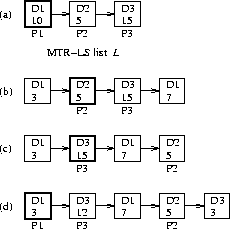
2:Figure 6 illustrates the
operation of MTR-LS. There are three tokens on ,
which belong to domains D1, D2 and
D3.
The processes P1, P2 and
P3 are associated with domains
D1, D2 and D3,
respectively.
The total quanta of D1, D2 and
D3 are
10, 5 and 15, respectively.
Initially (Figure 6a)
all the domains are busy. Since the first
busy domain is D1, process P1 is executed.
P1 goes ``elsewhere'' after receiving
seven time units of service. is updated such that quantum of
D1 is partitioned
as shown in Figure 6b.
Now the first busy domain is D2.
Therefore, process P2 is executed.
Once the quantum of D2 is exhausted in five unit of time,
D2's token is placed at the tail of the list
(Figure 6c).
The next busy domain is D3. Therefore, process
P3 selected for execution.
After three units of time, domain D1
becomes busy (process P1 arrives at
the resource). Since D1's token precedes
D3's token
in the list, P3 is preempted.
The quantum of D3 is partitioned as shown
in Figure 6d,
and process P1
is scheduled.
.Each token corresponds to a quantum of a given size and the sum
of all the quanta for a given domain
is equal to
T
should support the following operations:
1) find the first busy domain in ;2) split a token, and append one of the parts at the end of ;the original token is either updated in place or deleted;
3) append tokens of a new domain;
4) delete all tokens of a domain; and
5) combine tokens in .
All of the operations except the first may be performed in constant time.
The first operation may take O(T)
if all domains have
T
The worst case running time of MTR-LS may be improved by keeping
the domains in a heap instead of in a list, marking the tokens
by an increasing time-stamp, and sorting the domains
by the lowest time-stamp they currently have.
The complexity of this implementation is  where n is the number of
busy domains.
Further time reduction can be achieved by
using a priority queue or other data structures
that are described in [14].
where n is the number of
busy domains.
Further time reduction can be achieved by
using a priority queue or other data structures
that are described in [14].
 and the preemption interval is zero,
which means that a running
process is preempted immediately by a ready process that is ahead
of it in .However, if the preemption interval is positive,
MTR-LS requires that
and the preemption interval is zero,
which means that a running
process is preempted immediately by a ready process that is ahead
of it in .However, if the preemption interval is positive,
MTR-LS requires that
 1 -
1 -

Eclipse is derived from the Plan9 operating system
from Bell Labs [12].
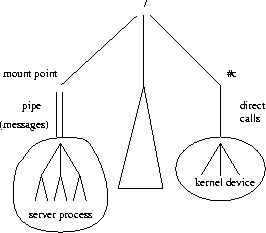
It provides a per-process name space,
access to resources via the name space,
a file access protocol (9P), that provides a uniform interface to all servers,
and many interesting file servers, such as the windowing system  ,an FTP file system, etc. [10].
Eclipse provides reservation domain functionality on top of Plan9, without any change to existing applications or servers. Eclipse is compatible with Plan9; that is, Eclipse retains the external interface of Plan9 (system calls, protocols, name space structure, etc.).
Eclipse implements reservation and scheduling of CPU, I/O and physical memory (working set size), which we describe in Sections 6.2, 6.3, and 6.4, respectively. The resources are managed independently. Resource reservations and reservation domain management can be done by the shell; no systems level programming is needed.
Since the sum of the explicit reservations of a resource
may be less than one,
Eclipse distributes the unreserved portion of the resource evenly
among all reservation domains.
For example,
the effective reservation of domain i is
 1 -
)/n,
where n is the number of reservation domains.
1 -
)/n,
where n is the number of reservation domains.
name
access
description rdcpu r/w % CPU reservation of current RD rdcpusum r sum of current CPU reservations rdcpulim r maximum allowed CPU reservation rdio r/w % I/O reservation of current RD rdiosum r sum of current I/O reservations rdiolim r maximum allowed I/O reservation rdmem r/w physical memory reservation in KB rdmemsum r sum of physical memory reservation rdmemlim r available physical memory rdsched r/w current CPU scheduling algorithm
Resource reservation is accomplished by writing strings to the appropriate control files. Table 1 describes some of the control files. For example, the shell command echo 50 > /dev/rdcpu requests reservation of 50% of the CPU to the reservation domain which runs this command. Eclipse will deny resource reservations if total reservation exceeds the corresponding limit. Eclipse deletes a reservation domain and releases its resources as soon as the last process belonging to this reservation domain is terminated.
Weighted Round-Robin (WRR) is similar to round-robin scheduling, but the CPU slice of each process is proportional to its reservation. In our case, the CPU slice of the processes belonging to a particular reservation domain is proportional to the domain's reservation. Note that WRR scheduling without an explicit CPU reservation is identical to regular round-robin.
Eclipse implements WRR scheduling by maintaining a a cpu_time_left field for each reservation domain, which contains its remaining CPU reservation for the current CPU service cycle. Eclipse maintains two ready queues: run_hi and run_lo. Ready processes are appended to run_hi if the corresponding reservation domain has a cpu_time_left > 0. Otherwise, the process is appended to run_lo. Eclipse selects the first process from run_hi that has an associated cpu_time_left > 0. Requests with cpu_time_left <= 0 are moved to run_lo. The clock interrupt handler decreases the corresponding cpu_time_left, appends the current process to either run_hi or run_lo according to the above criterion, and calls the scheduler. The cpu_time_left of all reservation domains is renewed at the beginning of every CPU service cycle according to the corresponding CPU reservation. At this time all processes are moved from the run_lo to the run_hi queue.
Eclipse does not maintain a global tokens list for
MTR-LS,
rather it keeps the creation time-stamp for each token,
and sorts the reservation domains by the lowest time-stamp of the
tokens that they hold.
In this way, the list is replaced with a collection of
cyclic buffers, one for each reservation domain, which keep the tokens
of that domain.
Each reservation domain consumes its tokens in their time-stamp order.
The Appendix contains code excerpts from the Eclipse kernel
that illustrate the
implementation of MTR-LS.
This implementation scans the ready process list,
and selects the ready process that is associated with the reservation
domain that holds the token with with the lowest time stamp.
The advantage of this implementation is its simplicity.
However, the time complexity of each scheduling decision
is O(n), where n is the number of ready processes.
A more sophisticated implementation may scan the ready
domains queue instead, which may reduce the scheduling time.
The overhead of maintaining the tokens during a clock interrupt is constant.
The current Eclipse implementation uses clock interrupts rate of 200Hz. The CPU service cycle (T) is 1/2 second long. More frequent clock interrupts improve responsiveness at the expense of more frequent context switches.
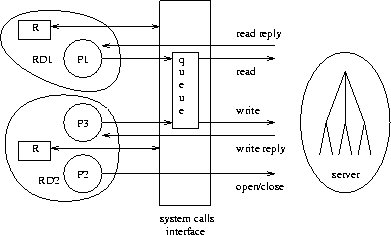
Only a part of the name space may be subject to I/O scheduling, according to a flag in the mount and bind system calls. All other parts of the name space are not affected by I/O scheduling. This is essential, since all resources in Eclipse are part of the name space. For example, it is inappropriate to schedule requests to screen and mouse. Moreover, an attempt to schedule paging requests may cause a deadlock.
I/O scheduling is implemented similar to WRR CPU scheduling, by maintaining two I/O queues, io_hi and io_lo, and an io_time_left field for each reservation domain, which is reduced by the elapsed time of the request. Since the server may re-order the requests, the elapsed time is computed from the end of the previous request (if the previous request ended after the current request was delivered to the server). The reservations are renewed at the beginning of every I/O service cycle, and the requests are moved to the io_hi queue.
Eclipse allows the server to queue up to maxactive requests internally, since performance is generally improved when servers have some internal queuing (e.g., by sorting disk accesses to reduce arm movement). The current implementation has a single global requests queue. Future versions will have a queue for each server. An I/O service cycle is 1/2 second long and maxactive is 4.
The above scheduling algorithm is bypassed if the server is currently idle or if there is no contention (all active requests belong to the same reservation domain).
| part | Plan9 2nd Ed. | Eclipse |
| portable | 31,046 lines | ±1,143 lines |
| PC dependent | 19,031 lines | +22 lines |
| total | 50,077 lines | 51,040 lines |
Eclipse is derived from the 2nd edition of Plan9. It is currently implemented on PC based machines. Table 2 describes the breakup of source lines in Plan9 and Eclipse. In both cases, we refer to an extravagant kernel including all device drivers and protocols. As Table 2 indicates, Eclipse is machine independent. The tiny machine dependent part of Eclipse is contained in the clock interrupt handler, and is shown in the Appendix. It can be easily ported to other architectures.
Eclipse has been operational since October 1995. It proved to be stable, useful and instructional. In particular, we can easily demonstrate and control extreme conditions, such as overloading, memory thrashing and starvation. We use Eclipse for running multimedia applications, such as MPEG players, concurrently with other demanding activities. The applications meet their deadlines when they run in reservation domains with appropriate resource reservations.
We used two methods for determining the appropriate reservations: manual trial and error (actually, a binary search), and an automatic resource monitor, which is a user-level process, that collect ``complaints'' from application programs and adjusts the reservations appropriately. The automatic monitor increases the reservation (fast) when the application suffers from delays, and reduces the reservation (slowly) when the application is not delayed.
We have two MPEG-1 players for Eclipse: a player which reads from a file, and a [9] client, which receives a stream of information from the continuous media server.
The rest of this section describes several experiments that illustrate the effectiveness of MTR-LS scheduling algorithm. In those experiments we used reservation domains extensively to distinguish between several classes of applications that run concurrently on the same machine.
The experiments compared three scheduling algorithms: the original Plan9 scheduler, which is a priority based scheduler, that adjusts the priorities of processes according to their CPU consumption, the MTR-LS scheduler, and a weighted round-robin (WRR) scheduler.
The first experiment runs a MPEG player under CPU and I/O overload. The MPEG-1 player has 10 read-ahead threads, that read a movie from the local disk and send it to the MPEG decoder card. The MPEG player requires both I/O and CPU resources.
We repeatedly created CPU overload by running multiple copies of the onoff program. Each copy of this program consumes 11ms of CPU and then sleeps for 5ms. The onoff program poses a challenge to most CPU schedulers, since it consumes CPU with a duty cycle of about 60%, and it sleeps frequently.
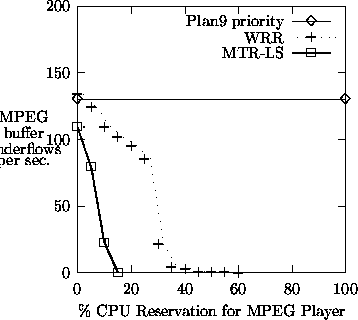
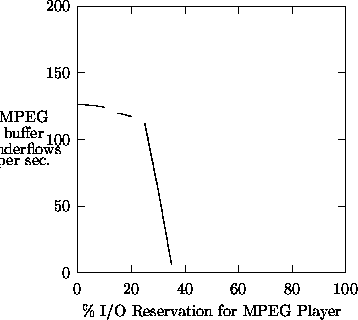
Figures 9 and 10 depict the effects of resource reservation on an MPEG-1 player under CPU and I/O overloads, respectively. In the CPU load experiment, the MPEG player was run against 8 concurrent instances of the onoff program. In the I/O load experiment, the MPEG player was run against 10 I/O processes that were accessing random locations on the disk that holds the MPEG movie. In all cases, the file system was running in reservation domain #1 with a fixed 20% CPU reservation (where applicable). The MPEG player was running in reservation domain #2. The I/O workload was running in reservation domain #3, and each competing instance of onoff was running in its own reservation domain without any explicit reservations. In all cases, we varied the corresponding resource reservation of domain #2.
Figures 9 and 10 show the average number of buffer underflows in the MPEG card (which indicate missed deadlines). Buffer underflows are sampled at a 200Hz rate. A zero value indicates no missed deadlines, and it is always achieved when the MPEG player is running in an otherwise idle system. The value 200 indicates that all deadlines were missed (the buffer underflowed continuously).
This experiment demonstrates that reservation domains provide guaranteed execution rate in an overloaded system. Both MTR-LS and WRR provided good quality of service under CPU load. However, MTR-LS required a reservation of 15% to prevent underflows, while WRR required a reservation of 55%. The reason for MTR-LS superiority is that it prefers less greedy processes, such as the MPEG player, over more greedy processes, such as onoff, which exhausted its entire reservation. Note that each onoff consumes more than 60% of the CPU on an idle machine, and here it was reserved less than 9% of the CPU. The Plan9 priority scheduler failed in this experiment to prevent buffer underflows, since it did not prefer the MPEG player over the onoff processes. The Plan9 scheduler detects CPU bound processes, but it failed to recognize the onoff processes as CPU hogs since they sleep frequently.
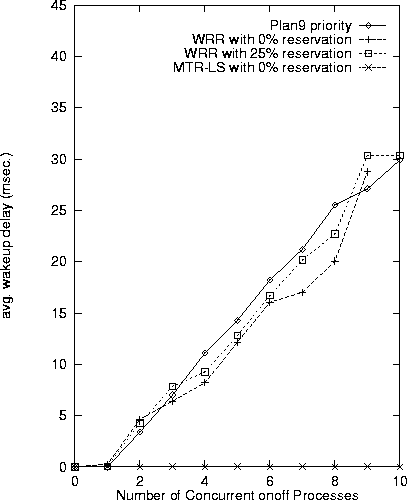
Figure 11 illustrates the advantage of MTR-LS over
Plan9 priority scheduling and WRR.
MTR-LS always schedules the sleeper program before onoff,
since sleeper consumes CPU at a slower rate,
and thus its tokens tend to migrate to the beginning of the list .
In other words,
MTR-LS prefers less-greedy processes.
In fact, this experiment shows that MTR-LS provides a delay bound to processes
that do not exceed their reservation.
Of course, if sleeper had an explicit priority (nice) in the priority scheduler, it would not suffer from wakeup delays. However, changing the process priority may not be available in many situations, and may cause undesired side effects.
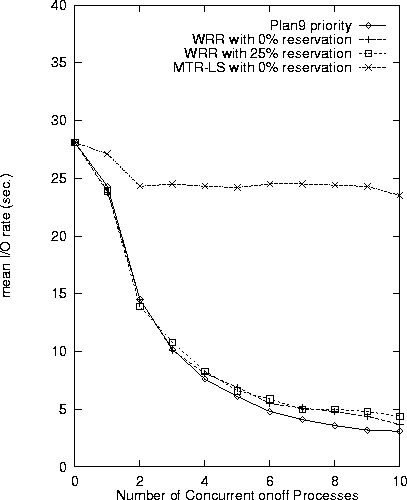
The most interesting result of this experiment is that the I/O rate decreased under increasing CPU load with the Plan9 priority scheduling and WRR. The explanation of this phenomenon is as follows: Although the I/O process has an unlimited access to the disk, it must wait for its turn for the CPU in order to issue the next I/O request. The I/O process is never granted the CPU immediately in WRR, since it is always appended to tail of the ready queue after the n onoff processes. This is why I/O throughput decreased as CPU contention increased. Providing CPU reservation to both the I/O process and to the file system process did not alleviate this problem. Plan9 priority scheduling failed to prefer the I/O process over the onoff processes, because all of them sleep frequently.
MTR-LS successfully isolated the I/O process from the CPU overload, even without any CPU reservations. The reason is that the I/O process is less CPU-greedy than the onoff processes. In other word, MTR-LS provided a cumulative service guarantee for the I/O bound process, which was not delayed by the CPU.
We also described a new scheduling algorithm, Move-to-Rear List Scheduling (MTR-LS), that provides fairness, delay bound, and cumulative service guarantees. We explained why those QoS parameters are important. The rest of the paper described Eclipse, a new experimental operating system, that implements reservation domains and MTR-LS scheduling. Eclipse can schedule three types of resources: CPU, disk I/O and physical memory (working set). Experimental results indicate that Eclipse provide delay bounds and cumulative service bounds in overload situations. We also showed that MTR-LS prefers less-greedy processes, which means that it automatically provides better performance in many cases, as shown by our experiments. We compared MTR-LS with Plan9 priority scheduling and with weighted round-robin scheduling. MTR-LS provided superior results in several cases. We illustrated a simple implementation of MTR-LS in the Appendix. More time efficient implementations of MTR-LS are possible, but they use more complex data structures.
Our ongoing work concentrates on extending the reservation domain approach into a distributed environment with multiple clients and servers, investigating hierarchical scheduling for reservation domains, developing new scheduling algorithms, and porting the reservation domains and MTR-LS into more popular operating systems, such as Linux or FreeBSD.
typedef struct Proc  Proc;
typedef struct Rd   Rd;

enum {
  /* clock ticks per sched. cycle */
  CYCLE2TK = (HZ/2),
};

struct Proc {
  Proc *rnext;  /* next process in run q */
  int  state;
  Rd   *rd;     /* reservation domain */
};

struct Rd {
  Rd   *next;   /* next RD in list */
  int  rdid;    /* reservation domain ID */
          /* 0 indicates a kernel proc. */
  int  cpu_resrv; /* CPU reservation in */
	          /* ticks */
  uint lo_tok;  /* lowest token time-stamp */
  /* cyclic list of time-stamps */
  uint tok_list[CYCLE2TK];
  int  head, tail;
};

/* Globals */
static Schedq runq; /* process run queue */
static RDq rd;      /* reservation domains */
uint hi_stamp;      /* current time-stamp */

/* Initialization of tokens list */
void
init_tok_list(void)
{
  Rd *r;
  int go;

  /* first token in each domain */
  hi_stamp = 0;
  for (r = rd.head; r; r = r->next) {
    r->lo_tok = r->tok_list[0] = hi_stamp++;
    r->head = r->tail = 1;
  }

  /* assign tokens in interleaved fashion */
  do {
    go = 0;
    for (r = rd.head; r; r = r->next)
      if (r->head < r->cpu_resrv) {
        go = 1;
        r->tok_list[r->head++] = hi_stamp++;
      }
  } while(go);
}

/* Clock interrupt routine */
static void
clock(Ureg *ur, void *arg)
{
  Proc *p;
  Rd *r;

  p = m->proc;
  if (p) {
    if (p->state == Running) {
      r = p->rd;
      if (++hi_stamp == 0)
        /* re-initialize tokens list at */
        /* time-stamp overflow */
        init_tok_list();
      r->tok_list[r->head++] = hi_stamp;
      if (r->head >= CYCLE2TK)
        r->head = 0;
      r->lo_tok = r->tok_list[r->tail++];
      if (r->tail >= CYCLE2TK)
        r->tail = 0;
    }
  }

  if (u && p && p->state == Running) {
    /* preempt if not holding a spin lock */
    ...
    sched();
  }
}

/* Select the next process to run */
Proc*
runproc(void)
{
  Proc *p, *prev, *best, *prevb;

loop:
  prev = best = 0;
  for (p = runq.head; p; p = p->rnext) {
    /* run kernel processes first */
    if (p->rd->rdid == 0) {
      best = p;
      prevb = prev;
      break;
    }

    if (best == 0 ||
        p->rd->lo_tok < best->rd->lo_tok) {
      best = p;
      prevb = prev;
    }
    prev = p;
  }

  if (best == 0)
    goto loop;

  /* remove process from run queue */
  remq(&runq, best, prevb);
  return best;
}
|
This paper was originally published in the
Proceedings of the 1998 USENIX Annual Technical Conference (NO 98),
New Orleans, Louisiana June 15-19, 1998 Last changed: June 11, 1998 prowillen |
|
 Technical Program