
The general shape of the response-time vs. load curve is well known, and
the form is similar for different workloads and server configurations.
This suggests that a model-guided approach could fit the curve from a few
test loads and converge more quickly to the peak rate.
Using the insight offered by well-known
open-loop queuing theory results [13],
we experimented with a simple model to fit the curve:
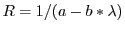 , where
  is the
response time,
is the
response time,  is the load, and
  and
and  are constants that depend
on the settings of factors in
are constants that depend
on the settings of factors in
 . To
learn the model, the controller needs tuples of the form
. To
learn the model, the controller needs tuples of the form
 .
.
Algorithm 4 outlines the model-guided algorithm. If there
are insufficient tuples for learning the model, it uses a simple
heuristic to pick the test loads for generating the tuples. After that, the
algorithm uses the model to predict the peak rate
 for
for
 , returns the prediction as the next test load, and relearns the model
using the new
tuple at the prediction.
The whole process repeats until the search converges to the peak rate. As the
controller observes more
tuples, the
model-fit should improve progressively, and the model should guide the search
to an accurate peak rate. In many cases, this happens in a single iteration of
model learning (Section 5).
, returns the prediction as the next test load, and relearns the model
using the new
tuple at the prediction.
The whole process repeats until the search converges to the peak rate. As the
controller observes more
tuples, the
model-fit should improve progressively, and the model should guide the search
to an accurate peak rate. In many cases, this happens in a single iteration of
model learning (Section 5).
However, unlike the previous approaches, a model-guided search is not guaranteed
to converge. Model-guided search is dependent on the accuracy of the model,
which in turn depends on the choice of
tuples that are used for learning. The choice of tuples is generated by previous
model predictions. This creates the possibility of learning an
incorrect model which in turn yields incorrect choices for test loads.
For example, if most of the test loads chosen for learning the model happen to
lie significantly outside the peak rate region, then the model-guided choice of
test loads may be incorrect or inefficient. Hence, in the worst case, the
search may never converge or converge slowly to the peak rate. We have
experimented with other models including polynomial models of the form
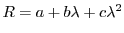 , which show similar limitations.
To avoid the worst case, the algorithm uses a simple heuristic to choose the
tuples from the list of available tuples. Each time the controller learns the
model, it chooses two tuples such that one of them is the last prediction, and
the other is the tuple that yields the response time closest to threshold mean
server response time  . More robust techniques for choosing the tuples
is a topic of ongoing study. Section 5 reports our experience with
the model-guided choice of test loads. Preliminary results
suggest that the
model-guided approaches are often superior but
can be unstable depending on the initial samples used to learn the model.
. More robust techniques for choosing the tuples
is a topic of ongoing study. Section 5 reports our experience with
the model-guided choice of test loads. Preliminary results
suggest that the
model-guided approaches are often superior but
can be unstable depending on the initial samples used to learn the model.
varun 2008-05-13


![\begin{algorithm}
% latex2html id marker 1514
[t]
\caption{Model-Guided {\bf Inp...
...a,b$ are the fitted coefficients\;
\par
\end{list}\vspace{-3ex}
\end{algorithm}](img92.png)