


Whenever a user's access is revoked, the file owner generates a new version
of the file-lockbox key. For this discussion, let  denote the version of
the file-lockbox key. The owner generates the next version file-lockbox key
from the current key by exponentiating the current key with the owner's
private key
denote the version of
the file-lockbox key. The owner generates the next version file-lockbox key
from the current key by exponentiating the current key with the owner's
private key  :
:
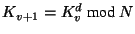 . This way only the
owner can generate valid new file-lockbox keys.
. This way only the
owner can generate valid new file-lockbox keys.
Authorized readers get the appropriate version of the file-lockbox key as
follows. (Figure 2 illustrates the
relation between the different file-lockbox key versions.) Let  be the
current version of the file-lockbox key that a user has.
be the
current version of the file-lockbox key that a user has.
 then the reader has the right file-lockbox key to access the file.
 then the reader has an older version of the key and needs
to request the latest file-lockbox key from the owner.
then the reader has an older version of the key and needs
to request the latest file-lockbox key from the owner.
 then the reader needs to generate the older version of the
file-lockbox key using the following recursion. If
then the reader needs to generate the older version of the
file-lockbox key using the following recursion. If  is the
file-lockbox key associated with version , then
is the
file-lockbox key associated with version , then
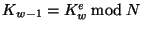 , where
  is the owner's public key. Readers can
recursively generate all previous file-lockbox key from the current key.
is the owner's public key. Readers can
recursively generate all previous file-lockbox key from the current key.
In the above protocol, we use RSA encryption as a pseudorandom number
generator; repeated encryption is not likely to result in cycling, for
otherwise, it can be used to factor the RSA modulus  [33].
Though we use RSA for our key rotation, the property we need is that there
be separate encryption and decryption keys, and that the sequence of
encryptions is a pseudorandom sequence with a large cycle; most asymmetric
cryptosystems have this property.
[33].
Though we use RSA for our key rotation, the property we need is that there
be separate encryption and decryption keys, and that the sequence of
encryptions is a pseudorandom sequence with a large cycle; most asymmetric
cryptosystems have this property.
Though this scheme resembles Lamport's password scheme [27], our scheme is more general. Our scheme provides for specific users (owners) to rotate the key forward, while allowing some other users (readers) to rotate keys backwards.