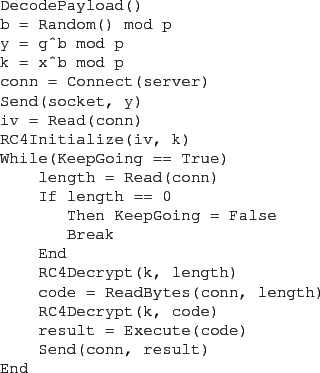


The Stage 1 payload is the machine code component included in the exploit delivered to the target's web browser or local application. Many injection vectors have limited space available for payload code, so the primary purpose of the Stage 1 payload is to establish communication with a server controlled by the penetration tester in order to download a subsequent stage payload that is free of code size constraints. The payload may be wrapped in a polymorphic decoder in order to evade intrusion detection and eliminate interpreted byte values from the exploit buffer.
The payload includes an ElGamal public key for the payload server
(generator  , prime modulus
  , public value
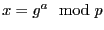 ,
where
,
where  is the secret exponent). The payload proceeds to complete
the ElGamal key agreement protocol and compute a session key for use
in communicating with the payload delivery server. The payload
generates a random number
is the secret exponent). The payload proceeds to complete
the ElGamal key agreement protocol and compute a session key for use
in communicating with the payload delivery server. The payload
generates a random number  using an operating-system provided
secure random facility. On Windows, RtlGenRandom from ADVAPI32.DLL can be used to easily generate secure random bytes.
Similarly, on Linux or other Unix-like operating systems /dev/urandom can be read for secure random bytes. The payload then
computes
using an operating-system provided
secure random facility. On Windows, RtlGenRandom from ADVAPI32.DLL can be used to easily generate secure random bytes.
Similarly, on Linux or other Unix-like operating systems /dev/urandom can be read for secure random bytes. The payload then
computes
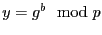 using the generator
and prime modulus
from the server's public key. The payload also computes the
session key
using the generator
and prime modulus
from the server's public key. The payload also computes the
session key
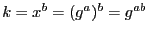 . Since
is a generator
over
. Since
is a generator
over
 and
is cryptographically random, the
computed session key will have sufficient entropy. The payload
proceeds to send
and
is cryptographically random, the
computed session key will have sufficient entropy. The payload
proceeds to send  to the payload server and further communication
is encrypted using the session key
to the payload server and further communication
is encrypted using the session key  and the RC4 stream cipher. The
initial 256 bytes of RC4 keystream are
discarded[16] and separate RC4 keystreams are
used for traffic in each direction in order to address weaknesses in
RC4. In addition, a random initialization vector is used for each
stream to prevent keystream reuse.
and the RC4 stream cipher. The
initial 256 bytes of RC4 keystream are
discarded[16] and separate RC4 keystreams are
used for traffic in each direction in order to address weaknesses in
RC4. In addition, a random initialization vector is used for each
stream to prevent keystream reuse.
Finally, the Stage 1 payload enters a loop repeatedly downloading, decrypting, and executing code from the payload server.