
| ||||||||||||||||||||||||||||||||||||||||||||||||||||
2nd USENIX Symposium on Internet Technologies & Systems, 1999
[Technical Program]
Hyokyung Bahn*, Sam H. Noh**,
Sang Lyul Min***, Kern Koh* * Department of Computer Science, Seoul National University, Seoul
151-742, Korea.
http://oslab.snu.ac.kr **
Department of Computer Engineering, Hong-Ik University, Seoul
121-791, Korea.
http://www.cs.hongik.ac.kr/~noh ***
Department of Computer Engineering, Seoul National University, Seoul
151-742, Korea. http://archi.snu.ac.kr Abstract With the increase in popularity
of the World Wide Web, the research community has recently seen a proliferation
of Web caching algorithms. This paper presents a new such algorithm, that is
efficient and robust, called Least Unified-Value (LUV). LUV evaluates a Web document
based on its cost normalized by the likelihood of it being re-referenced. This
results in a normalized assessment of the contribution to the value of a
document, leading to a fair replacement policy. LUV can conform to arbitrary
cost functions of Web documents, so it can optimize any particular performance
measure of interest, such as the hit rate, the byte hit rate, or the
delay-savings ratio. Unlike most existing algorithms, LUV exploits complete
reference history of documents, in terms of reference frequency and recency, to
estimate the likelihood of being re-referenced. Nevertheless, LUV allows for an
efficient implementation in both space and time complexities. The space needed to
maintain the reference history of a document is only a few bytes and furthermore,
the time complexity of the algorithm is O(log2n), where n is the
number of documents in the cache. Trace-driven simulations show that the LUV
algorithm outperforms existing algorithms for various performance measures for
a wide range of cache configurations. 1.
Introduction In an
effort to relieve the problem of network congestion and latency on the World
Wide Web (WWW), the research community has recently seen a proliferation of Web
cache replacement algorithms [1, 2, 3, 5, 6, 8, 9, 10, 14]. This paper presents
yet another such algorithm. However, the algorithm that we propose has the
following salient features: ·
First, it shows the best performance for a wide range of cache configurations
in terms of popular performance measures used in evaluating Web caching
algorithm, namely, the hit rate, the byte hit rate, and the delay-savings ratio.
·
Second, the proposed algorithm makes full use of all of the past activities, in
terms of reference frequency and recency, made upon the Web cache in deciding
which document to evict. By so doing, it not only accurately distinguishes actively
referenced documents and those that are not so, i.e. hot and cold documents,
but it also distinguishes those documents that are hot but are getting colder,
and those that are cold but are getting hotter. This is the main reason behind
the superior performance. ·
Third, the implementation of the replacement algorithm is efficient in both
space and time complexities. The space needed to maintain the reference history
of a document is only a few bytes per document and furthermore, the time
complexity of the algorithm is O(log2 n), where n is the number of
documents in the cache. This is a feature that is not easy to satisfy when the
size of the document and cost of fetching documents from remote sites have to
be incorporated into the algorithm, as it is in Web caching [5,6,8]. ·
Fourth, the replacement algorithm retains the above features irrespective of
what the performance measure of interest is. As mentioned above, in Web caching
environments, the typical performance measures of interest are the hit rate,
the byte hit rate, and the delay-savings ratio. The proposed algorithm can
easily be conformed to execute based on a particular performance measure. This
is unlike many previous algorithms that tightly couple the optimization of a
particular performance measure into the algorithm itself. Before
describing the algorithm, we describe, in the next section, the measures that
have been the focus of interest and optimization in the Web caching realm. We
also briefly make comparisons of previously presented algorithms. We focus on
the differences and main features of the algorithms rather than describing them
individually in detail. In Sections 3 and 4, we describe the proposed
algorithm, namely, the Least Unified-Value (LUV) algorithm and its
implementation. In Section 5, we describe the results of the simulation
experiments, and compare LUV’s performance with previously proposed algorithms.
Finally, we conclude in Section 6. 2.
Performance Measures and Related Works Performance
measures of interest in the Web caching realm can be defined according to the
goal of caching. The three popular performance measures used in Web caching,
that is, the hit rate, the byte hit rate, and the delay-savings ratio, denoted
as HR, BHR, and DSR, respectively, can be described as follows: HR
= ∑hi / ∑ri BHR
= ∑(si * hi ) / ∑(si
* ri ) DSR
= ∑(di * hi ) / ∑(di
* ri )
where hi : number of hit references to document
i, ri : total number of references to document
i (number of hits + number of misses), si : size of document i, di : delay time to fetch document i
from the original server to the cache. HR is the measure
used in traditional caching systems such as file caching and database buffer
management, and represents the number of hit references over the total number
of references. BHR represents the number of bytes saved from retransmission by using
the cache over the total amount of bytes referenced. BHR considers the size of the
Web document, but does not consider the difference in retrieval costs. Among
documents that are of the same size, those that incur higher cost in retrieving
the document should be retained in the cache longer than those that incur lower
cost. DSR, which considers this matter in terms of retrieval latency,
represents the reduced latency by virtue of a cache hit over the total latency incurred
when assuming caches are not used [8]. One may also define other new
performance measures that reflect the focus of interest one wants to measure.
For example, Kelley et al. define VHR (value hit rate) which represents a
normalized measure of social welfare [14]. In this case, performance is measured
by simply replacing the delay time (di ) in DSR by value in VHR. Many of
the previous algorithms proposed for Web caching have attempted to optimize
performance for one particular measure. The LRU, LFU, SIZE [9], HYBRID [10],
and LNC-R-W3 [8] are such algorithms (Note the Performance Measure column of
Table 1). These algorithms have a weakness that as the performance measure of
interest changes due to circumstantial changes, they have difficulty in
adjusting to these changes. The GD-SIZE [2], LRV [5], sw-LFU [14], and LUV
algorithms, on the other hand, are robust to changes in the performance measure
of interest. However, for the LRV algorithm, the time complexity varies
according to the performance measures. While the algorithm is efficient for the
byte hit rate measure, for other measures the complexity of the algorithm is
O(n), which makes it impractical as an on-line algorithm. For this reason, a recent version of LRV restricts their optimization
of the algorithm to only the byte hit rate measure [15]. Another weakness of
the LRV is that its replacement decision is based on extensive empirical
analysis of trace data. Finally, the
MIX algorithm tries to optimize the combination of the three measures, i.e.,
HR, BHR, and DSR [6]. For
caching algorithms to be practical, it is important that the time complexity of
the algorithm not be excessive, preferably not higher than O(log2 n)
where n is the number of documents in the cache [2,4]. Algorithms that do not
meet this criterion are the LNC-R-W3 and MIX algorithms (Note the Complexity
column of Table 1). In terms
of maintaining previous reference history, most of the algorithms maintain and
use the recency of the last reference to the document, with the exception of
the LNC-R-W3 algorithm that uses the k-th reference (Note the Maintaining
Reference History column of Table 1). The LNC-R-W3 algorithm uses a strategy
similar to the LRU-k algorithm that was proposed for buffer caching [7]. In
contrast, the LUV algorithm, as we will show later, uses the reference recency
history of all past references. As for the
reference frequency history, some algorithms simply use the frequency count,
while others combine this information with the recency history that is
maintained. The GD-SIZE algorithm,
however, does not consider any frequency information. Again, note that the LUV
algorithm uses the frequency count as well as the recency history of all prior
references to a document. Another
aspect that may be considered in classifying replacement algorithms is the way
in which reference history is maintained. Basically, there are two ways to
maintain the reference history of documents. One is in-cache-history and the
other is perfect-history. The in-cache-history method retains the reference
history of only those objects that are in the cache. Hence, reference
information is lost once the object is evicted. On the other hand, the perfect-history
method retains the reference history of an object even after its eviction,
allowing this information to be used when it returns to the cache. This method
may offer considerable information about the reference behaviors, resulting in
better prediction of future references than the in-cache-history method.
However, it incurs more space and time overhead for maintaining the information
of the evicted objects. To resolve this problem, perfect-history algorithms may
choose to retain approximations of the reference history. Breslau et
al. show that perfect-history LFU outperforms in-cache-history LFU in terms of
HR and BHR [13]. Recency history, i.e. reference time information, can also be
maintained as either in-cache-history or perfect-history. In fact, most caching
algorithms may be implemented using both in-cache-history and perfect-history
methods. However, this paper basically deals with in-cache-history algorithms
with the exception of some
algorithms that inherently use perfect-history such as the LNC-R-W3 and LRV
algorithms. Other algorithms shown in Table 1 are in-cache-history algorithms
unless explicitly stated. Other features of various Web caching algorithms,
including advantages and weaknesses, are summarized in Table 1.
3. The LUV (Least Unified-Value) Algorithm In this
section, we describe the Least Unified-Value (LUV) replacement algorithm. LUV
evaluates a Web document based on its retrieval cost normalized by the
likelihood of it being re-referenced. This results in a normalized assessment
of the contribution to the value of a document, leading to a fair replacement
policy. Like most existing algorithms, LUV associates a value Value(i) to each
document i in the cache and, when needed, replaces the document that has the
smallest Value. Value(i) in LUV is defined as
Value(i) = Weight(i) *H(i). Weight(i) denotes the retrieval cost of a document per unit
size and is defined as
Weight(i) = ci / si where ci
and si denotes the cost and the size of document i, respectively. ci
can be defined differently according to the performance measure of interest,
and for the HR, BHR, and DSR measures, the ci value used would
normally be 1, the document size, and the download latency, respectively. For
other measures such as social welfare as referred to by Kelly et al. [14], one
can define ci appropriately for the performance measure of interest.
H(i) represents
the likelihood of re-reference, that is, the worth of the document based on
observations of past behavior. For the LUV algorithm, this is based on the
recency and frequency history of all of the past references on document i. This
notion is taken directly from the LRFU replacement policy [4]. Each reference
to a document i in the past contributes to H(i) and a reference’s contribution
is determined by a weighing function F(x) where x is the time span from the
reference in the past to the current time. For example, assume that document i
was referenced at t1, t2, and t3. Then, H(i)
at current time, tc, is computed by H(i) = F(d 1 ) + F(d 2 ) + F(d 3 ) where d 1= tc – t1,
d 2= tc – t2,
and d
3= tc –
t3. A formal
definition of H(i) is, then, given as
H(i) = ∑k=1,2,…,n F(tc – tk ) where tc
is the current time, n is the number of references made to document i since it
has been brought into the cache, and tk is the time of the k-th reference. F(x) would
generally be a decreasing function as more weight should be given to more
recent references. In this paper, we use the function that was chosen in the
original LRFU presentation [4], that is,
F(x)=(1/2)lx (0 ≤ l
≤ 1). When l is equal to 0, H(i) simply
counts the number of previous references and LUV is reduced to the sw-LFU [14],
which is basically a weighted LFU. As l increases, LUV gives more weight to more
recent references. When l is equal to 1, the original LRFU is
reduced to the LRU algorithm, which considers only the last reference time.
Then, at first glance, LUV may again be thought of as a weighted LRU similar to
GD-SIZE [2]. However, this is not the case, though LUV indeed gives more weight
to more recent references. Moreover, there is an important difference between
LUV with l
=1 and GD-SIZE. Both of the algorithms increase the Value of a document when it
is referenced, and decrease it as time progresses. This aging mechanism
reflects the recency of past references in caching environments where
non-uniform costs may be associated with the objects. While LUV applies the
same decremental-rates to all of the documents in the cache, GD-SIZE applies
the same decremental-values. For example, let the Value of documents A and B be
1000 and 10, respectively, at time t, and no reference is made to these documents
up to time t+1. Then, when the same decremental-value of 1 is applied, as in
GD-SIZE, the Value of A and B becomes 999 and 9, respectively, at time t+1.
When the same decremental-rate of 0.1 is applied, as in LUV, the Value of A and
B becomes 900 and 9, respectively. Though both methods are identical in philosophy,
the same decremental-value method has a weakness that it may incur cache
pollution when the cost of documents has large variations as it may be
difficult to age documents with large costs in such environments. 4. Implementation of the LUV Algorithm According
to the description of the LUV algorithm given in Section 3, computing the Value
of each document requires all of the past reference times. At first thought,
this may seem impractical as space and time overhead for attaining and
maintaining this information may seem infeasible. Moreover, Value of each
document changes over time, and this necessitates recomputing the Value of all
documents in the cache as time progresses. Here, we show that this is not the
case, and that an efficient implementation is possible. Similar arguments were
presented for the LRFU algorithm [4]. In this paper, we show that the original
argument can be extended to the Web caching realm, where the Weight factor is
incorporated into the document value calculations. Property 1. Let the Value of document i at the n-th
reference time t and the (n+1)-th reference time t' be Valuet (i)
and Valuet' (i), respectively. Then Valuet' (i) is
derived from Valuet (i) as follows: Valuet'
(i) = Valuet (i) * F(d ) + Weight(i) where d = t' – t. Proof. Let d k denote the time interval between
the k-th reference time and the n-th reference time where 1≤ k≤ n
. Then, Valuet'
(i) = Weight(i) Ht' (i)
= Weight(i){F(d
1+d ) + … + F(d n+d ) + F(0)} = Weight(i){(1/2)l (d1+d) + … +
(1/2)l
(dn+d) + (1/2)0} = Weight(i){ (1/2)ld1 + … +
(1/2)ldn } (1/2)ld + Weight(i) = Weight(i){ F(d 1)+ … +F(d n)} F(d ) + Weight(i) = Weight(i) Ht (i) F(d ) + Weight(i)
= Valuet (i) F(d ) + Weight(i) □ Property 1
states that the Value at the time of the (n+1)-th reference can be computed
directly from the time of the n-th reference and the Value and Weight at that
time. Property 1 implies that the space complexity of LUV is constant per
document, thereby resolving the space complexity problem. Lemma 1. Let the Value of document i at time t
and t' (t' > t) be Valuet (i) and Valuet' (i),
respectively. If there have been no references to document i between the time
interval t and t', Valuet' (i) is derived from Valuet (i)
as follows:
Valuet' (i) = Valuet (i) * F(d ) where d = t' – t. Proof. Suppose document i had been referenced n times before t, and
let d k
denote the time interval between the k-th reference time and t. Then, Valuet' (i)
= Weight(i) Ht' (i)
= Weight(i){F(d 1+d ) + … + F(d n+d )} = Weight(i){(1/2)l(d1+d) + … +
(1/2)l(dn+d)} = Weight(i){ (1/2)ld1 + … +
(1/2)ldn } (1/2)ld = Weight(i){ F(d 1)+ … +F(d n)} F(d )
= Weight(i) Ht (i) F(d ) = Valuet (i)
F(d )
□ Lemma 1
states that the Value of document i can be computed directly from a recently
computed Value and the time this Value was computed. Property 2. If Valuet (a) > Valuet
(b) and neither a nor b have been referenced after t, then Valuet' (a)
> Valuet' (b) holds for any t' (t' > t). Proof. Let d = t' – t. Then, from Lemma 1, Valuet' (a) = Valuet (a)
F(d ) > Valuet (b)
F(d ) = Valuet' (b)
(∵ F(d ) > 0 ) □ Property 2
shows that the relative ordering of the documents in the cache does not change
if they are not re-referenced. This property, along with Property 1, allows LUV
to be implemented by a heap structure, where the time complexity of operations
on this data structure is O(log2 n). Figure 1 shows the algorithm
that is invoked upon a request for a document.
Figure 1. Operation upon
request for a document on the Web. 5. Experimental Results
In this
section, we discuss the results from trace-driven simulations performed to
assess the effectiveness of the LUV algorithm. We used two public traces:
Digital Equipment Corporation Web proxy traces (DEC) and access logs of proxy
caches at the National Lab for Applied Network Research (NLANR). DEC traces
used in our simulations are local-client traces that are references made by
clients within Digital’s Palo Alto campus [11]. NLANR provides ten sanitized proxy
cache access logs: bo1, bo2, lj, pa, pb, rtp, sd, sj, sv, and uc. Among these
sj was used in our experiments [12]. Table 2 shows the characteristics of the
traces. In the experiments, we filtered out some requests such as UDP requests,
cgi_bin requests, and requests whose size is larger than the cache size used in
the simulation. The
performance of LUV is compared with those of the LRU, LFU, SIZE, HYBRID, LRV,
GD-SIZE, LNC-R-W3, MIX, and sw-LFU in terms of HR, BHR, and DSR. Before
discussing the results themselves, we point out for clarity, some of the
peculiarities of the presented results and algorithms. ·
In case of the LRV algorithm, we analyzed each trace a priori and used the
complete parameter value information to reflect the characteristics of the
target traces. Note that this would not be possible in real life. ·
For the GD-SIZE algorithm, it has been reported that using the cost (ci )
value of 1 instead of the document download latency results in a higher DSR
[2]. It is not clear why this is so, but we think this is due to the decrements
used in GD-SIZE as described previously. As GD-SIZE applies the same decrements
to all of the documents in the cache, it is slow in aging documents that have
high latencies possibly leading to cache pollution. To deal with this situation,
we experimented with both cost values, that is, 1 and the download latency, and
selected the best results. ·
LNC-R-W3 and LRV are inherently perfect-history algorithms [5,8]. For LFU, both
in-cache-history and perfect-history methods are used. All other algorithms are
in-cache-history algorithms. ·
For GD-SIZE, sw-LFU, and LFU (both in-cache-history LFU and perfect-history
LFU), the LRU order is used as a tie breaker. That is, when there is more than
one document with the same Value, we select the victim by the LRU order. ·
For the LUV algorithm, the l value was tuned to reflect the
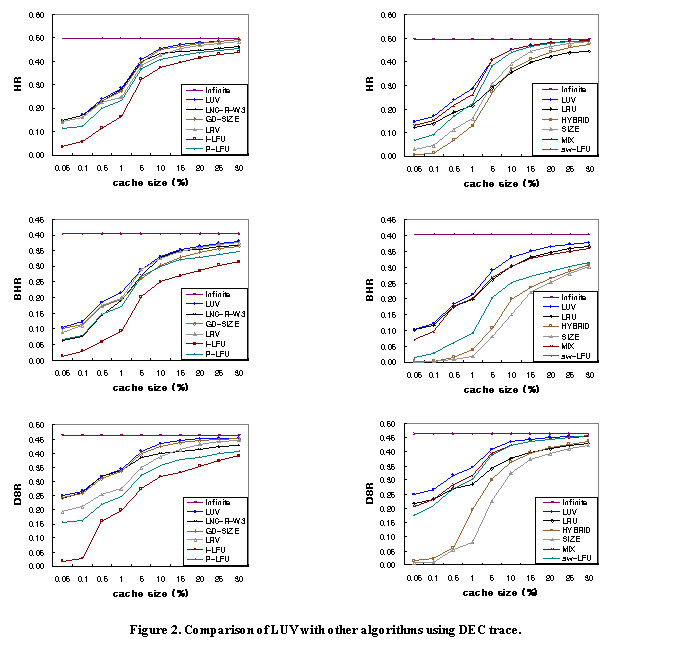
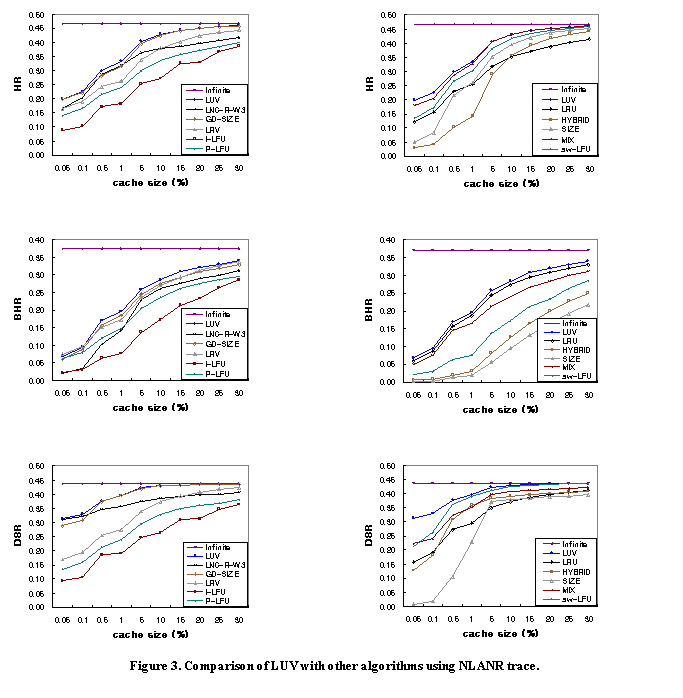
characteristics of the given traces. Figures 2
and 3 show the HR, BHR, and DSR of each algorithm as a function of the cache
size for the DEC and NLANR traces, respectively. In the figures, ‘Infinite’
represents the performance when the cache size is equal to Total Unique Mbytes
in Table 2, which is essentially equivalent to having an infinite size cache.
The x-axis, which is the cache size, is the size relative to the Infinite cache
size. We simulated a wide range of cache sizes, from 0.05% to 30% of the
Infinite cache size, to see the relation between the various cache sizes and
the performance of each algorithm. Small cache size results, such as when the
size is 0.05%, may be applicable to main memory caching, while results for
large sizes may be appropriately used for disk caching. Note that the scale of
the x-axis is not uniform. This arrangement is intended to show clearly the
relative performances of the algorithms. Note that for clarity, we show the
results in two groups of algorithms. The first group shows LUV, LNC-R-W3,
GD-SIZE, LRV, and the two types of LFU, i.e. in-cache-history LFU (denoted by
I-LFU) and perfect-history LFU (denoted by P-LFU), while the second group shows
LUV, LRU, HYBRID, SIZE, MIX, and sw-LFU. From the results, the following observations
can be made. ·
For most cases, the LUV algorithm performs the best irrespective of the cache
size for all performance measures, while the other algorithms give and take
amongst each other at particular cache sizes and measures. ·
Algorithms not considering the recency history perform worse than recency-based
algorithms when the cache size is small. The performance of the SIZE, HYBRID,
and LFU-based policies is consistently inferior and the gap is quite wide for
most of the cache sizes that were studied. The only range that they come close
is when the cache is large. Note that these algorithms do not consider the
recency of past references at all, which is primarily considered in other
algorithms compared in our experiments. ·
We find that generally, frequency-based algorithms are inferior to
recency-based replacement algorithms. However, as implied by the superior
performance of the LUV algorithm, a good combination of recency and frequency
can lead to even better performance. ·
MIX shows good performance for all performance measures, though the performance
gap between MIX and LUV is somewhat wider for smaller cache sizes. Recall,
however, that the MIX algorithm requires O(n) time complexity. ·
Though perfect-history LFU shows better performance than in-cache-history LFU
for all cases, there is no significant advantage of other perfect-history
algorithms, that is, LNC-R-W3 and LRV over in-cache-history algorithms. In
fact, even with perfect-history, none of these algorithms performed better than
the LUV algorithm. Moreover, LNC-R-W3 requires O(n) time complexity and LRV
requires trace analysis overhead.
6. Conclusion In this
paper, we presented a Web cache replacement algorithm called LUV. LUV evaluates
a Web document based on its retrieval cost normalized by the likelihood of it
being re-referenced. This results in a normalized assessment of the
contribution to the value of a document, leading to a fair replacement policy. Unlike
most previous algorithms, LUV estimates the re-reference likelihood of a
document by its full reference history during cache residency. Despite this, we
showed that LUV allows for an efficient implementation in both space and time
complexities. The space needed to maintain the reference history of a document is
only a few bytes and furthermore, the time complexity of the algorithm is O(log2n),
where n is the number of documents in the cache. Through trace-driven
simulations we showed that the LUV algorithm performs better than existing
algorithms for various performance measures for a wide range of cache configurations.
One direction for future research is to
model the distribution of Web requests seen by Web proxy caches considering
both recency and frequency. Breslau et al. show that an independent request
stream following a Zipf-like distribution is sufficient to model the requests
seen at Web proxies [13]. However, our experimental results show that temporal
locality is also important. Hence, we are attempting to model Web requests
considering both the recency and frequency information to simultaneously
reflect the reference popularity and the temporal locality. This will allow us
to fix a priori the control parameter l, which currently has to be determined
through off-line experiments, according to the corresponding model. Also, in
this paper, we only considered the in-cache-history LUV algorithm, which
requires low overhead in both time and space. However, because only a few bytes
of information is required for each object, perfect-history LUV may improve
performance even more without incurring much system overhead. We are currently
conducting experiments to validate this conjecture. References [1] M. Abrams, C. Standridge, G. Abdulla, S. Williams, and E. Fox, "Caching proxies: Limitations and potentials," In Proceedings of the 4th International WWW Conference, pp.
119-133, 1995. [2] P. Cao and S. Irani, "Cost-Aware WWW Proxy Caching Algorithms," In Proceedings of the USENIX Symposium on Internet Technology and Systems, pp. 193-206, 1997. [3] S. Glassman, "A caching relay for the World Wide Web," Computer Networks and ISDN system, vol. 27, no.
2, pp. 165-173, 1994. [4] D. Lee, J. Choi, J. Kim, S. H.
Noh, S. L. Min, Y. Cho, and C. Kim, "On the Existence of a Spectrum of Policies that Subsumes the LRU and LFU Policies," In Proceedings of the 1999 ACM SIGMETRICS Conference, pp.134-143,
1999. [5] P.
Lorenzetti, L. Rizzo, and L. Vicisano, "Replacement Policies for a Proxy Cache,"
http:// www.iet.unipi.it/~luigi/caching.ps.gzeunis,
1996. [6] N. Niclausse, Z. Liu, and P. Nain, "A new and efficient caching policy for the world wide web," In Workshop on Internet Server Performance (WISP'98), 1998. [7] E. O'Neil, P. O'Neil, and G. Weikum, "The LRU-k Page Replacement Algorithm for Database Disk Buffering," In Proceedings of the 1993 ACM SIGMOD Conference, pp. 297-306, 1993. [8] P. Scheuermann, J. Shim, and R. Vingralek, "A Case for Delay-Conscious Caching of Web Documents," In Proceedings of the Sixth International WWW Conference, 1997. [9] S. Williams, M. Abrams, C. Standridge, G. Abdulla, and E. Fox, "Removal policies in network caches for world-wide web documents," In Proceedings of the ACM SIGCOMM '96, pp.
293-305, 1996. [10] R. Wooster and M. Abrams, "Proxy caching that estimates page load delays," In Proceedings of the Sixth International WWW Conference, 1997. [11]ftp://ftp.digital.com/pub/DEC/traces/proxy/locallistv1.2.html [12]
ftp://ircache.nlanr.net/Traces/sj_sanitized-access_ 990718.gz ~
sj_sanitized-access_990731.gz [13] L.
Breslau, P. Cao, L. Fan, G. Phillips, and S. Shenker, "Web Caching and Zipf-like
Distributions: Evidence and Implications," In Proceedings of Infocom '99, 1999. [14] T.
Kelly, Y. Chan, S. Jamin, and J. MacKie-Mason, "Biased Replacement Policies
for Web Caches: Differential Quality-of-Service and Aggregate User Value," In Proceedings of the Fourth
International Web Caching Workshop, 1999. [15] L. Rizzo and L. Vicisano, "Replacement Policies for a Proxy Cache," Technical
Report UCL-CS RN/98/13, 1998 (available at http://www.iet.unipi.it /~luigi).
| ||||||||||||||||||||||||||||||||||||||||||||||||||||||||||||||||||||||||||||||||||||||||||||||||||||||||||||||||||||||||||
|
This paper was originally published in the
Proceedings of the 2nd USENIX Symposium on Internet Technologies & Systems,
October 11-14, 1999, Boulder, Colorado, USA
Last changed: 25 Feb 2002 ml |
|




 Technical Program