Devices That Tell On You: Privacy Trends in Consumer Ubiquitous
Computing
T. Scott Saponas
University of Washington
Jonathan Lester
University of Washington
Carl Hartung
University of Washington
Sameer Agarwal
University of Washington
Tadayoshi Kohno
University of Washington
|
We analyze three new consumer electronic gadgets in order to
gauge the privacy and security trends in mass-market
UbiComp devices. Our study of the Slingbox Pro uncovers a
new information leakage vector for encrypted streaming
multimedia. By exploiting properties of variable bitrate
encoding schemes, we show that a passive adversary can
determine with high probability the movie that a user is
watching via her Slingbox, even when the Slingbox uses
encryption. We experimentally evaluated our method against
a database of over 100 hours of network traces for 26 distinct
movies.
Despite an opportunity to provide significantly more
location privacy than existing devices, like RFIDs, we find
that an attacker can trivially exploit the Nike+iPod Sport
Kit’s design to track users; we demonstrate this with a
GoogleMaps-based distributed surveillance system. We also
uncover security issues with the way Microsoft Zunes
manage their social relationships.
We show how these products’ designers could have
significantly raised the bar against some of our attacks. We
also use some of our attacks to motivate fundamental
security and privacy challenges for future UbiComp
devices.
Keywords: Information leakage, variable bitrate (VBR)
encoding, encryption, multimedia security, privacy, location
privacy, mobile social applications, UbiComp.
|
1 Introduction
As technology continues to advance, computational devices
will increasingly permeate our everyday lives, placing more
and more wireless computers into our environment and
onto us. Many manufactures have predicted that the
increasing capabilities and decreasing costs of wireless
radios will enable common electronics in future homes to be
predominantly wireless, eliminating the clutter of wires
common in today’s homes. For example, TVs, cable boxes,
speakers, and DVD players could communicate without the
proximity restrictions of wires. The changing technological
landscape will also lead to new computing devices, such as
personal health monitors, for us to wear on our persons as we
move around our community. However, despite advances in
these areas we have only just begun to see the first examples
of such technologies enter the marketplace at a broad
scale. While the Ubiquitous Computing (UbiComp)
revolution will have many positive aspects, we must be
careful to not simultaneously endanger users’ privacy or
security.
By studying the Sling Media Slingbox Pro, the Nike+iPod
Sport Kit, and the Microsoft Zune, we provide a checkpoint
of current industrial trends regarding the privacy and security
of this new generation of UbiComp devices. (The Slingbox
Pro is a video relay system; the Nike+iPod Sport Kit is a
wireless exercise accessory for the iPod Nano; and the Zune
is a portable wireless media player.) In some cases, such as
our techniques for inferring information about what movie a
user is watching from 10 minutes of a Slingbox Pro’s
encrypted transmissions, we present new directions
for computer security research. For some of our other
results, such as the Nike+iPod’s use of a globally unique
persistent identifier, the key privacy issues that we uncover
are not new; but the ease with which we are able to
mount our attacks is surprising. This is particularly true
because we show that it would have been technically
possible for the Nike+iPod designers to prevent our
attacks.
In all cases, we use our results with these devices to paint
a set of research challenges that future commercial UbiComp
devices should address in order to provide users’ with strong
levels of privacy and security.
On Our Choice of Devices. The Slingbox Pro, the Nike+iPod
Sport Kit, and the Microsoft Zune represent a cross-section
of the different classes of UbiComp devices one might
encounter in the future: (1) devices that permeate our
environment and that stream or exchange information; (2)
devices that users have on their persons all the time; and (3)
devices that promote social interactions. While there is no
perfect division between these different classes of devices
(e.g., devices that users have on themselves all the time may
also exchange content and promote social activity), there are
unique aspects to the challenges for each class of devices; we
therefore consider each in turn. Specifically, (1) we use
the Slingbox Pro as a vehicle to study the issues and
challenges affecting next-generation wireless multimedia
environments, (2) we use the Nike+iPod Sport Kit as
the basis for assessing the issues and challenges with
devices that we have on our persons all the time, and (3)
we use the Zune as a foothold into understanding the
issues and challenges with devices promoting social
activity.
Below we survey our results and challenges for each of
these scenarios in turn, deferring further details to the body
of this paper.
1.1 The Sling Media Slingbox Pro
The Slingbox Pro allows users to remotely view (sling) the
contents of their TV over the Internet. The makers of the
Slingbox Pro are staged to introduce a new device, the
wireless SlingCatcher, which will allow Slingbox users to
sling video to other TVs located within the same home,
thereby making it one of the first next-generation wireless
video multimedia systems for the home [40]. Since the
SlingCatcher will not be commercially available until later
this year, we choose to study the privacy-preserving
properties of a Slingbox streaming encrypted movies to a
nearby computer over 802.11 wireless.
We describe in the following sections a technique for
monitoring a network connection, wired or wireless, and
based on the rate at which data is being sent from one device
to the other, predicting the content that is being transferred.
Our method consists of two parts. First, we describe a
procedure for collecting throughput traces across wired and
wireless connections and combining them into a single
reference trace per movie. These reference traces are
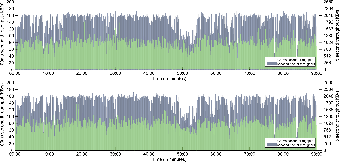
collected into a database for future query use. (Figure 1
shows the raw 5 second and 100 millisecond throughput data
for two wired traces of Ocean’s Eleven.) Second, we describe
a simple Discrete Fourier Transform based matching
algorithm for querying this database and predicting the
content being transmitted.
We test this algorithm on a dataset consisting of over
100 hours of network throughput data. With only 10
minutes worth of monitoring data, we are able to predict
with 62% accuracy the movie that is being watched (on
average over all movies); this compares favorably with
the less than 4% accuracy that one would achieve by
random chance. With 40 minutes worth of monitoring data,
we are able to predict the movie with 77% accuracy.
For certain movies we can do significantly better; for
15 out of the 26 movies, given a 40 minute trace we
are able to predict the correct movie with over 98%
accuracy. Given the simplicity of our algorithm, this
indicates a significant amount of information leakage — a
fact that is not immediately obvious to the users, who
likely trust the built in encryption in the device to protect
privacy.
Any transmission method whose characteristics depend
on the content that is being transmitted is susceptible
to the kind of attack we have described. As the world
moves towards more advanced multimedia compression
methods, and streaming media becomes ubiquitous, variable
bitrate encoding is here to stay. Preventing information
leakage in variable bitrate streams without a significant
performance penalty is an interesting challenge for both the
signal processing and the security communities. More broadly, a fundamental challenge that we must address is
how to identify, understand, and mitigate information
leakage channels in the full range of upcoming UbiComp
devices.
1.2 The Nike+iPod Sport Kit
The Nike+iPod Sport Kit is a new wireless accessory for the
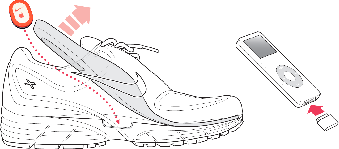
iPod Nano; see Figure 2. The kit consists of two components
— a wireless sensor that a user puts in one of her shoes and a
receiver that she attaches to her iPod Nano. When the user
walks or runs, the sensor wirelessly transmits information to
the receiver; the receiver and iPod will then interpret that
information and provide interactive audio feedback to the
user about her workout. The Nike+iPod sensor does
have an on-off button, but the online documentation
suggests that most users should leave their sensors in
the on position. Moreover, since the Nike+iPod online
documentation encourages users to “just drop the sensor in
their Nike+ shoes and forget about it [36],” the Nike+iPod
Sport Kit is a prime example of the types of devices
that people might eventually find on themselves all the
time.
One well-known potential privacy risk with having
wireless devices on ourselves all the time is: if the devices
use unique identifiers when they communicate, and if
someone can intercept (sniff) those unique identifiers from
the communications, then that someone might learn
potentially private information about a user’s presence or
location. This someone might use that information in ways
that are not in a user’s best interest; e.g., a stalker might use
this information to digitally track one or many people, a
company might use this information for targeted advertising,
and a court might examine this information when debating a
contentious case. Location and tracking issues such as these
are broadly discussed in the context of RFIDs [27],
bluetooth devices [26, 44], and (to a lesser extent) 802.11
wireless devices [15], and there is a large body of
UbiComp literature focused on privacy in location-aware
systems [5, 11, 12, 19, 20, 25, 22, 29, 34]. Given this
broad awareness of the potential trackability issues with
wireless devices, and given media reports that the Nike+iPod
Sport Kit used a proprietary wireless protocol [35] we set
out to determine whether the new Nike+iPod Sport Kit
proprietary system “raised the bar” against parties wishing to
track users’ locations.
We describe the technical process that we went through in
order to discover the Nike+iPod Sport Kit protocol in
Section 3. The key discovery we found is that not only does
each Nike+iPod sensor have a globally unique identifier,
but we can cheaply and easily detect the transmissions
from the Nike+iPod shoe sensors from 10–20 meters
away — an order of magnitude further than what one
would expect from a wireless device that only needs
to communicate from a user’s shoe to the user’s iPod
(typically strapped around the user’s arm), and also
significantly further than the conventional passive RFID. The
Nike+iPod sensor also broadcasts its unique identifier
even when there are no iPods nearby — the user must
simply be moving with a Nike+iPod sensor in her shoe.
To illustrate the ease with which one could create a
Nike+iPod tracking system, we developed a network
of Nike+iPod surveillance devices, including a $250
gumstix-based node. The gumstix uses an 802.11 wireless
Internet connection to dynamically stream surveillance
data to our back-end server, which then displays the
surveillance data in a GoogleMaps application in real
time.
We then describe cryptographic mechanisms that, if
implemented, would have significantly improved the
Nike+iPod Sport Kit’s resistance to our tracking attacks,
albeit with the potential drawback of additional resource
consumption (e.g., battery life and communication overhead).
Our basic approach is to mask the unique identifiers so
that only the intended recipient can unmask them. Our
solution, however, exploits the fact that the Nike+iPod Sport Kit has a very simplistic communications topology
— at any given time a Nike+iPod Sport Kit sensors
only needs to be able to communicate with one receiver.
The challenge is therefore to lift our privacy-preserving
mechanisms (or other mechanisms) to a broader context with
heterogeneous devices communicating in an ad hoc
manner.
1.3 The Microsoft Zune
The Microsoft Zune is a portable digital media player with
one (currently) unusual feature: built in 802.11 wireless
capabilities. The intended goal is to let users wirelessly share
pictures and songs with other nearby Zunes — including
Zunes belonging to total strangers. As such, the Zune is
arguably the first major commercial device with the design
goal of helping catalyze ad hoc social interactions in a
peer-to-peer wireless environment. (Strictly speaking, we
have not read the Zune design documents. Rather, we are
inferring this design goal from articles in the popular press
and from other publicly available information about the
Zune [32].)
Unfortunately, just as it is possible for spammers to send
unsolicited or inappropriate emails to users, it is possible
for an attacker to beam unsolicited content to a nearby
Zune. This unsolicited content may be annoying, such as
advertisements or propaganda, or malicious, such as images
or songs that might make the recipient feel uncomfortable or
unsafe.
Given the Zune’s goal of enabling ad hoc interactions, the
Zune cannot fall back on traditional mechanisms for
preventing unsolicited content, such as buddy lists for
instant messaging. Further, much of the research on social
interactions for ubiquitous devices is restricted to scenarios
where users have a hierarchy of social relationships (e.g.,
friends and non-friends) [22], which is incompatible with
the assumed Zune design goals. Rather, in apparent
anticipation of such unsolicited content, the Microsoft Zune
allows users to “block” a particular device — a malicious
individual might be able to get a user to accept an image or
song once, but the recipient should be able to block the
originating device from ever sending the user other content
in the future. Unfortunately, we find that it is easy for an
adversary to subvert this blocking mechanism, thereby
allowing the adversary to repeatedly initiate content
pushes to the victim until the victim walks out of range or
turns off the wireless in her Zune. While we describe
techniques that would address the above scenario in
the particular case of the Zune, the observations we
make underscore two challenges for UbiComp devices
designed to enable ad hoc social interactions: (1) how to
technically implement a blocking procedure or proactively
protect against undesired content, especially among a
set of heterogeneous devices, and (2) how to balance
the blocking mechanisms with our desire to protect
location privacy and avoid certain uses of globally unique
identifiers.
1.4 Organization and Remarks
We respectively discuss our analyses of the Slingbox Pro, the
Nike+iPod Sport Kit, and the Microsoft Zune, as well as the
associated research challenges, in Sections 2, 3, and 4. We
discuss related work in-line.
We stress that there is no evidence that Sling Media,
Apple, Nike, or Microsoft intended for any of these
devices to be used in any malicious manner. Neither
Sling Media, Apple, Nike, nor Microsoft endorsed this
study.
2 The Slingbox Pro: Information Leakage and Variable
Bitrate Encoding
Although the future of home entertainment is somewhat
fuzzy, many companies have predicted the future home to be
a wireless one. Wireless devices tend to be easier to install
(though not necessarily easier to setup), provide the user with
more flexibility, allow the devices to interoperate with other
technologies, and reduce clutter from wires. While it is
currently easier to simply plug these devices in once and
forget about them, future wireless technologies promise an
ever increasing amount of bandwidth, range, and decreasing
manufacturing costs, making them more appealing and
more likely to be included in future products. Consider,
for example, the buzz associated with the upcoming
SlingCatcher and the Apple TV; the former is expected to
feature integrated wireless support; the latter currently does.
In addition to the drive for devices to be connected together,
wirelessly, in the home, these devices are often finding
themselves networked together and connected to the
Internet.
Protecting our private information becomes increasingly
difficult as we begin to continually use more wireless
devices. Devices in our homes could leak private information
to wireless eavesdroppers or, when using home devices over
the Internet, wired eavesdroppers. We have investigated one
such new wireless/remote TV viewing application — the
Slingbox Pro — from a privacy standpoint. In doing so
we have uncovered a new information leakage vector
for encrypted multimedia systems via variable bitrate
encoding.
2.1 Slingbox Pro Description
The Slingbox Pro is a networked video streaming device
built by Sling Media, Inc. It is capable of streaming video
using its built in TV tuner or one of four inputs connected to
DVD players, cable TV, personal video recorders, built in TV
tuner, etc. and controlling these devices using an IR
emitter. The device itself has no hard drive and cannot
store media locally, relying on the connected devices
to provide the video and audio content. Paired with
player software, called SlingPlayer, the user can watch
video streamed by the Slingbox Pro on their laptop,
desktop, or PDA anywhere they have Internet access. To
accommodate limited network connections when watching
videos over a wireless network or away from home, the
Slingbox Pro re-encodes the video stream using a variable
bitrate encoder, likely a optimized version of Windows
Media 9s VC-1 implementation [41]. The Slingbox
Pro provides encryption for its data stream (regardless
of any transport encryption like WPA). To avoid any
problems caused by latency or network interruption
the SlingPlayer will cache a buffer of several seconds
worth of video. Because of this caching behavior and
commonly used packet sizes for TCP packets, the data
packets from the Slingbox Pro tend to always be large data
packets of similar size or small (seemingly control)
packets.
Sling Media recently announced a new device, the
wireless SlingCatcher, which users can attach to their TVs.
The SlingCatcher would allow users to wirelessly stream
content from a Slingbox Pro to their TVs, thereby taking us
one step further to a wireless multimedia home. Since the
SlingCatcher is not yet commercially available, we choose to
study the Slingbox Pro in isolation.
2.2 Experimental Setup
We ask whether Slingbox’s use of encryption prevents an
eavesdropper from discovering what content is being
transmitted. This private information could be potentially
sensitive if the content is illegal (e.g., pirated), embarrassing,
or is otherwise associated with some social stigma. Toward
answering this question, we conducted the following
experiments.
|
|
|
| | Index | Movie | Index | Movie |
|
|
|
| | A | Bad Boys | B | Bad Boys II |
|
|
|
| | C | Bourne Supremacy | D | Break-Up |
|
|
|
| | E | Harry Potter 1 | F | Harry Potter 3 |
|
|
|
| | G | Incredibles | H | Men in Black II |
|
|
|
| | I | Ocean’s Eleven | J | Short Circuit |
|
|
|
| | K | X2 | L | X-Men |
|
|
|
| | M | Air Force One | N | Bourne Identity |
|
|
|
| | O | Caddyshack | P | Clueless |
|
|
|
| | Q | Happy Gilmore | R | Jurassic Park |
|
|
|
| | S | Nightmare Before | T | Office Space |
|
|
|
| | U | Red October | V | Austin Powers 1 |
|
|
|
| | W | Austin Powers 2 | X | Bruce Almighty |
|
|
|
| | Y | Hurricane | Z | Short Circuit 2 |
|
|
|
| | |
| Table 1: | Mapping from movie names to movie indices. |
|
We streamed a total of 26 movies from a Slingbox Pro to
laptop and desktop Windows XP computers running the
Slingmedia SlingPlayer. See Table 1. For each movie we
streamed the first hour of the movie twice over a wired
connection and twice over an 802.11G WPA-PSK TKIP
wireless connection. Each time we used the Wireshark
protocol analyzer [43] to capture all of the Slingbox
encrypted packets to a file. We split each of these traces into
100-millisecond segments and calculate the data throughput
for each segment. We use these 100-millisecond throughput
traces as the basis for our eavesdropping analysis. See
Figure 1 for two examples of these 100-millisecond
traces, as well as two example 5-second throughput
traces.
2.3 Throughput Analyses
Our eavesdropping algorithm consists of two parts. In the
first part, we construct a database of reference traces.
Each movie was represented by exactly one reference
trace obtained by combining all the throughput traces
corresponding to it. Each reference trace requires
approximately 600 kilobytes of storage per hour of video.
The second part of our algorithm uses this database of
reference traces to match against a previously unseen trace.
In the following we describe each of these two stages in
detail.
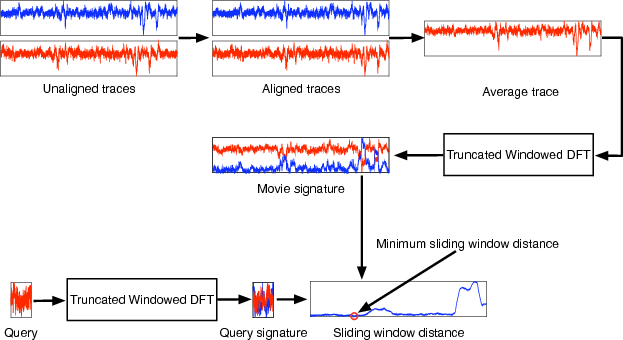
| Figure 4: | Database construction and query matching. The raw throughput traces corresponding to a movie are aligned
and averaged to produce a single composite trace. A windowed Fourier transform is performed on the composite trace
and the first f = 2 coefficients are kept. A database of movie signatures is constructed in this manner. A query trace is
transformed similarly into a signature, and the minimum sliding window distance between the movie signatures and
the query signature is calculated. The movie with the minimum distance is declared a match. |
|
Building a Database of Reference Traces. While it is
possible to use our matching algorithm against individual
raw traces, combining the raw traces for a movie into one
reference trace, reduces the time complexity of the matching
process and increases the statistical robustness of the
matching procedure by eliminating noise and network effects
peculiar to a particular trace.
For each movie, all its traces were temporally aligned with
each other. This is needed because the trace capturing
process was started manually and the traces could be offset
in time by 0 to 20 seconds. The alignment was done
by looking at the maximum of the normalized cross
correlation between smoothed versions of the traces. The
smoothing was performed using Savitzky-Golay filtering of
degree 2 and windowsize 300. These filters perform
smoothing while preserving high frequency content
better than standard averaging filters [38]. The reference
trace was obtained by averaging over the aligned raw
signals.
Matching a Query Trace to the Database. Given a
database of reference traces and a short throughput trace, we
are now faced with the task of finding the best matching
reference trace. This is an instance of the problem of
subsequence matching in databases, which has been
widely studied in both discrete and continuous domains.
Our algorithm is inspired by the work of Faloutsos et
al. [13].
The simplest approach to subsequence matching in
timeseries is to calculate the Euclidean distance between the
query sequence and all contiguous subsequences of the same
size in the database. Due to the amount of noise present in
these traces, this method does not perform well in practice.
Following Faloutsos et al., instead of comparing raw
throughput values, we first extract noise tolerant features
from the traces and then compare subsequences based on
these features.
A number of feature extraction schemes have been
proposed for this task in the literature, including the
Discrete Fourier Transform (DFT) and the Discrete Wavelet
Transform. We use the DFT in our experiments. Each point
in a throughput sequence was replaced by the first f DFT
coefficients of window size w centered on that point. Thus
each reference trace in the database was a sequence
of non-negative throughput values was replaced by a
sequence of f-dimensional Fourier coefficients. The low
order Fourier coefficients capture the dominant low
frequency behavior in each window. We treat the higher
frequency components as noise and ignore them. The
same transformation is applied to the query trace. The
resulting f-dimensional query trace is compared with all
subsequences of the same in the database. The movie with
the closest matching subsequence is declared a match. Figure 4 illustrates the database construction and matching
process.
We note that exhaustive matching of all subsequences
would not be computationally feasible in a production
environment with thousands of references traces. Methods
based on approximate nearest neighbor searching can be
used to substantially accelerate the matching process without
a significant loss in accuracy [13].
Experiments. The above algorithm has two parameters. The
size w of the sliding window used to extract the features and
the number of Fourier features f, extracted from each
window. Both affect the recognition performance of the
algorithm. Small values of w and f result in high noise
sensitivity, and large values result in over-smoothing
of the data. The other factor that affects recognition
performance is the length l of the query trace. To choose
a good parameter setting, we studied the behavior of
the algorithm described above for varying values of
w = [100,300,600],f = [1,2,4]. For each setting of the
parameters, a random query trace of length l = 6000 was
extracted from one of the raw throughput traces and
compared using the matching algorithm described above.
This procedure was repeated 100 times for every parameter
setting. The highest accuracy was obtained for w = 100 and
f = 2, or a sliding window of 10 seconds with two Fourier
coefficients per window.
We now fix w = 100 and f = 2 parameters, vary
l = [6000,12000,18000,24000] (10, 20, 30, and 40
minutes), and estimate the prediction accuracy of the
eavesdropping algorithm. This is done by choosing one
throughput trace at a time, constructing the reference trace
database using the rest of the throughput traces and then
counting how many times random subsequences from
the chosen trace result in an incorrect prediction. The
average number of incorrect matches over all traces
is the leave one out error [18]. In our experiment, 50
random subsequences were chosen from each trace.
Sometimes a good shortlist of possible matches is also
useful, where the list can be further trimmed with side
information, for example, the cable schedule for the area.
To account for this possibility, not only do we count
the number of times we get the best match right, we
also count for varying values of k = 1,…,5, when the
algorithm correctly ranks the movie amongst the top k
matches.
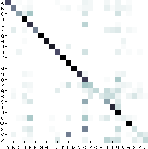
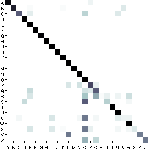
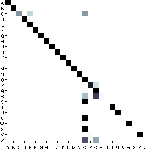
| Figure 5: | Confusion matrices for: (a) 10 minute probes from both wired and wireless traces; (b) 40 minute probes
from both wired and wireless traces; (c) 40 minute probes from wired traces; (d) 40 minute probes from wireless
traces. The color scale is on the right; black corresponds to 1.0 and white corresponds to 0.0. |
|
Table 2 reports the overall accuracy (1-error) of the
algorithm, where the accuracy (true positive rate) was
computed over all 26 movies. (We define the true positive
rate of a movie M as the rate at which a random query trace
for movie M is correctly identified as movie M; we define
the false positive rate of a movie M as the rate at which a
random query trace for a movie M′⁄= M is incorrectly
identified as movie M.)
For 10- and 40-minute queries, the overall accuracy rates
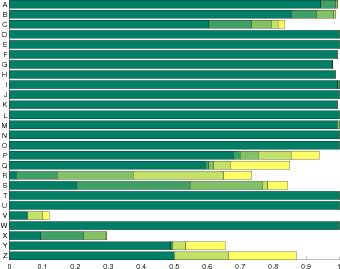
are respectively 62% and 77%. Table 3 and Figures 5 and 6
show that the accuracy rate for individual movies can be
significantly higher. From Table 3, 15 of our 26 movies had
≥ 98% true positive rates for 40-minute traces with k = 1,
and 22 of our 26 movies had ≤ 1% false positive rates for
our 40-minute traces with k = 1.
Figures 5 (a) and (b) show the confusion matrices for 10
and 40 minute query traces with k = 1. The shade of the cell
in row i, column j denotes the rate at which the i-th movie is
identified as the j-th movie; the cells on the diagonal
correspond to correct identifications. Contrasting Figures 5
(a) and (b) visually show the increase in accuracy as
the length of the query trace increases. Our wireless
traces have a higher level of noise as compared to our
wired traces. Figures 5 (c) and (d) therefore show the
confusion matrices for when the query is restricted to (c)
wired and (d) wireless traces. Note that a few movies
were misidentified as Caddyshack, as represented by
the vertical band most visible in Figure 5 (c); this is
likely due to the fact that the bitrate for Caddyshack
was fairly constant and the misidentified movies had
significant noise (e.g., the wireless traces for Austin
Powers 1 had significant noise, which influenced the
composite reference trace and therefore the ability of
the Austin Power query trace to match to the reference
trace).
|
|
|
|
|
| | | k = 1 | k = 2 | k = 3 | k = 4 | k = 5 |
|
|
|
|
|
| | 10 mins | 0.62 | 0.66 | 0.69 | 0.71 | 0.73 |
|
|
|
|
|
| | 20 mins | 0.71 | 0.75 | 0.78 | 0.80 | 0.82 |
|
|
|
|
|
| | 30 mins | 0.74 | 0.79 | 0.81 | 0.84 | 0.85 |
|
|
|
|
|
| | 40 mins | 0.77 | 0.81 | 0.84 | 0.86 | 0.89 |
|
|
|
|
|
| | chance | 0.04 | 0.08 | 0.12 | 0.15 | 0.19 |
|
|
|
|
|
| | |
| Table 2: | Overall accuracy of the eavesdropping
algorithm. The rows correspond to 10, 20, 30, and 40
minute query traces, and the columns report the success
with which the algorithm correctly placed the movie in
the top k matches. The bottom row correspond to the
probability of a match by random chance. |
|
|
|
|
|
| | | True positives | False positives
| | | n minute probes | n minute probes
| | Movie Index | n = 10 | n = 40 | n = 10 | n = 40
|
|
|
|
|
| | A | 0.67 | 0.95 | 0.00 | 0.00 |
|
|
|
|
| | B | 0.51 | 0.86 | 0.01 | 0.00 |
|
|
|
|
| | C | 0.38 | 0.60 | 0.01 | 0.00 |
|
|
|
|
| | D | 1.00 | 1.00 | 0.02 | 0.01 |
|
|
|
|
| | E | 0.78 | 1.00 | 0.04 | 0.02 |
|
|
|
|
| | F | 0.47 | 0.99 | 0.00 | 0.00 |
|
|
|
|
| | G | 0.99 | 0.98 | 0.00 | 0.00 |
|
|
|
|
| | H | 0.90 | 0.99 | 0.00 | 0.00 |
|
|
|
|
| | I | 0.87 | 1.00 | 0.00 | 0.01 |
|
|
|
|
| | J | 0.66 | 1.00 | 0.01 | 0.00 |
|
|
|
|
| | K | 0.99 | 0.99 | 0.00 | 0.00 |
|
|
|
|
| | L | 0.99 | 1.00 | 0.03 | 0.02 |
|
|
|
|
| | M | 0.98 | 0.99 | 0.00 | 0.00 |
|
|
|
|
| | N | 0.79 | 1.00 | 0.00 | 0.01 |
|
|
|
|
| | O | 0.72 | 1.00 | 0.08 | 0.10 |
|
|
|
|
| | P | 0.22 | 0.68 | 0.01 | 0.01 |
|
|
|
|
| | Q | 0.18 | 0.59 | 0.00 | 0.02 |
|
|
|
|
| | R | 0.10 | 0.02 | 0.00 | 0.00 |
|
|
|
|
| | S | 0.37 | 0.20 | 0.03 | 0.00 |
|
|
|
|
| | T | 0.83 | 1.00 | 0.02 | 0.00 |
|
|
|
|
| | U | 0.97 | 1.00 | 0.06 | 0.01 |
|
|
|
|
| | V | 0.07 | 0.06 | 0.01 | 0.01 |
|
|
|
|
| | W | 0.99 | 1.00 | 0.01 | 0.01 |
|
|
|
|
| | X | 0.14 | 0.10 | 0.01 | 0.00 |
|
|
|
|
| | Y | 0.12 | 0.49 | 0.01 | 0.00 |
|
|
|
|
| | Z | 0.18 | 0.50 | 0.01 | 0.00 |
|
|
|
|
| | |
| Table 3: | True and false positive rates for 10 and 40
minute probes of both wired and wireless traces. The
true positive rate of a movie M is the rate at which an
n-minute query of that movie is correctly identified as
movie M. The false positive rate of a movie M is the
rate at which an n-minute query of some other movie
M′⁄= M is incorrectly identified as M. |
|
2.4 Limitations, Implications, and Challenges
While our experiments were conducted in a laboratory
setting, they do reflect some possible configurations that one
might encounter in a future home equipped with many
wireless multimedia devices. The implications of our results
are, therefore, that an adversary in close proximity to a users’
home might be able to infer information about what videos a
user is watching. This adversary might be a nosy neighbor.
Or the adversary might be someone sitting outside in a
van, looking to collect forensics evidence about those
viewing “illegal” (e.g., censored or pirated) content.
Moreover, a content producer (such as the creator of a
movie) could intentionally construct its movies to have
stronger, more distinctive fingerprints. This situation would
seem to violate the user’s perception of privacy within their
own home, especially given the Slingbox Pro’s use of
encryption.
More broadly, our Slingbox results provide further
evidence that encryption alone cannot fully conceal
the contents of encrypted data. Other results show that
one can infer the origins of encrypted web traffic or
infer application protocol behaviors from encrypted
data [30, 45]. Concurrent with this work, Wright et al. show
how variable bitrate encodings can reveal the language
spoken through an encrypted VoIP connection [46].
Protecting against such information leakage vectors for all
possible applications seems to be a fundamental challenge.
Indeed, it may be difficult to simultaneously preserve
desirable properties like low-latency and low bandwidth
consumption while also allowing for applications with bursty
or otherwise data-dependent communication properties. As a
concrete example, while it may be possible to significantly
raise the bar against information leakage through the
Slingbox by having the Slingbox push data at a constant rate
while a user is watching a movie, a passive eavesdropper
may still be able to learn when a user watches movies, and
for how long. The challenge, therefore, is to first determine
the possible information leakage vectors, understand their
implications, and develop technical means for mitigating
them.
3 The Nike+iPod Sport Kit: Devices that Reveal Your
Presence
The Nike+iPod Sport Kit foreshadows the types of
application-specific UbiComp devices that we might soon
find ourselves wearing as part of our daily routine. Indeed,
based on publicly available information about the intended usage of the Nike+iPod Sport Kit, as well as our own
personal observations, we expect that many Nike+iPod users
will always leave their Nike+iPod sensors turned on and in
their shoes.
We describe here the steps we took to discover the
Nike+iPod protocol; our goal was to assess whether the
Nike+iPod Sport Kit provides protection mechanisms against
an adversary who wishes to track users’ locations. Having
uncovered no such protection mechanisms, we then describe
our subsequent steps to gauge how easy and cheap it might
be for an adversary to implement our attacks. Finally
we consider fixes to the Nike+iPod protocol as well
as some broader research challenges that our results
raise.
3.1 Nike+iPod Description
The Nike+iPod Sport Kit allows runners and walkers to hear
real time workout progress reports on their iPod Nanos. A
typical user would purchase an iPod Nano, a Nike+iPod
Sport Kit, and either a pair of Nike+ shoes or a special pouch
to attach to non-Nike+ shoes. The kit consists of a receiver
and a sensor. Users place the sensor in their left Nike+ shoe
and attach the receiver to their iPod Nano as shown in
Figure 2. The sensor is a 3.5cm x 2.5cm x 0.75cm plastic
encased device, and the receiver is a 2.5cm x 2cm x 0.5cm
plastic encased device. When a person runs or walks
the sensor begins to broadcasts sensor data via a radio
transmitter whether or not an iPod Nano is present. When the
person stops running or walking for ten seconds, the sensor
goes to sleep. When the iPod Nano is in workout mode
and the receiver’s radio receives sensor data from the
sensor, the receiver will relay (a function of) that data to
the iPod Nano, which will then give audio feedback
(via the iPod headphones) to the person about his or
her workout. As of September 2006, Apple has sold
more than 450,000 of the $29 (USD) Nike+iPod Sport
Kits [1].
3.2 Discovering the Nike+iPod Protocol
Initial Analysis. The first step was to learn how the Nike+iPod
sensor communicates with the receiver. According to the
Nike+iPod documentation, a sensor and receiver need to be
linked together before use; this linking process involves
user participation. Once linked, the receiver will only
report data from that specific sensor, eliminating the
readings from other nearby sensors. The receiver can also
remember the last sensor to which it was linked so that
users do not need to perform the linking step every time
they turn on their iPods. The receiver can also later be
linked to a different sensor (for a replacement sensor or
different user), but under the standard user interface the
receiver can only be linked to one sensor at any given
time.
We observed, however, that a single sensor could be linked
to two receivers simultaneously, meaning that two people
could use their iPod Nanos and the standard user interface to
read the data from a single Nike+iPod sensor at the same
time. Further investigation revealed that the sensor was
a transmitter only, meaning that it was incapable of
knowing what iPod or receiver it was associated with. This
observation provides the underlying foundation for our
results since it concretely shows that a Nike+iPod Sport
Kit does not enforce a strong, exclusive, one-to-one
binding between a sensor and a receiver. Having made this
observation, we then commenced to uncover more details
about the Nike+iPod protocol.
The Hardware, Serial Communications, and Unique
Identifiers. The Nike+iPod Sport Kit receiver communicates
with the iPod Nano through the standard iPod connector.
Examining which pins are present on the receiver’s connector
and comparing those pins with online third-party pin
documentation [24], we determined that communication was
most likely being done over a serial connection.
Opening the white plastic case of the receiver reveals a
component board and the pin connections to the iPod
connector. There are ten pins in use; three of these pins are
used in serial communication: ground, iPod transmit, and
iPod receive. We verified that digital data was being sent
across this serial connection using an oscilloscope and
soldered wires connecting them to the serial port of our
computer. With the receiver connected to the iPod we turned
on the iPod and observed data sent in both directions over the
serial connection.
As noted above, before the receiver can be used with a
new sensor, the sensor must be linked with the receiver.
This is initiated by the user through menus in the iPod
interface. The user is asked to walk around so that the
sensor can be detected by the receiver. When the link
process is started, the iPod sends some data to the receiver.
Then, the receiver begins sending data back to the iPod
until the new sensor is discovered and linked by the
receiver. Finally, the iPod sends some more data back to the
receiver.
After collecting and comparing several traces of the link
process with several different sensors we noticed that linking
seemed to complete when the third occurrence of a certain
packet came from the receiver. These packets’ payload
started with the same four bytes; however, the next four bytes
were different depending on which sensor we used.
In all our experiments these four bytes appear to be
consistent and unique for a single sensor, and therefore we
refer to these four bytes as the sensor’s unique identifier
or UID. As further corroboration for the uniqueness of these UIDs, we find that we can use the iPod Nano
as an oracle for translating between the UIDs and the
Nike+iPod sensor’s serial number as it appears on the
back of the sensor; we omit details but instead refer
the reader to Figure 7 for a sketch of how one might
use an iPod Nano as a UID to serial number oracle. As
suggested above, the Nike+iPod Sport Kit appears to use
these UIDs for addressing purposes — after linking, a
receiver will only report packets containing the specified
UID.
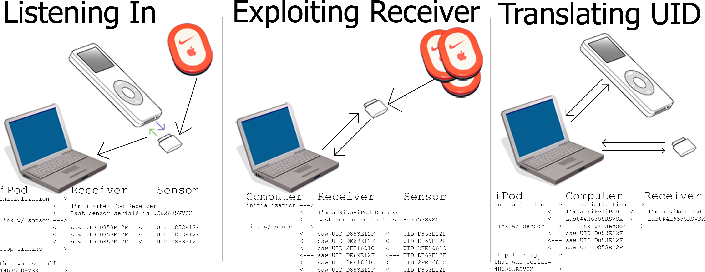
| Figure 7: | The figure on the left shows our approach for passively monitoring the serial communications between an
iPod and the Nike+iPod receiver; the communications between the iPod and the receiver are over a physical, serial
connection, and the communication from the sensor to the receiver is via a radio. The figure in the middle shows our
approach for directly controlling a Nike+iPod receiver from a computer; the communication from the computer to the
Nike+iPod receiver is over a physical serial connection. The figure on the right shows our approach for translating
between a sensor’s UID and the sensor’s serial number. |
|
Automatically Discovering UIDs. Our next step was to use
the Nike+iPod receiver to listen for sensor UIDs in an
automated fashion without the iPod Nano. To do this we
modified an iPod female connector by soldering wires from
the serial pins on the iPod connector to our adapter, adjusted
the voltage accordingly, and attached 3.3V power to the
power pin. We then plugged an unmodified Nike+iPod
receiver into our female connector and replayed the data that
we saw coming from the iPod when the iPod is turned on and
then when the iPod enters link mode. This process caused the
receiver to start sending packets over the serial connection to
our computer with the identifiers of the broadcasting
sensors in range. However, because our computer never
responds to the receiver’s packets, the link process never
ends and the receiver continues to send to our computer
the identifiers of transmitting sensors until power is
removed.
Implications. Our observations here immediately imply that
the Nike+iPod Sport Kit may leak private information about
a user’s location. Namely, as is well known in the context of
other devices (like RFIDs and discoverable bluetooth
devices [26, 27, 44]), if a wireless devices broadcasts a
persistent globally unique identifier, an attacker with
multiple wireless sniffers can correlate the location of that
device (and by inference the user) across different physical
spaces and over time.
3.3 Measurements
To understand the implications of our observations in
Section 3.2, we must understand the following properties of
a Nike+iPod sensor: when it transmits; how often it
transmits; the range at which the receiver hears the sensor’s
UID; and the collision behavior of multiple sensors. We have
already partially addressed some of these properties, but
elaborate on our observations here.
When the sensor is still, it is “sleeping” to save battery.
When one begins to walk or run with the sensor in their shoe,
the sensor begins transmitting. It is also possible to wake up
the sensor without putting it in a shoe. For example, shaking
the sensor while still in the sealed package from the store
will cause it to transmit its UID. Sensors can also be
awakened by tapping them against a hard surface or shaking
them sharply. Similarly, if a sensor is in the pocket of one’s
pants, backpack, or purse, it will occasionally wake up and
start transmitting. Once walking, running, or shaking
ceases, the sensor goes to sleep after approximately ten
seconds.
While the sensor is awake and nearby we observed that it
transmits one packet every second (containing the UID).
When the sensor is more distant or around a corner the
receiver heard packets intermittently, but still on second intervals. When multiple sensors are awake near one another
some packets get corrupted (their checksums do not match).
As the number of awake sensors increase so does the
number of corrupt packets. However, our tests with seven
sensors indicated the receiver still hears every sensor
UID at least once in a ten second window. During our
experiments with the Nike+iPod sensors we observed
approximately a 10 meter range indoors and a 10–20 meter
range outdoors. Sensors are also detectable while moving
quickly. Running by a receiver at approximately 10 MPH,
the sensor is reliably received. Driving by someone
walking with a sensor in their shoe, the sensor can be
reliably detected at 30 MPH. We have not tested faster
speeds.
3.4 Instrumenting Attacks
Section 3.2 shows that it is possible for an adversary to
extract a Nike+iPod sensor’s UIDs from sniffed radio
transmissions, and Section 3.3 qualifies the circumstances
under which the receiver might be able to sniff those
transmissions. These results already enable us to conclude
that, despite broad awareness about the trackability concerns
with unique identifiers in other technologies (e..g, RFIDs,
discoverable bluetooth), new commercial products are
still entering the market without any strong protection
mechanisms for ensuring users’ location privacy.
We now seek to explore just how easy — in terms of cost
and technical sophistication — it might be for an adversary
to exploit the Nike+iPod Sport Kit’s lack of location privacy
protection and, at the same time, to explore the types of
applications that an adversary might build. For example, one
application that we built is a GoogleMaps-based system that
pools data from multiple Nike+iPod sniffers and displays the
resulting tracking information on a map in real-time.
When assessing the ease with which an attacker might
be able to implement a Nike+iPod-based surveillance
system, it is worth noting that the attacker may not need
to write source code him or herself, but may instead
download the necessary software from somewhere on
the Internet. We built the following components and
systems:
-
∙
-
Receiver to USB Adaptor. We created a compact
USB receiver module for connecting the Nike+iPod
receiver to a computer via USB. Our module does
not require any modification to the Nike+iPod
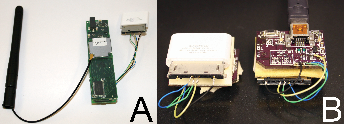
receiver; see Figure 3b, and consists of a female iPod
connector [23] and a serial-to-USB board utilizing
the FTDI FT2232C chipset [14]. We connected the
serial pins and power pins of the iPod connector to
the appropriate pins of the FT2232C board. When this
module is connected to a computer, the receiver is then
powered and a USB serial port is made available for
our software to communicate with the receiver. With
the receiver attached, this package is approximately
3cm x 3cm x 2cm.
We also created a windows serial communications
tool for interfacing with the Nike+iPod Receiver using
our adapter. Our tool can detect the UIDs of nearby
Nike+iPod sensors and transmit those UID readings, a
timestamp, and latitude and longitude information to a
back-end SQL server for post-processing; the latitude
and longitude are currently set manually. Optionally,
when a sensor is detected, this application can take
photographs with a USB camera and upload those
photographs to the SQL server along with the UID
information. This application can also SMS or email
sensor information to pre-specified phone numbers or
email addresses.
-
∙
-
Gumstixs.
We also implemented a cheap Nike+iPod surveillance
device using the Linux-based gumstix computers.
This module consists of an unmodified $29 Nike+iPod
receiver, a $109 gumstix connex 200xm motherboard,
a $79 wifistix, a $27.50 gumstix breakout board, and a
$2.95 female iPod connector. The Nike+iPod receiver
is connected directly to the gumstix’s serial port,
thereby eliminating the need for our serial-to-USB
adaptor. The assembled package is 8cm x 2.1cm x
1.3cm and weighs 1.1 ounces; see Figure 3a.
Our gumstix-based module runs a 280 line C
program that communicates with the Nike+iPod
receiver over a serial port and that uses the
wifistix 802.11 wireless module to wirelessly transmit
real-time surveillance data to a centralized back-end
server. The real-time reporting capability allows the
gumstix module to be part of a larger real-time
surveillance system. If an adversary does not need this
real-time capability, then the adversary can reduce the
cost of this module by omitting the wifistix.
-
∙
-
A Distributed Surveillance System. To illustrate
the power of aggregating
sensor information from multiple physical locations,
we created a GoogleMaps-based web application. Our
web application uses and displays the sensor event
data uploaded to a central SQL server from multiple
data sources. The data sources may be our serial
communication tool or our gumstix application.
In real-time mode, sensors’ UIDs are overlayed
on a GoogleMaps map at the location the sensor
is seen. When the sensor is no longer present at
that location, the UID disappears. Optionally, digital
pictures taken by a laptop when the sensor is first
seen can be overlayed instead of the UID. In history
mode, the web application allows the user to select
a timespan and show all sensors recorded in that
timespan. For example, one could select the timespan
between noon and 6pm on a given day; all sensors
seen that afternoon will be overlayed on the map at the
appropriate location.
This application would allow many individuals to
track people of interest. An attacker might also use
this tool to establish patterns of presence. If many
attackers with receivers cooperated, this software and
website would allow the tracking and correlation of
many
people with Nike+iPod sensors. Among the related
research, demonstration, and commercial bluetooth-
and 802.11 wireless-based tracking systems (e.g.,
[6, 8, 10, 17, 31, 37, 39]), we are unaware of any
other location-based surveillance system that goes
as far as plotting subjects’ locations on a map in
real-time.
We also developed two other surveillance devices —
one which uses a third-generation iPod and iPod Linux
to detect nearby Nike+iPod sensors, and the other of
which uses a second-generation Intel Mote (iMote2) to
detect nearby Nike+iPod sensors and beams the recorded
information to a paired Microsoft SPOT watch via bluetooth.
For brevity, and since the above applications provide a
survey of the applications that we developed, we omit
discussion of our iPod Linux- and iMote2-based applications
here.
3.5 Privacy-Preserving Alternatives
Our results show that, despite public awareness of the
importance of location privacy and untrackability, major new
products are still being introduced without strong privacy
guards. We consider this situation unfortunate since in many
cases it is technically possible to significantly improve
consumer privacy.
Exploiting (Largely) Static Associations. Consider the
typical usage scenario for the Nike+iPod Sport Kit. In the
common case, we expect that once a user purchases
a Nike+iPod Sport Kit, he or she will rarely use the
sensor from that kit with the receiver from a different kit.
This means that the sensor and the receiver could have
been pre-programmed at the factory with a shared secret
cryptographic key. By having the sensor encrypt each
broadcast message with this shared key, the Nike+iPod
designers could have addressed most of our privacy concerns
about the Nike+iPod application protocol; there may still be
information leakage through the underlying radio hardware,
which would have to be dealt with separately. If the
manufacturer decides a sensor from one kit should be used
with the receiver from a separate kit, then several options still
remain. For example, under the assumption that one will only
rarely want to use a sensor from one kit with a receiver from
another, the cryptographic key could be written on the backs
of the sensors, and a user could manually enter that key
into their iPods or computers before using that new
sensor. Alternately, the sensor could have a special button
on it that, when pressed, causes the sensor to actually
broadcasts a cryptographic key for some short duration of
time.
Un-Sniffable Unique Identifiers. Assume now that both the
sensor and the receiver in a Nike+iPod Sport Kit are
preprogrammed with the same shared 128-bit cryptographic
key K. One design approach would be for the sensor to
pre-generate a new pseudorandom 128-bit value X during
the one-second idle time between broadcasts. Although
the sensor could generate X using physical processes,
we suggest generating X by using AES in CTR mode
with a second, non-shared 128-bit AES key K′. Also
during this one-second idle time between broadcast, the
sensor could pre-generate a keystream S using AES in
CTR mode, this time with the initial counter X and the
shared key K. Finally, when the sensor wishes to send a
message M to the corresponding receiver, the sensor would
actually send the pair (X,M ⊕ S), where “⊕” denotes
the exclusive-or operation. Upon receiving a message
(X,Y ), the receiver would re-generate S from X and the
shared key K, recover M as Y ⊕ S, and then accept M
as coming from the paired sensor if M contains the
desired UID. This construction shares commonality
with the randomized hash lock protocol for anonymous
authorization [42] in which an RFID tag reader must try all
tag keys in order to determine the identity of an RFID tag; in
our case a receiver must attempt to decrypt all received
messages, even when the messages are intended for other
receivers. While it is rather straightforward to argue that this
construction provides privacy at the application level against
passive adversaries (by leveraging Bellare et al.’s [4]
provable security results for CTR mode encryption), we
do acknowledge that this construction may not fully
provide all desired target security properties against active
adversaries. Furthermore, we acknowledge that there
are ways of optimizing the approach outlined above,
and that the above approach may affect the battery life,
manufacturing costs, and usability of the Nike+iPod Sport
Kit.
Use an On-Off Switch. One natural question to ask is
whether a sufficient privacy-protection mechanism might
simply be to place on-off switches directly on all mobile
personal devices, like the Nike+iPod Sport Kit sensors.
Unfortunately, this approach by itself will not protect
consumers’ privacy while the devices are in operation.
Additionally, we believe that it is unrealistic to assume that
most users will actually turn their devices off when not in
use, especially as the number of such personal devices
increases over time.
3.6 Challenges
While the above discussion clearly shows that it is possible
to significantly improve upon the privacy properties
of the current Nike+iPod Sport Kits, from a broader
perspective the solutions advocated above are somewhat
unsatisfying. For example, how does one generalize the
above recommendations (or derive new recommendations)
for wireless devices that do not have largely static pairings,
such as commercial 802.11 wireless hot spots or the dynamic
peer-to-peer pairings of the Zune, where one may wish to
allow for ad hoc network formations but still restrict
access to only authorized devices? And how does one
reduce the extra costs (e.g., battery lifetime, packet size,
the need to decrypt packets intended to other parties),
to environments that cannot afford the extra resource
requirements? If we wish to provide a strong level of
location privacy for future UbiComp devices, we need to
develop mechanisms for handling such broad classes of
situations.
The challenge, therefore, is to provide anonymous
communications for wireless devices in more diverse and
potentially ad hoc environments. This challenge is not unique
to us — indeed, others have also considered this problem in
other restricted contexts [16, 21, 33, 42, 28, 33, 44] —
but bears repeating given the potential complexities; e.g.,
while we have focused this discussion on unique identifiers,
which by themselves are not trivial to address, application
characteristics and other side channel information, which can
survive encryption [30, 45], might facilitate the tracking
and identification of individuals.
4 Zunes: Challenges with Managing Ad Hoc Mobile
Social Interactions
The Microsoft Zune portable media player is one of the first
portable media devices to include wireless capability for the
purpose of sharing media. Zune owners can enter a coffee
shop, turn on their Zune, and discover nearby Zunes. Once a
nearby Zune is discovered, users can send music or photos
to the nearby Zune. Discovery and sharing are meant
to facilitate social interaction; hence the Zune slogan:
“Welcome to the Social.” Like the Nike+iPod Sport Kit and
SlingBox, the Zune represents a gadget pioneering a new
application space and represents a central example of our
third class of UbiComp devices geared toward catalyzing
new social interactions. However, we demonstrate that there
are challenges with protecting users’ privacy and safety
while simultaneously providing ad hoc communications with
strangers.
4.1 Zune Description
We focus this description on how the Zune media player
allows users to control their social interactions. Consider a
scenario consisting of two users, Alice and Bob, and assume
that Alice and Bob respectively name their Zunes AliceZune
and BobZune; Alice and Bob choose these names when
they configure their Zune. If Bob wishes to utilize the
Zune social system, to see who’s around, he would first
use the Zune interface navigate to the “community –
nearby devices” menu. He will then see the names of all
discoverable nearby Zunes and, depending on the options
chosen by the owners of the other Zunes, the names of
the songs that his neighbors are listening to or their
state (online/busy). If Bob wishes to share a song or
picture with his neighbors, he must first select the song or
picture and then select the “send” option. The Zune will
then show Bob the names of nearby Zunes, and Bob
can then send the song or picture to a neighbor of his
choosing, in this case AliceZune. The interface on Alice’s
Zune asks whether Alice wishes to accept a song from
BobZune; no additional information about the song or
picture is included in the prompt. Alice has two choices: to
accept the content or to not accept the content. If Alice
accepts the song and later decides that she would like to
prevent Bob from ever sending her a song in the future,
she can navigate to her Zune’s “community – nearby
devices” menu, select BobZune, and then select the “block”
option.
4.2 Circumventing the Zune Blocking Mechanism
Microsoft appears to envision a world where Zune owners
wish to receive interesting content from people they have
never met before. Of course, these users also wish to
avoid being bothered by people or companies that send
inappropriate or annoying content, hence the Zune’s
blocking feature. Such a situation is not purely hypothetical;
indeed, there has recently been media reports about
advertisers beaming unsolicited content to users with discoverable Bluetooth devices [7].
Unfortunately, we find that a malicious adversary could
circumvent the Zune blocking feature, and we have verified
this in practice. The critical issue revolves around how
blocking is actually implemented on the Zunes. When Bob
sends a song or image to Alice, Alice is only given the option
of accepting or denying the song or image; she is not given
the option of blocking the sender. Then, after playing the
song or viewing the image, if Alice wishes to block Bob’s
Zune in the future, she must navigate to the “community
– nearby devices” menu and actively choose to block
BobZune.
The crux of the problem is that Alice will not be able to
block Bob’s Zune if BobZune is no longer nearby or
discoverable.
Disappearing attack Zune. A simple method to circumvent
the Zune block feature is, after beaming an inappropriate
image, to turn the wireless on the originating Zune off. Since
Alice may remember the name of Bob’s Zune, and thereby
simply deny messages from BobZune in the future, Bob
can change the name of his Zune before trying to beam
Alice additional content. Also, before beaming Alice
the inappropriate content in the first place, Bob could
scan his nearby community, find a nearby Zune named
CharlieZune, and then name his Zune CharlieZune. If Bob
sends inappropriate content to Alice and then turns off his
wireless, he might trick Alice into blocking the real
CharlieZune.
Fake MAC addresses. Upon further investigation, we find
that the Zune neighbor discovery process and blocking
mechanism is based on 802.11 probe-responses and MAC
addresses. Bob could therefore use a Linux laptop to fool
Alice into thinking that she has blocked BobZune when in
fact she has not; unlike the observation in the previous
paragraph, our attack here works even when there are no
other nearby Zunes.
Building on the scenario above, where Bob sends
inappropriate content to Alice, disables his Zune’s wireless,
and changes his Zune’s name. Suppose Alice does not
like the content she received from Bob and navigates to
the nearby list on her Zune. Bob can use his laptop to
send out Zune 802.11 probe-responses with the same
name that his Zune was using but with a different MAC
address. Alice will then see the previous name of Bob’s
Zune in her nearby list and select the block command. It
will now appear to Alice that she has blocked Bob’s
Zune. Conversely, what has actually occurred is Alice
has blocked a different MAC address. The next time
Bob enables his Zune’s wireless and attempts to send
inappropriate content to Alice, it will appear to Alice
that Bob is sending content from a third BobZune that
Alice has never seen before. We have implemented a C
application for Linux that uses the MadWiFi drivers
and an Atheros Chipset-based wireless card to listen to
802.11 probe-requests from Zunes and send a Zune
probe-response with whatever name and MAC address the
user desires.
Post-blocking privacy. Lastly, even when the blocking
mechanism is used successfully, it only stops Alice from
receiving new content pushes from BobZune; the malicious
user, Bob, can still detect Alice’s presence unless she turns
off her Zune’s wireless capability all together; this has the
negative side effect of preventing Alice from sharing
any media at all if she doesn’t want to be detectable by
Bob.
4.3 Improving User Control
Perhaps the most natural method for protecting against such
unsolicited content is to adopt what is now common practice
in other social applications, such as instant messaging:
create a “buddy list” and only accept connections from
known buddies. One might populate the buddy list using
some interactions that require two Zunes to be in close
proximity [2]. Such a buddy list is, however, in direct
conflict with the Zune’s intended goal of initiating ad hoc
interactions with total strangers.
Therefore, the goal is to improve the resistance of the
Zune blocking mechanisms to attacks like those we present
above. One simple solution to Bob’s blocking circumvention
is to record which Zune sent the specific media and allow the
user to block the sender of media even if they are not
currently nearby and active. We note, however, that there are
some subtleties that one must consider. For example, since
the Zune blocking mechanism described above seems to be
based on the Zune’s MAC address (recall that our C program
in Section 4.2 created 802.11 probe-responses with
forged MAC addresses to trick the Zune blocking feature)
Bob might still be able to circumvent this improved
blocking mechanism by mounting a MAC-rewriting
man-in-the-middle attack between his Zune and Alice’s.
Since the Zune’s communicate using encryption, MAC
rewriting of this form will not, however, be successful if the
Zunes’ MAC addresses are used as input to the encryption
key derivation process. We have currently not successfully
determined whether or not this is actually the case, but argue
below that the use of MAC addresses for this purpose is
fundamentally problematic if one also wishes to protect
information about a user’s presence to outsiders (recall
Section 3).
4.4 Challenges
While there has been significant research on providing control over private information in social networks in
ubiquitous social applications, much of the work focuses on
situations with hierarchical or other complex relationships,
such as boss/spouse/friend or buddies/non-buddies [22].
While there is still much work to be done in this space, the
Zunes suggest another scenario in which a key target
application is to share content with strangers. Blocking
individuals in such a scenario can be very challenging when
users have complete control over the information that their
devices present to others.
When all the devices are homogeneous and incorporate a
secure hardware module, one possibility is to let that
secure hardware control what information is shared
with the user and other devices, and to ensure that some
information (such as a unique identifier) is not mutable
by the user. The secure hardware might then use this
non-mutable information to control blocking. Coupled with
the discussion in Section 3, one must ensure that these
unique identifiers do not reveal private information about a
user’s presence. For example, this unique identifier should
not be an 802.11 MAC address, which the Zunes currently
appear to use for blocking purposes. While there might
be approaches for addressing this problem in the case
of homogeneous devices with secure hardware from
the same manufacturer (e.g., restricted behavior on the
secure hardware and symmetric key agreement using the
exchange of anonymous public keys [3] signed using a
group signature scheme [9]), solving this problem in the
case of a heterogeneous environment appears to be a
challenge.
5 Conclusions
We technically explore privacy and security properties of
several commercial UbiComp products. We find that despite
research and public awareness, these products do not provide
strong levels of privacy protection and do not put the user in
control of their private information.
Our analysis of the encrypted SlingBox stream suggests
that transmission characteristics from variable data rate
encoding can cause information leakage even when such a
stream is encrypted. This puts users privacy at risk because
one might assume encryption is enough to thwart an
eavesdropper from learning what media one is watching. Our
first attempt at recognizing movies via their variable
throughput in a 26 movie database yielded an overall
accuracy of approximately 62% for the best match and 73%
for ranking in the top 5 matches when a 10 minute query
trace was used, and 77% and 89% respectively when a 40
minute query trace was used; which compared with the 4%
and 21% respectively that one can expect with random
guessing, shows much information leakage. For certain
movies our accuracy rates are significantly higher; for
example, for 15 out of our 26 movies, a 40-minute query
trace will match with the correct movie over 98% of the time.
When a variable data rate encoding is used, a content
provider could potentially increase this accuracy by using a
throughput-based watermarking scheme.
Persistent identifiers in the Nike+iPod Sport Kit and Zune
potentially reveal presence and, in the Nike+iPod case, we
demonstrate how a tracking system can be built using the
Nike+iPod Sport Kit sensors and receivers. We argue that
these persistent identifiers should not be used in future
devices and should instead be replaced with other privacy
preserving mechanisms.
Finally, our evaluation of the Zune blocking scheme
shows that an interface design choice coupled with a
technology choice can take control away from the consumer
and put it in the hands of malicious users. Together, the
results from this paper demonstrate with new classes
of devices come new privacy and security challenges;
privacy must be designed in at all levels of the protocol
stack.
Acknowledgments
We thank Yaw Anokwa, Kate Everitt, Kevin Fu, J. Alex
Halderman, Karl Koscher, Ed Lazowska, David Molnar,
Fabian Monrose, Lincoln Ritter, Avi Rubin, Jason Schultz,
Adam Stubblefield, Dan Wallach, and David Wetherall.
S. Agarwal was funded by NSF EIA-0321235, University of
Washington Animation Research Labs, Washington Research
Foundation, Adobe and Microsoft. T. Kohno thanks
Cisco Systems Inc. for a gift supporting his research
on information leakage and the interactions between
compression and encryption.
References
[1] Apple ‘It’s Showtime!’ event – live coverage. https://www.macworld.com/news/2006/09/12/showtime/index.php.
[2] D. Balfanz, G. Durfee, R. Grinter, D. Smetters, and
P. Stewart. Network-in-a-Box: How to set up a secure
wireless network in under a minute. In 13th USENIX
Security Symposium, 2004.
[3] M. Bellare, A. Boldyreva, A. Desai, and D. Pointcheval. Key-privacy in public-key
encryption. In C. Boyd, editor, Advances in Cryptology
– ASIACRYPT 2001, volume 2248 of Lecture Notes in
Computer Science, pages 566–582. Springer-Verlag, Dec.
2001.
[4] M. Bellare, A. Desai, E. Jokipii, and P. Rogaway.
A concrete security treatment of symmetric encryption.
In Proceedings of the 38th Annual Symposium on
Foundations of Computer Science, pages 394–403. IEEE
Computer Society Press, 1997.
[5] A. Beresford and F. Stajano. Location privacy in
pervasive computing. In IEEE Pervasive Computing,
January 2003.
[6] BlueTags to install world’s first
Bluetooth tracking system, 2003. https://www.geekzone.co.nz/content.asp?contentid=1070.
[7] Bluetooth Spam in Public Places. https://it.slashdot.org/it/07/01/28/2114253.shtml.
[8] Braces – A Bluetooth Tracking Utility. https://braces.shmoo.com/.
[9] D. Chaum and E. van Heyst. Group signatures.
In D. W. Davies, editor, Advances in Cryptology –
EUROCRYPT ’91, volume 547 of Lecture Notes in
Computer Science, pages 257–265, 1991.
[10] J. Collins. Lost and Found
in Legoland, RFID Journal, 2004. https://www.rfidjournal.com/article/articleview/921/1/1/.
[11] J. Cornwell, I. Fette,
G. Hsieh, M. Prabaker, J. Rao, K. Tang, K. Vaniea,
L. Bauer, L. Cranor, J. Hong, B. McLaren, M. Reiter,
and N. Sadeh. User-controllable security and privacy for
pervsaive computing. In 8th IEEE Workshop on Mobile
Computing Systems and Applications (HotMobile 2007),
2007.
[12] Y. Duan and
J. Canny. Protecting user data in ubiquitous computing
environments: Towards trustworthy environments. In
Workshop on Privacy Enhancing Technology, 2004.
[13]
C. Faloutsos, M. Ranganathan, and Y. Manolopoulos.
Fast subsequence matching in time-series databases.
ACM SIGMOD Record, 23(2):419–429, 1994.
[14] FT2232C Dual USB UARF/FIFO IC. https://www.ftdichip.com/Products/FT2232C.htm.
[15] M. Gruteser and D. Grunwald. A methodological
assessment of location privacy risks in wireless hotspot
networks. In First International Conference on Security
in Pervasive Computing, 2003.
[16] M. Gruteser and D. Grunwald. Enhancing location
privacy in wireless LAN through disposable interface
identifiers: A quantitative analysis. In ACM Mobile
Networks and Applications (MONET), volume 10, pages
315–325, Hingham, MA, USA, 2005. Kluwer Academic
Publishers.
[17] M. Haase and M. Handy. BlueTrack – Imperceptible
tracking of bluetooth devices. In Ubicomp Poster
Proceedings, 2004.
[18] T. Hastie, R. Tibshirani, J. Friedman, et al. The
elements of statistical learning: data mining, inference,
and prediction. Springer, 2001.
[19] J. I. Hong and J. A. Landay. An
architecture for privacy-sensitive ubiquitous computing.
In Second International Conference on Mobile Systems,
Applications, and Services (Mobisys 2004), 2004.
[20] J. I. Hong and J. A. Landay. Privacy risk models
for designing privacy-sensitive ubiquitous computing
systems. In Designing Interactive Systems (DIS2004),
2004.
[21] Y.-C. Hu and H. J. Wang. A framework for location
privacy in wireless networks. In ACM SIGCOMM Asia
Workshop, 2005.
[22] G. Iachello, I. Smith, S. Consolvo, M. chen, and G. Abowd. Developing privacy guidelines for social
location disclosure applications and services. In
Symposium on Usable Privacy and Security, 2005.
[23] iPod Connector Female SMD. https://www.sparkfun.com/commerce/product_info.php?products_id=8035.
[24] iPod Linux. https://ipodlinux.org/Dock_Connector.
[25]
A. Jacobs and G. Abowd. A framework for comparing
perspectives on privacy and pervasive technologies. In
IEEE Pervasive Computing Magazine. Volume 2, Number
4, October-December, 2003.
[26] M. Jakobsson and S. Wetzel. Security weaknesses
in bluetooth. In 2001 Conference on Topics in
Cryptography, 2001.
[27] A. Juels. RFID security and privacy: A research
survey. In IEEE Journal on Selected Areas in
Communications, 2006.
[28] A. Juels and S. Weis. Authenticating pervasive
devices with human protocols. In 25th Annual
International Cryptography Conference, August 2005.
[29]
A. LaMarca, Y. Chawathe, S. Consolvo, J. Hightower,
I. Smith, J. Scott, timothy Sohn, J. Howard, J. Hughes,
F. Potter, J. Tabert, P. Powledge, G. Borriello, and
B. Schilit. Place lab: Device positioning using radio
beacons in the wild. In Third International Conference on
Pervasive Computing, 2005.
[30] M. Liberatore and B. N. Levine. Inferring the
Source of Encrypted HTTP Connections. In Proc. ACM
conference on Computer and Communications Security
(CCS), October 2006.
[31] Loca – About Loca. https://www.loca-lab.org/.
[32] Microsofts Zune Delivers Connected
Music and Entertainment Experience. https://www.microsoft.com/presspass/press/2006/sep06/09-14ZuneUnveiling%'PR.mspx.
[33] D. Molnar and D. Wagner. Privacy and security
in library RFID issues, practices, and architectures. In
11th ACM Conference on Computer and Communications
Security (CCS 2004), 2004.
[34] G. Myles, A. Friday, and N. Davies. Preserving
privacy in environments with location-based applications.
In IEEE Pervasive Computing, 2003.
[35] Nike and Apple Lanch Nike+iPod Sport Kit (for real).
https://www.engadget.com/2006/07/13/
nike-and-apple-launch-nike-ipod-sport-
kit-for-real/.
[36] Nike + iPod Frequently Asked Questions (Technical). https://docs.info.apple.com/article.html?artnum=303934.
Last accessed on November 12, 2006.
[37] E. O’Neill,
V. Kostakos, T. Kindberg, A. F. gen. Schieck, A. Penn,
D. S. Fraser, and T. Jones. Instrumenting the city:
Developing methods for observing and understanding the
digital cityscape. In Ubicomp, 2006.
[38] S. Orfanidis. Introduction to Signal Processing.
Inglewood Cliffs. NJ: Prentice-Hall, 1996.
[39] M. Pels, J. Barhorst, M. Michels, R. Hobo,
and J. Barendse. Tracking people using bluetooth:
Implications of enabling bluetooth discoverable mode,
2005. Manuscript.
[40] Sling Media Announces SlingCatcher. https://us.slingmedia.com/object/io_1168286861787.html.
[41] Sling Media’s Newly-Released SlingBox Uses
Microsoft Windows Media and Texas Instruments Digital
Media Technology to Deliver On-the-Go Entertainment. https://us.slingmedia.com/object/io_1157566629962.html.
[42] S. A. Weis, S. E. Sarma, R. L. Rivest, and D. W.
Engels. Security and Privacy Aspects of Low-Cost
Radio Frequency Identification Systems. In Security in
Pervasive Computing, 2004.
[43] WireShark. https://www.wireshark.org.
[44] F.-L. Wong and F. Stajano. Location privacy in
bluetooth. In 2nd European Workshop on Security and
Privacy in Ad hoc and Sensor Networks, 2005.
[45] C. Wright, F. Monrose, and G. Masson. On
Inferring Application Protocol Behaviors in Encrypted
Network Traffic. In Journal of Machine Learning
Research (JMLR): Special issue on Machine Learning for
Computer Security, 2006.
[46] C. V. Wright, L. Ballard, F. Monrose, and G. M.
Masson. Language identification of encrypted VoIP
traffic: Alejandra y Roberto or Alice and Bob? In 16th
Usenix Security Symposium, 2007.