1. Introduction
Many security researchers have noted that the current computing
monoculture leaves our infrastructure vulnerable to a massive, rapid attack
[70, 29, 59]. One mitigation strategy that has been proposed is to
increase software diversity. By making systems appear different to attackers,
diversity makes it more difficult to construct exploits and limits an attack’s
ability to propagate. Several techniques for automatically producing diversity
have been developed including rearranging memory [8, 26, 25, 69]
and randomizing the instruction set [6, 35]. All these techniques depend
on keeping certain properties of the running execution secret from the attacker.
Typically, these properties are determined by a secret key used to control the
randomization. If the secret used to produce a given variant is compromised, an
attack can be constructed that successfully attacks that variant. Pointer
obfuscation techniques, memory address space randomization, and instruction set
randomization have all been demonstrated to be vulnerable to remote attacks
[55, 58, 64]. Further, the diversification
secret may be compromised through side channels, insufficient entropy, or
insider attacks.
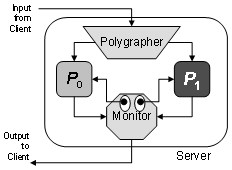
Figure
1. N-Variant System
Framework.
|
Our work uses artificial diversity in a new way that does not
depend on keeping secrets: instead of diversifying individual systems, we construct
a single system containing multiple variants designed to have disjoint exploitation
sets. Figure 1 illustrates our framework. We refer to the entire server as an
N-variant system. The system shown is a 2-variant system, but our framework
generalizes to any number of variants. The polygrapher takes input from the
client and copies it to all the variants. The original server process P is replaced with the two variants, P0 and P1. The variants maintain the client-observable behavior
of P on all normal inputs. They are,
however, artificially diversified in a way that makes them behave differently
on abnormal inputs that correspond to an attack of a certain class. The monitor
observes the behavior of the variants to detect divergences which reveal
attacks. When a divergence is detected, the monitor restarts the variants in
known uncompromised states.
As a simple example, suppose P0
and P1 use disjoint memory
spaces such that any absolute memory address that is valid in P0 is invalid in P1, and vice versa. Since the
variants are transformed to provide the same semantics regardless of the memory
space used, the behavior on all normal inputs is identical (assuming
deterministic behavior, which we address in Section 5). However, if an exploit
uses an absolute memory address directly, it must be an invalid address on one
of the two variants. The monitor can easily detect the illegal memory access on
the other variant since it is detected automatically by the operating system.
When monitoring is done at the system call level, as in our prototype
implementation, the attack is detected before any external state is modified or
output is returned to the attacker.
The key insight behind our approach is that in order for an
attacker to exploit a vulnerability in P,
a pathway must exist on one of the variants that exploits the vulnerability
without producing detectably anomalous behavior on any of the other variants.
If no such pathway exists, there is no way for the attacker to construct a successful
attack, even if the attacker has complete knowledge of the variants. Removing
the need to keep secrets means we do not need to be concerned with probing or
guessing attacks, or even with attacks that take advantage of insider
information.
Our key contributions are:
1.
Introducing the N-variant systems framework that uses
automated diversity techniques to provide high assurance security properties
without needing to keep any secrets.
2.
Developing a model for reasoning about N‑variant
systems including the definition of the normal equivalence and detection properties
used to prove security properties of an ideal N‑variant system (Section
3).
3.
Identifying two example techniques for providing
variation in N-variant systems: the memory address partitioning technique (introduced
above) that detects attacks that involve absolute memory references and the
instruction tagging technique that detects attempts to execute injected code
(Section 4).
4.
Describing a Linux kernel system implementation and
analyzing its performance (Section 5).
In this paper we do not address recovery but consider it to be a
successful outcome when our system transforms an attack that could compromise
privacy and integrity into an attack that at worst causes a service shutdown
that denies service to legitimate users. It has not escaped our attention,
however, that examining differences between the states of the two variants at
the point when an attack is detected provides some intriguing recovery
possibilities. Section 6 speculates on
these opportunities and other possible extensions to our work.
2. Related Work
There has been extensive work done on eliminating security
vulnerabilities and mitigating attacks.
Here, we briefly describe previous work on other types of defenses and
automated diversity, and summarize related work on redundant processing and
design diversity frameworks.
Other defenses.
Many of the specific vulnerabilities we address have well known
elimination, mitigation and disruption techniques. Buffer overflows have been
widely studied and numerous defenses have been developed including static
analysis to detect and eliminate the vulnerabilities [66, 67, 39, 23],
program transformation and dynamic detection techniques [19, 5, 30, 45, 49, 57]
and hardware modifications [38, 40, 41, 64]. There have also
been several defenses proposed for string format vulnerabilities [56, 20, 63, 47]. Some of these techniques can mitigate
specific classes of vulnerabilities with less expense and performance overhead
than is required for our approach. Specific defenses, however, only prevent a
limited class of specific vulnerabilities. Our approach is more general; it can
mitigate all attacks that depend on particular functionality such as injecting
code or accessing absolute addresses.
More general defenses have been proposed for some attack
classes. For example, no execute pages
(as provided by OpenBSD’s W^X and Windows XP Service Pack 2) prevent many code
injection attacks [2], dynamic taint analysis tracks information flow to
identify memory corruption attacks [43], and control-flow integrity can detect
attacks that corrupt an application to follow invalid execution paths [1].
Although these are promising approaches, they are limited to particular attack
classes. Our framework is more general in the sense that we can construct
defense against any attacker capability that can be varied across variants in
an N‑variant system.
Automated diversity. Automated diversity applies transformations
to software to increase the difficulty an attacker will face in exploiting a
security vulnerability in that software.
Numerous transformation techniques have been proposed including rearranging
memory [26, 8, 69, 25], randomizing system calls [17], and
randomizing the instruction set [6, 35]. Our work is complementary to
work on producing diversity; we can incorporate many different sources of
variation as long as variants are constructed carefully to ensure the disjointedness
required by our framework. A major advantage of the N-variant systems approach
is that we do not rely on secrets for our security properties. This means we
can employ diversification techniques with low entropy, so long as the transformations
are able to produce variants with disjoint exploitation sets. Holland,
Lim, and Seltzer propose many low entropy diversification techniques including
number representations, register sets, stack direction, and memory layout [31].
In addition, our approach is not vulnerable to the type of secret-breaking
attacks that have been demonstrated against secret-based diversity defenses
[55, 58, 64].
O’Donnell and Sethu studied techniques for distributing diversity
at the level of different software packages in a network to mitigate spreading
attacks [44]. This can limit the ability of a worm exploiting a vulnerability
present in only one of the software packages to spread on a network. Unlike our
approach, however, even at the network level an attacker who discovers
vulnerabilities in more than one of the software packages can exploit each of
them independently.
Redundant execution. The idea of using redundant program
executions for various purposes is not a new one. Architectures involving replicated processes
have been proposed as a means to aid debugging, to provide fault tolerance, to
improve dependability, and more recently, to harden vulnerable services against
attacks.
The earliest work to consider running multiple variants of a
process of which we are aware is Knowlton’s 1968 paper [37] on a variant technique
for detecting and localizing programming errors. It proposed simultaneously
executing two programs which were logically equivalent but assembled
differently by breaking the code into fragments, and then reordering the code
fragments and data segments with appropriate jump instructions inserted between
code fragments to preserve the original program semantics. The CPU could run in a checking mode that
would execute both programs in parallel and verify that they execute semantically
equivalent instructions. The variants
they used did not provide any guarantees, but provided a high probability of
detecting many programming errors such as out-of-range control transfers and
wild memory fetches.
More recently, Berger and Zorn proposed a redundant execution
framework with multiple replicas each with a different randomized layout of
objects within the heap to provide probabilistic memory safety [7]. Since there is no guarantee that there will
not be references at the same absolute locations, or reachable through the same
relative offsets, their approach can provide only probabilistic expectations
that a memory corruption will be detected by producing noticeably different
behavior on the variants. Their goals were to enhance reliability and availability,
rather than to detect and resist attacks. Consequently, when variations diverge
in their framework, they allow the agreeing replicas to continue based on the
assumption that the cause of the divergence in the other replicas was due a
memory flaw rather than a successful attack. Their replication framework only
handles processes whose I/O is through standard in/out, and only a limited
number of system calls are caught in user space to ensure all replicas see the same
values. Since monitoring is only on the
standard output, a compromised replica could be successfully performing an attack
and, as long as it does not fill up its standard out buffer, the monitor would
not notice. The key difference between their approach and ours, is that their
approach is probabilistic whereas our variants are constructed to guarantee disjointedness
with respect to some property, and thereby can provide guarantees of invulnerability
to particular attack classes. A possible extension to our work would consider
variations providing probabilistic protection, such as the heap randomization
technique they used, to deal with attack classes for which disjointedness is
infeasible.
Redundant processing of the same instruction stream by multiple
processors has been used as a way to provide fault-tolerance by Stratus [68]
and Tandem [32] computers. For example,
Integrity S2 used triple redundancy in hardware with three synchronized identical
processors executing the same instructions [32]. A majority voter selects the
majority output from the three processors, and a vote analyzer compares the outputs
to activate a failure mode when a divergence is detected. This type of
redundancy provides resilience to hardware faults, but no protection against
malicious attacks that exploit vulnerabilities in the software, which is identical
on all three processors. Slipstream
processors are an interesting variation of this, where two redundant versions
of the instruction stream execute, but instructions that are dynamically
determined to be likely to be unnecessary are removed from the first stream
which executes speculatively [60]. The
second stream executes behind the first stream, and the processor detects inconsistencies
between the two executions. These deviations
either indicate false predications about unnecessary computations (such as a mispredicted
branch) or hardware faults.
The distributed systems community has used active replication to
achieve fault tolerance [9, 10, 16, 18, 50]. With
active replication, all replicas are running the same software and process the
same requests. Unlike our approach, however, active replication does nothing to
hide design flaws in the software since all replicas are running the same software.
To mitigate this problem, Schneider and Zhou have suggested proactive
diversity, a technique for periodically randomizing replicas to justify the
assumption that server replicas fail independently and to limit the window of
vulnerability in which replicas are susceptible to the same exploit [51].
Active replication and N-variant systems are complementary approaches. Combining
them can provide the benefits of both approaches with the overhead and costs
associated with either approach independently.
Design diversity
frameworks. The name N-variant systems
is inspired by, but fundamentally different from, the technique known as N-version programming [3, 14]. The
N-version programming method uses several independent development groups to
develop different implementations of the same specification with the hope that
different development groups will produce versions without common faults. The
use of N-version programming to help with system security was proposed by Joseph
[33]. He analyzed design diversity as manifest in N-version programming to see
whether it could defeat certain attacks and developed an analogy between faults
in computing systems that might affect reliability and vulnerabilities in
computer systems that might affect security. He argued that N-version
programming techniques might allow vulnerabilities to be masked. However, N-version programming provides no
guarantee that the versions produced by different teams will not have common
flaws. Indeed, experiments have shown that common flaws in implementations do
occur [36]. In our work, program variants are created by mechanical
transformations engineered specifically to differ in particular ways that enable
attack detection. In addition, our variants are produced mechanically, so the
cost of multiple development teams is avoided.
Three recent projects [46, 62, 28] have explored
using design diversity in architectures similar to the one we propose here in
which the outputs or behaviors of two diverse implementations of the same
service (e.g., HTTP servers Apache on Linux and IIS on Windows) are compared
and differences above a set threshold indicate a likely attack. The key
difference between those projects and our work is that whereas they use diverse
available implementations of the same service, we use techniques to
artificially produce specific kinds of variation. The HACQIT project [34, 46]
deployed two COTS web servers (IIS running on Windows and Apache running on
Linux) in an architecture where a third computer forwarded all requests to both
servers and compared their responses. A divergence was detected when the HTTP
status code differed, hence divergences that caused the servers to modify
external state differently or produce different output pages would not be detected.
The system described by Totel, Majorczyk, and Mé extended this idea to compare
the actual web page responses of the two servers [62]. Since different servers
do not produce exactly the same output on all non-attack requests because of
nondeterminism, design differences in the servers, and host-specific
properties, they developed an algorithm that compares a set of server responses
to determine which divergences are likely to correspond to attacks and which
are benign. The system proposed by Gao, Reiter, and Song [28] deployed multiple
servers in a similar way, but monitored their behavior using a distance metric
that examined the sequence of system calls each server made to determine when
the server behaviors diverged beyond a threshold amount.
All of these systems use multiple available implementations of
the same service running on isolated machines and compare the output or aspects
of the behavior to notice when the servers diverged. They differ in their
system architectures and in how divergences are recognized. The primary
advantage of our work over these approaches is the level of assurance automated
diversity and monitoring can provide over design diversity. Because our system
takes advantage of knowing exactly how the variants differ, we can make
security claims about large attack classes. With design diversity, security
claims depend on the implementations being sufficiently different to diverge
noticeably on the attack (and functionality claims depend on the behaviors
being sufficiently similar not exceed the divergence threshold on non-attack
inputs). In addition, these approaches can be used only when diverse implementations
of the same service are available. For HTTP servers, this is the case, but for
custom servers the costs of producing a diverse implementation are prohibitive
in most cases. Further, even though many HTTP servers exist, most advanced
websites take advantages of server-specific functionality (such as server-side
includes provided by Apache), so would not work on an alternate server. Design
diversity approaches offer the advantage that they may be able to detect attacks
that are at the level of application semantics rather than low-level memory corruption
or code injection attacks that are better detected by artificial diversity. In
Section 6, we consider possible extensions to our work that would combine both
approaches to provide defenses against both types of attacks.
3. Model
Our goal is to show that for all attacks in a particular attack
class, if one variant is compromised by a given attack, another variant must
exhibit divergent behavior that is detected by the monitor. To show this, we develop
a model of execution for an N-variant system and define two properties the
variant processes must maintain to provide a detection guarantee.
We can view an execution as a possibly infinite sequence of
states: [S0, S1, …]. In an N-variant
system, the state of the system can be represented using a tuple of the states
of the variants (for simplicity, this
argument assumes the polygrapher and monitor are stateless; in our
implementation, they do maintain some state but we ignore that in this presentation).
Hence, an execution of an N-variant system is a sequence of state-tuples where St,v represents the state of variant v at step t: [<S0,0, S0,1, … S0,N-1>, <S1,0, S1,1,
… S1,N-1>, … ].
Because of the artificial variation,
the concrete state of each variant differs. Each variant has a canonicalization function, Cv, that maps its state to a
canonical state that matches the corresponding state for the original process.
For example, if the variation alters memory addresses, the mapping function
would need to map the variant’s altered addresses to canonical addresses. Under
normal execution, at every execution step the canonicalized states of all
variants are identical to the original program state:
forall t ≥ 0, 0 ≤ v < N, 0 ≤
w < N:
Cv
(St, v) = Cw (St, w) = St.
Each variant has a transition
function, Tv, that
takes a state and an input and produces the next state. The original program, P, also has a transition function, T. The set of possible transitions can
be partitioned into consistent
transitions and aberrant transitions.
Consistent transitions take the system from one normal state to another normal
state; aberrant transitions take the system from a normal state to a compromised
state. An attack is successful if it produces an aberrant transition without detection.
Our goal is to detect all aberrant transitions.
We partition possible variant states into three sets: normal, compromised, and alarm. A
variant in a normal state is behaving as intended. A variant in a compromised
state has been successfully compromised by a malicious attack. A variant in an
alarm state is anomalous in a way that is detectable by the monitor. We aim to
guarantee that the N-variant system never enters a state-tuple that contains
one or more variants in comprised states without any variants in alarm states.
To establish this we need two properties: normal
equivalence and detection.
Normal equivalence.
The normal equivalence property is satisfied if the N-variant system
synchronizes the states of all variants. That is, whenever all variants are in
normal states, they must be in states that correspond to the same canonical
state. For security, it is sufficient to show the variants remain in equivalent
states. For correctness, we would also like to know the canonical state of each
of the variants is equivalent to the state of the original process.
We can prove the normal equivalence
property statically using induction:
1.
Show that initially all variants are in the same canonical
state: forall 0 ≤ v < N: Ci (S0, v) = S0.
2.
Show that every normal transition preserves the
equivalence when the system is initially in a normal state:
forall S in Normal, 0 ≤ v < N,
Sv where Cv (Sv)
= S, p in Inputs:
Cv (Tv (Sv, p)) = T (S,
p).
Alternatively, we can establish it dynamically by examining the
states of the variants and using the canonicalization function to check the
variants are in equivalent states after every step. In practice, neither a full
static proof nor a complete dynamic comparison is likely to be feasible for
real systems. Instead, we argue that our implementation provides a limited form
of normal equivalence using a combination of static argument and limited
dynamic comparison, as we discuss in Section 5.
Detection.
The detection property guarantees that all attacks in a certain class will
be detected by the N‑variant system as long as the normal equivalence
property is satisfied. To establish the detection property, we need to know
that any input that causes one variant to enter a compromised state must also
cause some other variant to enter an alarm state. Because of the normal
equivalence property, we can assume the variants all are in equivalent states
before processing this input. Thus, we need to show:
forall S in Normal, 0 ≤ v < N,
Sv where
Cv(Sv) =
S,
p in Inputs:
Tv
(Sv, p) in Compromised implies
there exists w such that Tw
(Sw, p) is in Alarm and
Cw(Sw) =
S.
If the detection property is established, we know that whenever
one of the variants enters a compromised state, one of the variants must enter
an alarm state. An ideal monitor would instantly detect the alarm state and
prevent all the other variants from continuing. This would guarantee that the
system never operates in a state in which any variant is compromised.
In practice, building such a monitor is impossible since we
cannot keep the variants perfectly synchronized or detect alarm states
instantly. However, we can approximate this behavior by delaying any external
effects (including responses to the client) until all variants have passed a
critical point. This keeps the variants loosely synchronized, and approximates
the behavior of instantly terminating all other variants when one variant
encounters an alarm state. It leaves open the possibility that a compromised
variant could corrupt the state of other parts of the system (including the
monitor and other variants) before the alarm state is detected. An
implementation must use isolation mechanisms to limit this possibility.
4. Variations
Our framework works with any diversification technique that
produces variants different enough to provide detection of a class of attack
but similar enough to establish a normal equivalence property. The variation
used to diversify the variants determines the attack class the N-variant system
can detect. The detection property is defined by the class of attack we detect,
so we will consider attack classes, such as attacks that involve executing
injected instructions, rather than vulnerability classes such as buffer
overflow vulnerabilities.
Next, we describe two variations we have implemented: address
space partitioning and instruction set tagging. We argue (informally) that they
satisfy both the normal equivalence property and the detection condition for
important classes of attacks. The framework is general enough to support many
other possible variations, which we plan to explore in future work. Other
possible variations that could provide useful security properties include
varying memory organization, file naming, scheduling, system calls, calling
conventions, configuration properties, and the root user id.
4.1 Address Space Partitioning
The Introduction described an example variation where the address
space is partitioned between two variants to disrupt attacks that rely on
absolute addresses. This simple variation does not prevent all memory
corruption attacks since some attacks depend only on relative addressing, but
it does prevent all memory corruption attacks that involve direct references
to absolute addresses. Several common vulnerabilities including format string
[56, 54], integer overflow, and double-free [24] may allow an attacker to
overwrite an absolute location in the target’s address space. This
opportunity can be exploited to give an attacker control of a process, for
example, by modifying the Global Offset Table [24] or the .dtors
segment of an ELF executable [48].
Regardless of the vulnerability exploited and the targeted data structure, if
the attack depends on loading or storing to an absolute address it will be
detected by our partitioning variants. Since the variation alters absolute
addresses, it is necessary that the original program does not depend on actual
memory addresses (for example, using the value of a pointer directly in a
decision). Although it is easy to construct programs that do not satisfy this
property, most sensible programs should not depend on actual memory addresses.
Detection. Suppose P0 only uses addresses whose
high bit is 0 and P1 only
uses addresses whose high bit is 1. We can map the normal state of P0 and P1 to equivalent states using the identity function for C0 and a function that flips
the high bit of all memory addresses for C1
(to map onto the actual addresses used by P,
more complex mapping functions may be needed). The transition functions, T0 and T1 are identical; the generated code is what makes
things different since a different address will be referenced in the generated
code for any absolute address reference. If an attack involves referencing an
absolute address, the attacker must choose an address whose high bit is either
a 0 or 1. If it is a 0, then P0
may transition to a compromised state, but P1
will transition to an alarm state when it attempts to access a memory address
outside P1’s address
space. In Unix systems, this alarm state is detected by the operating system as
a segmentation fault. Conversely, if the attacker chooses an address whose high
bit is 1, P1 may be compromised
but P0 must enter an alarm
state. In either case, the monitor detects the compromise and prevents any external
state modifications including output transmission to the client.
Our detection argument relies on the assumption that the attacker
must construct the entire address directly. For most scenarios, this assumption
is likely to be valid. For certain vulnerabilities on platforms that are not
byte-aligned, however, it may not be. If the attacker is able to overwrite an
existing address in the program without overwriting the high bit, the attacker
may be able to construct an address that is valid in both variants. Similarly,
if an attacker can corrupt a value that is subsequently used with a transformed
absolute address in an address calculation, the detection property is violated.
As with relative attacks, this indirect memory attacks would not be detected by
this variation.
Normal equivalence. We
have two options for establishing the normal equivalence property: we can check
it dynamically using the monitor, or we can prove it statically by analyzing
the variants. A pure dynamic approach is attractive for security assurance
because of its simplicity but impractical for performance-critical servers. The
monitor would need to implement C0
and C1 and compute
the canonical states of each variant at the end of each instruction execution.
If the states match, normal equivalence is satisfied. In practice, however,
this approach is likely to be prohibitively expensive. We can optimize the
check by limiting the comparison to the subset of the execution state that may
have changed and only checking the state after particular instructions, but the
overhead of checking the states of the variants after every step will still be
unacceptable for most services.
The static approach requires proving that for every possible
normal state, all normal transitions result in equivalent states on the two variants.
This property requires that no instruction in P can distinguish between the two variants. For example, if there
were a conditional jump in P that
depended on the high bit of the address of some variable, P0 and P1
would end up in different states after executing that instruction. An attacker
could take advantage of such an opportunity to get the variants in different
states such that an input that transitions P0
to a compromised state does not cause P1
to reach an alarm state. For example, if the divergence is used to put P0 in a state where the next
client input will be passed to a vulnerable string format call, but the next
client input to P1 is
processed harmlessly by some other code, an attacker may be able to
successfully compromise the N-variant system. A divergence could also occur if
some part of the system is nondeterministic, and the operating environment does
not eliminate this nondeterminism (see Section 5). Finally, if P is vulnerable to some other class of attack,
such as code injection, an attacker may be able to alter the transition
functions T0 and T1 in a way that allows the
memory corruption attack to be exploited differently on the two variants to
avoid detection (of course, an attacker who can inject code can already
compromise the system in arbitrary ways).
In practice, it will not usually be possible to completely
establish normal equivalence statically for real systems but rather we will use
a combination of static and dynamic arguments, along with assumptions about the
target service. A combination of static and dynamic techniques for checking
equivalence may be able to provide higher assurance without the overhead necessary
for full dynamic equivalence checking. Our prototype implementation checks
equivalence dynamically at the level of system calls, but relies on informal
static arguments to establish equivalence between them.
Implementation. To
partition the address space, we vary the location of the application data and
code segments. The memory addresses used by P0
and P1 are disjoint: any
data address that is valid for P0
is invalid for P1, and
vice versa. We use a linker script to create the two variants. Each variant loads both the code and data
segments of the variants at different starting addresses from the other variant.
To ensure that their sets of valid data memory addresses are disjoint, we use ulimit to limit the size
of P0’s data segment so it
cannot grow to overlap P1’s
address space.
4.2 Instruction Set Tagging
Whereas partitioning the memory address space disrupts a class of
memory corruption attacks, partitioning the instruction set disrupts code
injection attacks. There are several possible ways to partition the instruction
set.
One possibility would be to execute the variants on different
processors, for example one variant could run on an x86 and the other on a
PowerPC. Establishing the security of such an approach would be very difficult,
however. To obtain the normal equivalence property we would need a way of
mapping the concrete states of the different machines to a common state. Worse,
to obtain the detection property, we would need to prove that no string of bits
that corresponds to a successful malicious attack on one instruction set and a
valid instruction sequence on the other instruction set. Although it is likely
that most sequences of malicious x86 instructions contain an invalid PowerPC
instruction, it is certainly possible for attackers to design instruction
sequences that are valid on both platforms (although we are not aware of any
programs that do this for the x86 and PowerPC, Sjoerd Mullender and Robbert van Renesse won the 1984 International Obfuscated
C Code Contest with an entry that replaced main with an array of bytes that was
valid machine code for both the Vax and PDP-11 but executed differently on each
platform [35]).
Instead, we use a single instruction set but prepend a
variant-specific tag to all instructions. The diversification transformation
takes P and inserts the appropriate
tag bit before each instruction to produce each variant.
Detection. The
variation detects any attack that involves executing injected code, as long as
the mechanism used to inject code involves injecting complete instructions. If
memory is bit-addressable, an attacker could overwrite just the part of the
instruction after the tag bit, thereby changing an existing instruction while
preserving the original tag bit. If the attacker can inject the intended code
in memory, and then have the program execute code already in the executable
that transforms the injected memory (for example, by XORing each byte with a
constant that is different in the two variants), then it is conceivable that an
attacker could execute an indirect code injection attack where the code is
transformed differently on the two variants before executing to evade the
detection property. For all known realistic code injection attacks, neither of
these is considered a serious risk.
Normal equivalence.
The only difference between the two variants is the instruction tag, which has
no effect on instruction execution. The variants could diverge, however, if the
program examines its own instructions and makes decisions that depend on the
tag. It is unlikely that a non-malicious program would do this. As with the
memory partitioning, if the instruction tags are visible to the executing
process an attacker might be able to make them execute code that depends on the
instruction tags to cause the variants to diverge before launching the code
injection attack on one of the variants. To prevent this, we need to store the
tagged instructions in memory that is not readable to the executing process and
remove the tags before those instructions reach the processor.
Implementation. To
implement instruction set tagging, we use a combination of binary rewriting
before execution and software dynamic translation during execution. We use
Diablo [61, 22], a retargetable binary rewriting framework, to insert the
tags. Diablo provides mechanisms for modifying an x86 binary in ELF format. We
use these to insert the appropriate variant-specific tag before every
instruction. For simplicity, we use a full byte tag even though a single bit
would suffice for two variants. There is no need to keep the tags secret, just
that they are different; we use 10101010 and 01010101 for the A and B variant tags.
At run-time, the tags are checked and removed before instructions
reach the processor. This is done using Strata, a software dynamic translation
tool [52, 53]. Strata and other software dynamic translators [4, 11]
have demonstrated that it is possible to implement software dynamic translation
without unreasonable performance penalty. In our experiments (Section 5),
Strata’s overhead is only a few percent. The Strata VM mediates application
execution by examining and translating instructions before they execute on the
host CPU. Translated instructions are placed in the fragment cache and then
executed directly on the host CPU. Before switching to the application code,
the Strata VM uses mprotect to
protect critical data structures including the fragment cache from being
overwritten by the application. At the end of a translated block, Strata appends
trampoline code that will switch execution back to the Strata VM, passing in
the next application PC so that the next fragment can be translated and
execution will continue. We implement the instruction set tagging by extending
Strata’s instruction fetch module. The modified instruction fetch module checks
that the fetched instruction has the correct tag for this variant; if it does
not, a security violation is detected and execution terminates. Otherwise, it
removes the instruction tag before placing the actual instruction in the fragment
cache. The code executing on the host processor contains no tags and can
execute normally.
5. Framework
Implementation
Implementing an N-variant system involves generating variants
such as those described in Section 4 as well as implementing the polygrapher
and monitor. The trusted computing base comprises the polygrapher, monitor and
mechanisms used to produce the variants, as well as any operating system
functionality that is common across the variants. An overriding constraint on
our design is that it be fully automated. Any technique that requires manual
modification of the server to create variants or application-specific
monitoring would impose too large a deployment burden to be used widely. To
enable rapid development, our implementations are entirely in software. Hardware
implementations would have security and performance advantages, especially
in monitoring the instruction tags. Furthermore, placing monitoring as close as
possible to the processor eliminates the risk that an attacker can exploit a
vulnerability in the monitoring mechanism to inject instructions between the
enforcement mechanism and the processor.
The design space for N-variant systems implementations presents a
challenging trade-off between isolation of the variants, polygrapher, and
monitor and the need to keep the variant processes synchronized enough to
establish the normal equivalence property. The other main design decision is
the granularity of the monitoring. Ideally, the complete state of each variant
would be inspected after each instruction. For performance reasons, however, we
can only observe aspects of the state at key execution points. Incomplete monitoring means that an attacker
may be able to exploit a different vulnerability in the server to violate the
normal equivalence property, thereby enabling an attack that would have
otherwise been detected to be carried out without detection. For example, an
attacker could exploit a race condition in the server to make the variants
diverge in ways that are not detected by the monitor. Once the variants have
diverged, the attacker can construct an input that exploits the vulnerability
in one variant, but does not produce the detected alarm state on the other
variants because they started from different states.
In our first proof-of-concept implementation, described in
Section 5.1, we emphasized isolation and executed the variants on separate machines.
This meant that any nondeterminism in the server program or aspects of the host
state visible to the server program that differed between the machines could be
exploited by an attacker to cause the processes to diverge and then allow a successful
attack. It also meant the monitor only observed the outputs produced by the two
variants that would be sent over the network. This enabled certain attacks to
be detected, but meant a motivated attacker could cause the states to diverge
in ways that were not visible from the output (such as corrupting server data) but
still achieved the attacker’s goals.
Our experience with this implementation led us to conclude that a
general N-variant systems framework needed closer integration of the variant
processes to prevent arbitrary divergences. We developed such a framework as a
kernel modification that allows multiple variants to run on the same platform
and normal equivalence to be established at system call granularity. This
eliminates most causes of nondeterminism and improves the performance of the
overall system. Section 5.2 describes our Linux kernel implementation, and
Section 5.3 presents performance results running Apache variants on our system.
5.1 Proof-of-Concept Implementation
In our proof-of-concept implementation, the variants are isolated
on separate machines and the polygrapher and monitor are both implemented by
the nvd process running on
its own machine. We used our implementation to protect both a toy server we
constructed and Apache. In order for our approach to work in practice it is
essential that no manual modification to the server source code is necessary.
Hence, each server variant must execute in a context where it appears to be
interacting normally with the client. We accomplish this by using divert
sockets to give each variant the illusion that it is interacting directly with
a normal client. To implement the polygrapher we use ipfw,
a firewall implementation for FreeBSD [27] with a rule that redirects packets
on port 80 (HTTP server) to our nvd
process which adjusts the TCP sequence numbers to be consistent with the
variant’s numbering. Instead of sending responses directly to the client, the
variant’s responses are diverted back to nvd,
which buffers the responses from all of the variants. The responses from P0 are transmitted back to
the client only if a comparably long response is also received from the other
variants. Hence, if any variant crashes on a client input, the response is
never sent to the client and nvd
restarts the server in a known uncompromised state.
We tested our system by using it to protect a toy server we
constructed with a simple vulnerability and Apache, and attempted to compromise
those servers using previously known exploits as well as constructed exploits
designed to attack a particular variant. Exploit testing does not provide any
guarantees of the security of our system, of course, but it does demonstrate
that the correct behavior happens under the tested conditions to increase our
confidence in our approach and implementation. Our toy server contained a
contrived format string vulnerability, and we developed an exploit that used
that vulnerability to write to an arbitrary memory address. The exploit could
be customized to work against either variation, but against the N-variant
system both versions would lead to one of the variants crashing. The monitor
detects the crash and prevents compromised outputs from reaching the client. We
also tested an Apache server containing a vulnerable OpenSSL implementation (before
0.9.6e) that contained a buffer overflow vulnerability that a remote attacker
could exploit to inject code [13]. When instruction set tagging is used, the
exploit is disrupted since it does not contain the proper instruction tags in
the injected code.
We also conducted some performance measurements on our 2-variant
system with memory address partitioning. The average response latency for HTTP
requests increased from 0.2ms for the unmodified server to 2.9ms for the
2-variant system.
The proof-of-concept implementation validated the N-variant
systems framework concept, but did not provide a practical or secure implementation
for realistic services. Due to isolation of the variants, various non-attack
inputs could lead to divergences between the variants caused by differences
between the hosts. For example, if the output web page includes a time stamp or
host IP address, these would differ between the variants. This means false
positives could occur when the monitor observes differences between the
outputs for normal requests. Furthermore, a motivated attacker could take advantage
of any of these differences to construct an attack that would compromise one of
the variants without leading to a detected divergence.
5.2 Kernel Implementation
The difficulties in eliminating nondeterminism and providing
finer grain monitoring with the isolated implementation, as well as its performance
results, convinced us to develop a kernel implementation of the framework by
modifying the Linux 2.6.11 kernel. In this implementation, all the variants run
on the same platform, along with the polygrapher and monitor. We rely on
existing operating system mechanisms to provide isolation between the variants,
which execute as separate processes.
We modified the kernel data structures to keep track of variant
processes and implemented wrappers around system calls. These wrappers
implement the polygraphing functionality by wrapping input system calls so that
when both variants make the same input system call, the actual input operation
is performed once and the same data is sent to all variants. They provide the
monitoring functionality by checking that all variants make the same call with
equivalent arguments before making the actual system call.
This system call sharing approach removes nearly all of the
causes of nondeterminism that were problematic in the proof-of-concept implementation.
By wrapping the system calls, we ensure that variants receive identical results
from all system calls. The remaining cause of nondeterminism is due to
scheduling differences, in particular in handling signals. We discuss these
limitations in Section 6.
|
ssize_t sys_read(int fd, const void *buf, size_t
count) {
if (!hasSibling
(current)) { make system
call normally } // not a variant process
else {
record
that this variant process entered call
if
(!inSystemCall (current->sibling)) { //
this variant is first
save
parameters
sleep
// sibling will wake us up
get
result and copy *buf data back into address space
return result;
} else if (currentSystemCall (current->sibling) == SYS_READ) { // this variant is second, sibling waiting
if
(parameters match) { // what it means
to “match” depends on variation and system call
perform system call
save result and data in kernel buffer
wake up sibling
return result;
}
else { DIVERGENCE ERROR! } // sibling
used different parameters
} else { DIVERGENCE ERROR! } } } // sibling is in a different system call
Figure 2. Typical
shared system call wrapper.
|
In order to bring an N-variant system into execution we created
two new system calls: n_variant_fork,
and n_variant_execve. The
program uses these system calls similarly to the way a shell uses fork/execve
to bring processes into execution. The n_variant_fork
system call forks off the variants, however instead of creating a single child
process it creates one process per variant. The variants then proceed to call n_variant_execve, which
will cause each of the variants to execute their own diversified binary of the
server. Note that our approach requires no modification of an existing binary
to execute it within an N-variant system; we simply invoke a shell command that
takes the pathnames of variant binaries as parameters and executes n_variant_execve.
Next, we provide details on the system call wrappers that
implement the polygraphing and monitoring. The Linux 2.6.11 kernel provides 267
system calls. We generalize them into three categories based on the type of
wrapper they need: shared system calls, reflective system calls, and dangerous
system calls.
Shared System Calls. For system calls that interact with external state, including I/O system
calls, the wrapper checks that all variants make equivalent calls, makes the
actual call once, and sends the output to all variants, copying data
into each of the variants address space if necessary. Figure 2 shows pseudocode
for a shared call, in this case the read
system call. The actual wrappers are generated using a set of preprocessor macros
we developed to avoid duplicating code. The first if
statement checks whether this process is part of an N‑variant system. If
not, the system call proceeds normally. Hence, a single platform can run both
normal and N-variant processes. If the process is a variant process, it records
that it has entered this system call and checks if its sibling variant has
already entered a system call. If it has not, it saves the parameters and
sleeps until the other variant wakes it up. Otherwise, it checks that the
system call and its parameters match those used by the first variant to make
the system call. If they match, the actual system call is made. The result is
copied into a kernel buffer, and the sibling variant process (which reached
this system call first and went to sleep) is awoken. The sibling process copies
the result from the kernel buffer back into its address space and continues
execution.
Reflective System Calls. We consider any system call that observes or modifies properties of the
process itself a reflective system
call. For these calls, we need to ensure that all observations always return
the same value regardless of which variant reaches the call first, and that all
modifications to process properties are done equivalently on all variants. For
observation-only reflective calls, such as getpid, we check that all variants make the same
call, and then just make the call once for variant 0 and send the same result
to all variants. This is done using wrappers similar to those for shared system
calls, except instead of just allowing the last variant that reaches the call
to make the actual system call we need to make sure that each time a reflective
call is reached, it is executed for the same process.
Another issue is raised by the system calls that create child processes
(sys_fork, sys_vfork, and sys_clone). The wrappers for these calls must coordinate
each variant’s fork and set up all the child processes as a child N‑variant
system before any of the children are placed on the run queue. These system
calls return the child process’ PID. We ensure that all the parents in the N‑variant
system get the same PID (the PID of variant 0’s child), as with the process
observation system calls.
The other type of
reflective system call acts on the process itself. These system calls
often take parameters given by the reflective observation system calls. In
this case, we make sure they make the same call with the same parameters, but
alter the parameters accordingly for each variant. For example, sys_wait4 takes a PID as
an input. Each of the variants will call sys_wait4
with the same PID because they were all given the same child PID when they
called sys_fork (as was
required to maintain normal equivalence). However, each variant needs to clean
up its corresponding child process within the child system. The wrapper for sys_wait4 modifies the
PID value passed in and makes the appropriate call for each variant with its
corresponding child PID. Similar issues arise with sys_kill,
sys_tkill, and sys_waitpid.
Finally, we have to deal with two system calls that terminate a
process: sys_exit and sys_exit_group. A terminating
process does not necessarily go through these system calls, since it may
terminate by crashing. To ensure that we capture all process termination events
in an N-variant system we added a monitor inside the do_exit
function within the kernel which is the last function all terminating processes
execute. This way, if a process receives a signal and exits without going
through a system call, we will still observe this and can terminate the other
variants.
Dangerous System Calls.
Certain calls would allow processes to break assumptions on which we rely. For
example, if the process uses the execve
system to run a new executable, this will escape the N-variant protections unless
we can ensure that each variant executes a different executable that is
diversified appropriately. Since it is unlikely we can establish this property,
the execve wrapper just
disables the system call and returns an error code. This did not pose problems
for Apache, but might for other applications.
Other examples of dangerous system calls are those for memory
mapping (old_mmap, sys_mmap2) which map a
portion of a file into a process’ address space. After a file is mapped into an
address space, memory reads and writes are analogous to reads and writes from
the file. This would allow an attacker to compromise one variant, and then use
the compromised variant to alter the state of the uncompromised variants
through the shared memory without detection, since no system call is necessary.
Since many server applications (including Apache) use memory mapping, simply
blocking these system calls is not an option. Instead, we place restrictions on
them to allow only the MAP_ANONYMOUS
and MAP_PRIVATE options with
all permissions and to permit MAP_SHARED
mappings as long as write permissions are not requested. This eliminates the communication channel
between the variants, allowing memory mapping to be used safely by the variants.
Apache runs even with these restrictions since it does not use other forms of
memory mapping, but other solutions would be needed to support all services.
5.3 Performance
Table 1 summarizes our performance results. We measured the
throughput and latency of our system using WebBench 5.0 [65], a web server
benchmark using a variety of static web page requests. We ran two sets of
experiments measuring the performance of our Apache server under unsaturated
and saturated load conditions. In both
sets, there was a single 2.2GHz Pentium 4 server machine with 1GB RAM running
Fedora Core 3 (2.6.11 kernel) in the six different configurations shown in
Table 1. For the first set of experiences, we used a single client machine
running one WebBench client engine. For the load experiments, we saturated our
server using six clients each running five WebBench client engines connected to
the same networks switch as the server.
|
Configuration
|
1
|
2
|
3
|
4
|
5
|
6
|
|
Description
|
Unmodified Apache, unmodified kernel
|
Unmodified Apache, N‑variant kernel
|
2-variant system, address partitioning
|
Apache running under Strata
|
Apache with instruction tags
|
2-variant system, instruction tags
|
|
Unsaturated
|
Throughput (MB/s)
|
2.36
|
2.32
|
2.04
|
2.27
|
2.25
|
1.80
|
|
Latency (ms)
|
2.35
|
2.40
|
2.77
|
2.42
|
2.46
|
3.02
|
|
Saturated
|
Throughput (MB/s)
|
9.70
|
9.59
|
5.06
|
8.54
|
8.30
|
3.55
|
|
Latency (ms)
|
17.65
|
17.80
|
34.20
|
20.30
|
20.58
|
48.30
|
Table 1. Performance Results.
Configuration 1 is the baseline configuration: regular apache
running on an unmodified kernel. Configuration 2 shows the overhead of the
N-variant kernel on a normal process. In our experiments, it was negligible;
this is unsurprising since the overhead is only a simple comparison at the
beginning of each wrapped system call. Configuration 3 is a 2-variant
system running in our N-variant framework where the two variants differ in the
address spaces according to the partitioning scheme described in Section 4.1. For
the unloaded server, the latency observed by the client increases by 17.6%. For
the loaded server, the throughput decreases by 48% and the latency nearly
doubles compared to the baseline configuration. Since the N-variant system
executes all computation twice, but all I/O system calls only once, the overhead
incurred reflects the cost of duplicating the computation, as well as the
checking done by the wrappers. The overhead measured for the unloaded server is
fairly low, since the process is primarily I/O bound; for the loaded server,
the process becomes more compute-bound, and the approximately halving of
throughput reflects the redundant computation required to run two variants.
The instruction tagging variation is more expensive because of
the added cost of removing and checking the instruction tags. Configuration 4
shows the performance of Apache running on the normal kernel under Strata with
no transformation. The overhead imposed by Strata reduces throughput by about
10%. The Strata overhead is relatively low because once a code fragment is in
the fragment cache it does not need to be translated again the next time it
executes. Adding the instruction tagging (Configuration 5) has minimal impact
on throughput and latency. Configuration
6 shows the performance of a 2-variant system where the variants are running
under Strata with instruction tag variation. The performance impact is more
than it was in Configuration 3 because of the additional CPU workload
imposed by the instruction tags. For the unloaded server, the latency increases
28% over the baseline configuration; for the saturated server, the throughput
is 37% of the unmodified server’s throughput.
Our results indicate that for I/O bound services, N-variant
systems where the variation can be achieved with reasonable performance overhead,
especially for variations such as the address space partitioning where little
additional work is needed at run-time. We anticipate there being many other
interesting variations of this type, such as file renaming, local memory
rearrangement, system call number diversity, and user id diversity. For
CPU-bound services, the overhead of our approach will remain relatively high
since all computation needs to be performed twice. Multiprocessors may alleviate
some of the problem (in cases where there is not enough load to keep the other
processors busy normally). Fortunately, many important services are largely
I/O-bound today and trends in processor and disk performance make this increasingly
likely in the future.
6. Discussion
Our prototype implementation illustrates the potential for
N-variant systems to protect vulnerable servers from important classes of
attacks. Many other issues remain to be explored, including how our approach
can be applied to other services, what variations can be created to detect
other classes of attacks, how an N-variant system can recover from a detected
attack, and how compositions of design and artificially diversified variants
can provide additional security properties.
Applicability.
Our prototype kernel implementation demonstrated the effectiveness of
our approach using Apache as a target application. Although Apache is a
representative server, there are a number of things other servers might
do that would cause problems for our implementation. The version of
Apache used in our experiments on uses the fork system call to create
separate processes to han-dle requests. Each child process is run as an
independent N-variant system. Some servers use user-level threading
libraries where there are multiple threads within a single process
invisible to our kernel monitor. This causes problems in an N variant
system, since the threads in the variants may interleave differently to
produce different sequences of system calls (resulting in a false
detection), or worse, interleave in a way that allows an attacker to
exploit a race condi-tion to carry out a successful attack without
detection. One possible solution to this problem is to modify the thread
scheduler to ensure that threads in the variants are scheduled
identically to preserve synchronization between the variants.
The asynchronous property of process signals makes it difficult
to ensure that all variants receive a signal at the exact same point in each of
their executions. Although we can ensure that a signal is sent to all the
variants at the same time, we cannot ensure that all the variants are exactly
at the same point within their program at that time. As a result, the timing of
a particular signal could cause divergent behavior in the variants if the code
behaves differently depending on the exact point when the signal is received.
This might cause the variants to diverge even though they are not under attack,
leading to a false positive detection. As with user-level threads, if we modify
the kernel to provide more control of the scheduler we could ensure that
variants receive signals at the same execution points.
Another issue that limits application of our approach is the use
of system calls we classified as dangerous such as execve
or unrestricted use of mmap.
With our current wrappers, a process that uses these calls is terminated since
we cannot handle them safely in the N-variant framework. In some cases, more
precise wrappers may allow these dangerous calls to be used safely in an N‑variant
system. Some calls, however, are inherently
dangerous since they either break isolation between the variants or allow them
to escape the framework. In these situations, either some loss of security
would need to be accepted, or the application would need to be modified to
avoid the dangerous system calls before it could be run as an N-variant system.
Other variations. The
variations we have implemented only thwart attacks that require accessing
absolute memory addresses or injecting code. For example, our current
instruction tagging variation does not disrupt a return-to-libc attack (since it does not involve injecting code),
and our address space partitioning variation provides no protection against
memory corruption attacks that only use relative addressing. One goal for our future
work is to devise variations that enable detection of larger classes of attack
within the framework we have developed. We believe there are rich opportunities
for incorporating different kinds of variation in our framework, although the
variants must be designed carefully to ensure the detection and normal
equivalence properties are satisfied.
Possibilities include variations involving memory layout to prevent
classes of relative addressing attacks, file system paths to disrupt attacks
that depend on file names, scheduling to thwart race condition attacks, and
data structure parameters to disrupt algorithmic complexity attacks [21].
Composition. Because
of the need to satisfy the normal equivalence property, we cannot simply
combine multiple variations into two variants to detect the union of their
attack classes. In fact, such a combination risks compromising the security
properties each variation would provide by itself. By combining variations more
carefully, however, we can compose variants in a way that maintains the
properties of the independent variations. To do this securely, we must ensure
that, for each attack class we wish to detect, there is a pair of variants in
the system that differs only in the transformation used to detect that attack
class. This is necessary to ensure that for each variation, there is a pair of
variants that satisfy the normal equivalence property for that variation but
differ in the varied property. This approach can generalize to compose n binary variations using n + 1 variants. More clever approaches
may be able to establish the orthogonality of certain variations to allow
fewer variants without sacrificing normal equivalence.
Another promising direction is to combine our approach with
design diversity approaches [46, 28, 62]. We could create a
3-variant system where two variants are Apache processes running on Linux hosts
with controlled address space partitioning variation, and the third variant is
a Windows machine running IIS. This would provide guaranteed detection of a
class of low-level memory attacks through the two controlled variants, as well
as probabilistic detection of attacks that exploit high-level application
semantics through the design variants.
Recovery. Our modified
kernel detects an attack when the system calls made by the variants diverge. At
this point, one variant is in an alarm state (e.g., crashed), and the other
variant is in a possibly compromised state. After detecting the attack, the
monitor needs to restart the service in an uncompromised state. Note that the
attack is always detected before any system call is executed for a compromised
process; this means no external state has been corrupted. For a stateless
server, the monitor can just restart all of the variants. For a stateful
server, recovery is more difficult. One interesting approach is to compare the
states of the variants after the attack is detected to determine the valid
state. Depending on the variation used, it may be possible to recover a known
uncompromised state from the state of the alarm variant, as well as to deduce
an attack signature from the differences between the two variants’ states.
Another approach involves adding an extra recovery
variant that maintains a known uncompromised state and can be used to
restart the other variants after an attack is detected. The recovery variant
could be the original P, except it
would be kept behind the normal variants. The polygrapher would delay sending
input to the recovery variant until all of the regular variants process it
successfully. This complicates the wrappers substantially, however, and raises
difficult questions about how far behind the recovery variant should be.
7. Conclusion
Although the cryptography community has developed techniques for
proving security properties of cryptographic protocols, similar levels of
assurance for system security properties remains an elusive goal. System
software is typically too complex to prove it has no vulnerabilities, even for
small, well-defined classes of vulnerabilities such as buffer overflows.
Previous techniques for thwarting exploits of vulnerabilities have used ad hoc
arguments and tests to support claimed security properties. Motivated
attackers, however, regularly find ways to successfully attack systems
protected using these techniques [12, 55, 58, 64].
Although many defenses are available for the particular attacks
we address in this paper, the N-variant systems approach offers the promise of
a more formal security argument against large attack classes and correspondingly
higher levels of assurance. If we can prove that the automated diversity
produces variants that satisfy both the normal equivalence and detection properties
against a particular attack class, we can have a high degree of confidence that
attacks in that class will be detected. The soundness of the argument depends
on correct behavior of the polygrapher, monitor, variant generator and any
common resources.
Our framework opens up exciting new opportunities for
diversification approaches, since it eliminates the need for high entropy
variations. By removing the reliance on keeping secrets and providing an
architectural and associated proof framework for establishing security properties,
N-variant systems offer potentially substantial gains in security for high
assurance services.
Availability
Our implementation is available as source code from http://www.nvariant.org. This website also provides
details on the different system call wrappers.
Acknowledgments
We thank Anil Somayaji for extensive comments
and suggestions; Lorenzo Cavallaro for help with the memory partitioning
scripts; Jessica Greer for assistance setting up our experimental infrastructure;
Caroline Cox, Karsten Nohl, Nate Paul, Jeff Shirley, Nora Sovarel, Sean Talts,
and Jinlin Yang for comments on the work and writing. This work was supported
in part by grants from the DARPA Self-Regenerative Systems Program
(FA8750-04-2-0246) and the National Science Foundation through NSF Cybertrust (CNS-0524432).
References
[1] Martin
Abadi, Mihai Budiu, Ulfar Erlingsson, and Jay Ligatti. Control-Flow
Integrity: Principles, Implementations, and Applications. CCS 2005.
[2] Starr Andersen. Changes to Functionality in
Microsoft Windows XP Service Pack 2: Part 3: Memory Protection Technologies. Microsoft TechNet. August 2004.
[3] Algirdas Avizienis and L. Chen. On the Implementation of N-version
Programming for Software Fault-Tolerance During Program Execution. International
Computer Software and Applications Conference. 1977.
[4] Vasanth Bala, E. Duesterwald, S. Banerjia. Dynamo:
A Transparent Dynamic Optimization System. ACM
Programming Language Design and Implementation (PLDI). 2000.
[5] Arash Baratloo, N. Singh, T. Tsai. Transparent
Run-Time Defense against Stack Smashing Attacks. USENIX Technical Conference. 2000.
[6] Elena Barrantes, D. Ackley, S. Forrest, T.
Palmer, D. Stefanovic, D. Zovi. Intrusion Detection: Randomized Instruction Set
Emulation to Disrupt Binary Code Injection Attacks. CCS 2003.
[7] Emery Berger and Benjamin Zorn. DieHard: Probabilistic Memory Safety for
Unsafe Languages. ACM Programming Language Design and Implementation (PLDI), June 2006.
[8] Sandeep Bhatkar, Daniel DuVarney, and R.
Sekar. Address Ofuscation: an
Efficient Approach to Combat a Broad Range of Memory Error Exploits. USENIX Security 2003.
[9] Kenneth Birman. Replication and Fault Tolerance
in the ISIS System. 10th ACM Symposium on Operating Systems Principles,
1985.
[10] K. Birman, Building
Secure and Reliable Network Applications, Manning Publications, 1996.
[11] Derek Bruening,
Timothy Garnett, Saman Amarasinghe. An Infrastructure for Adaptive Dynamic Optimization.
International Symposium on Code Generation
and Optimization. 2003.
[12] Bulba and Kil3r. Bypassing StackGuard and
StackShield. Phrack. Vol 0xa Issue
0x38. May 2000. http://www.phrack.org/phrack/56/p56-0x05
[13] CERT. OpenSSL
Servers Contain a Buffer Overflow During the SSL2 Handshake Process. CERT
Advisory CA-2002-23. July 2002.
[14] L. Chen and Algirdas Avizienis. N-Version Programming: A Fault Tolerance Approach
to Reliability of Software Operation. 8th International Symposium on Fault-Tolerant Computing.
1978.
[15] Shuo Chen, Jun Xu, Emre C. Sezer, Prachi
Gauriar, R. K. Iyer. Non-Control-Data Attacks Are Realistic Threats. USENIX Security 2005.
[16] Marc Chérèque, David Powell, Philippe
Reynier, Jean-Luc Richier, and Jacques Voiron. Active Replication in Delta-4. 22nd
International Symposium on Fault-Tolerant Computing. July 1992.
[17] Monica Chew and Dawn Song. Mitigating Buffer Overflows by Operating
System Randomization. Tech Report CMU-CS-02-197. December 2002.
[18] George Coulouris, Jean Dollimore and Tim Kindberg.
Distributed Systems: Concepts and Design
(Third Edition). Addison-Wesley. 2001.
[19] Crispin Cowan, C. Pu, D. Maier, H. Hinton, J.
Walpole, P. Bakke, S. Beattie, A. Grier, P. Wagle, and Q. Zhang. Stackguard:
Automatic Adaptive Detection and Prevention of Buffer-Overflow Attacks. USENIX Security 1998.
[20] C. Cowan, M. Barringer, S. Beattie, G.
Kroah-Hartman, M. Frantzen, and J. Lokier. FormatGuard: Automatic Protection
From printf Format String Vulnerabilities. USENIX
Security 2001.
[21] Scott Crosby and Dan Wallach. Denial of Service
via Algorithmic Complexity Attacks. USENIX Security 2003.
[22] Bruno De Bus, Bjorn De Sutter, Ludo Van Put,
D. Chanet, K. De Bosschere. Link-time Optimization
of ARM Binaries. Language. Compiler and
Tool Support for Embedded Systems. 2004.
[23] Nurit Dor, M. Rodeh, M. Sagiv. CSSV: Towards
a Realistic Tool for Statically Detecting All Buffer Overflows in C. ACM
Programming Language Design and Implementation. June 2003.
[24] Jon
Erickson. Hacking: The Art of Exploitation. No Starch Press. November
2003,
[25] Hiroaki Etoh. GCC extension for protecting applications from stack-smashing attacks.
IBM, 2004. http://www.trl.ibm.com/projects/security/ssp
[26] Stephanie Forrest, Anil Somayaji, David Ackley.
Building diverse computer systems. 6th
Workshop on Hot Topics in Operating Systems. 1997.
[27]
The FreeBSD Documentation Project. FreeBSD Handbook, Chapter 24. 2005.
[28] Debin Gao, Michael Reiter, Dawn Song. Behavioral Distance for Intrusion Detection. 8th International Symposium on Recent Advances
in Intrusion Detection. September
2005.
[29] Daniel Geer, C. Pfleeger, B. Schneier, J.
Quarterman, P. Metzger, R. Bace, P. Gutmann. Cyberinsecurity: The Cost of Monopoly. CCIA Technical Report, 2003.
[30] Eric Haugh and Matt Bishop. Testing C programs
for buffer overflow vulnerabilities. NDSS 2003.
[31] David Holland, Ada Lim, and Margo Seltzer. An
Architecture A Day Keeps the Hacker Away. Workshop
on Architectural Support for Security and Anti-Virus. April 2004.
[32] D. Jewett. Integrity S2: A Fault-Tolerant Unix
Platform. 17th International Symposium on Fault-Tolerant Computing
Systems. June 1991.
[33] Mark K. Joseph. Architectural Issues in Fault-Tolerant, Secure Computing Systems. Ph.D. Dissertation. UCLA Department of Computer
Science, 1988.
[34] James Just, J. Reynolds, L. Clough, M. Danforth,
K. Levitt, R. Maglich, J. Rowe. Learning Unknown Attacks – A Start. Recent Advances in Intrusion Detection.
Oct 2002.
[35] Gaurav
Kc, A. Keromytis, V. Prevelakis. Countering
Code-injection Attacks with Instruction Set Randomization. CCS 2003.
[36] John Knight and N. Leveson. An Experimental
Evaluation of the Assumption of Independence
in Multi-version Programming. IEEE Transactions on Software Engineering,
Vol 12, No 1. Jan 1986.
[37] Ken Knowlton. A Combination Hardware-Software
Debugging System. IEEE Transactions on
Computers. Vol 17, No 1. January
1968.
[38] Benjamin Kuperman, C. Brodley, H. Ozdoganoglu,
T. Vijaykumar, A. Jalote. Detection and Prevention of Stack Buffer Overflow Attacks.
Communications of the ACM, Nov 2005.
[39] David Larochelle and David Evans. Statically Detecting
Likely Buffer Overflow Vulnerabilities. USENIX Security 2001.
[40] Ruby Lee, D. Karig, J. McGregor, and Z. Shi.
Enlisting Hardware Architecture to Thwart Malicious Code Injection. International Conference on Security in
Pervasive Computing. March 2003.
[41] John McGregor, David Karig, Zhijie Shi, and
Ruby Lee. A Processor Architecture Defense against Buffer Overflow Attacks. IEEE International Conference on Information
Technology: Research and Education. August 2003.
[42] Sjoerd Mullender and Robbert van Renesse. The
International Obfuscated C Code Contest Entry. 1984. http://www1.us.ioccc.org/1984/mullender.c
[43] James Newsome and Dawn Song. Dynamic Taint
Analysis for Automatic Detection, Analysis, and Signature Generation of
Exploits on Commodity Software. NDSS 2005.
[44] Adam J. O’Donnell and H. Sethu. On Achieving
Software Diversity for Improved Network Security using Distributed Coloring Algorithms. CCS 2004.
[45] Manish Prasad and T. Chiueh. A Binary Rewriting Defense against
Stack-Based Buffer Overflow Attacks. USENIX
Technical Conference. June 2003.
[46] James Reynolds, J. Just, E. Lawson, L. Clough,
R. Maglich, K. Levitt. The Design and Implementation of an Intrusion Tolerant
System. Foundations of Intrusion Tolerant
Systems (OASIS). 2003.
[47] Michael Ringenburg and Dan Grossman. Preventing Format-String Attacks via
Automatic and Efficient Dynamic Checking.
CCS 2005.
[48] Juan Rivas. Overwriting the .dtors Section. Dec 2000. http://synnergy.net/downloads/papers/dtors.txt
[49] Olatunji Ruwase and Monica S. Lam. A Practical
Dynamic Buffer Overflow Detector. NDSS
2004.
[50] Fred Schneider. Implementing Fault-Tolerant Services
Using the State Machine Approach: A Tutorial. ACM Computing Surveys. Dec 1990.
[51] Fred Schneider and L. Zhou. Distributed Trust: Supporting Fault-Tolerance
and Attack-Tolerance, Cornell TR 2004-1924, January 2004.
[52] Kevin Scott and Jack W. Davidson. Safe Virtual
Execution Using Software Dynamic Translation. ACSAC. December 2002.
[53] Kevin Scott, N. Kumar, S. Velusamy, B. Childers,
J. Davidson, M. L. Soffa. Retargetable and Reconfigurable Software Dynamic
Translation. International Symposium on
Code Generation and Optimization. March 2003.
[54]
Scut / team teso. Exploiting Format String Vulnerabilities. March 2001.
[55] Hovav Shacham, M. Page, B. Pfaff, Eu-Jin Goh,
N. Modadugu, Dan Boneh. On the
effectiveness of address-space randomization. CCS 2004.
[56] Umesh Shankar, K. Talwar, J. Foster, D. Wagner.
Detecting Format String Vulnerabilities with Type Qualifiers. USENIX Security 2001.
[57] Stelios
Sidiroglou, G. Giovanidis, A. Keromytis. A Dynamic Mechanism for Recovering
from Buffer Overflow Attacks. 8th
Information Security Conference. September 2005.
[58] Ana
Nora Sovarel, David Evans, Nathanael Paul. Where’s the FEEB?: The Effectiveness of Instruction Set Randomization.
USENIX Security 2005.
[59] Mark Stamp. Risks of Monoculture. Communications of the ACM. Vol 47,
Number 3. March 2004.
[60] Karthik Sundaramoorthy, Z. Purser, E. Rotenberg.
Slipstream Processors: Improving both Performance and Fault Tolerance. Architectural Support for Programming
Languages and Operating Systems (ASPLOS). Nov 2000.
[61] Bjorn
De Sutter and Koen De Bosschere. Introduction: Software techniques for Program
Compaction. Communications of the ACM.
Vol 46, No 8. Aug 2003.
[62] Eric Totel, Frédéric Majorczyk, Ludovic Mé. COTS Diversity Intrusion Detection and Application
to Web Servers. Recent Advances in
Intrusion Detection. September 2005.
[63] Timothy Tsai and Navjot Singh. Libsafe 2.0: Detection of Format String
Vulnerability Exploits. Avaya Labs White Paper. February 2001.
[64] Nathan Tuck, B. Calder, and G. Varghese. Hardware and Binary Modification Support for
Code Pointer Protection from Buffer Overflow. International Symposium on Microarchitecture.
Dec 2004.
[65] VeriTest Corporation. WebBench 5.0. http://www.veritest.com/benchmarks/webbench
[66] John Viega, J. Bloch, T. Kohno, Gary McGraw.
ITS4 : A Static Vulnerability
Scanner for C and C++ Code. ACSAC.
Dec 2000.
[67] David Wagner, J. Foster, E. Brewer, A. Aiken. A First Step Towards Automated Detection of
Buffer Overrun Vulnerabilities. NDSS
2000.
[68] D. Wilson.
The STRATUS Computer System. Resilient
Computer Systems: Volume 1. John Wiley and Sons, 1986. p. 208-231.
[69] Jun Xu, Z. Kalbarczyk, R. Iyer. Transparent Runtime Randomization for Security.
Symposium on Reliable and Distributed
Systems. October 2003.
[70] Yongguang
Zhang, H. Vin, L. Alvisi, W. Lee, S. Dao. Heterogeneous Networking: a
New
Survivability Paradigm. New Security
Paradigms Workshop 2001.