| ||||||||||||||||||||||||||||||||||||||||||||||||||||
|
MobiSys '03 Paper
[MobiSys '03 Tech Program Index]
Service-oriented Network Sockets M.I.T. Laboratory for Computer Science {umar, jmp}@mit.edu Abstract
This paper presents the
design and implementation of service-oriented network sockets (SoNS) for
accessing services in a dynamically changing networked environment. A
service-oriented network socket takes a high-level description of a service and
opportunistically connects to the best provider of that service in the changing
characteristics of a mobile system. An application states its high-level
service requirements as a set of constraints on the properties required in a
suitable resource and SoNS continuously monitors, evaluates and compares the
available resources and (re-)connects to the resource that best satisfies the
specified constraints. Unlike content-based
routing systems, SoNS is an end-host system, interposed at the session-binding
layer, and offers connection-oriented semantics. SoNS’ interface allows an
application to tailor the planning policy used to establish and rebind a
network session. SoNS is based on an extensible architecture to leverage the
wide-range of emerging technologies for discovering and locating resources in a
mobile system. SoNS integrates a
service-oriented abstraction with the traditional operating system interface
for accessing network services, making it simpler to develop pervasive, mobile
applications. We present an implementation for a mobile handheld device,
analyze the performance of our system and describe an application to
demonstrate the utility of our system. 1
Introduction
Advances in digital
electronics over the last decade have made computers faster, cheaper and
smaller. This coupled with the revolution in communication technology has led
to the development and rapid market growth of embedded devices equipped with
network interfaces. It has also promoted the development and widespread use of
battery-operated portable computers, allowing users to carry their computation
resources and tasks with them. These advances have led to
the recent activity in pervasive systems [1][2]. MIT’s project Oxygen [22], and
related pervasive computing projects elsewhere, aim to define computational
environments that would allow users to carry their mobile handheld devices from
one networked environment to another, possibly disconnected, environment while
providing personalized ubiquitous access to services in the environment of the
user. Such a system must be able to continuously adapt to
changes in user locations and needs, respond both to component failures and
newly available resources, and maintain continuity of service as the set of
available resources change. This requires more than service discovery
[3] or simple content-based routing [4]; it necessitates a certain degree of
planning involving continuous reevaluation of available alternatives, as well
as heuristic compromises to best address the application’s requirement using
imperfect resources in the changing environment of the application [5]. Such opportunistic access
to system resources is contrary to what is offered by traditional mobile
systems [6] that aim to preserve access to a mobile host as the
characteristics of the system change. Such systems do not cater to context-aware
applications [5][1][2] that desire to access the best provider of a service
(henceforth referred to as a resource) in their environment, rather than
maintaining access to a particular host. Traditionally, such a
context-aware application must itself provide the planning involved in accessing
the best available service-provider in its environment. Such applications
typically contain a planning component that continuously reevaluates the
available alternatives and provides access to the best available
service-provider. These planning components often employ a resource discovery
system to find the available alternatives and use the operating system socket
interface to establish and rebind network connections as better alternatives
become available. Most context-aware and
adaptive applications layered on top of traditional operating systems and
network routing architectures are examples of this model [7]. Where the above-mentioned
model has the virtue that the application is free to use any arbitrarily
complex planning policy befitting its requirements, allowing the underlying
system to be policy-neutral, it requires every application to be capable of
discovering, monitoring, evaluating and comparing the available alternatives in
order to utilize the best available service-provider in its environment. In a
pervasive computing environment, where such opportunistic access to
service-providers is a norm, it is clearly desirable to separate this
complexity in a re-usable planning layer that can be employed by
different applications to opportunistically access resources in a dynamically
changing networked environment. Among the existing
systems, the Intentional Naming System (INS) [4] comes closest to achieving
this goal. The late binding architecture of INS allows an application to send intentional
datagrams that carry a description of the properties of the required
service, instead of the network address of a host, and an overlay of INS
resolvers route these datagrams to the hosts that match the service
description. Where this scheme of integrating service location and message
routing alleviates an application from the task of continuously monitoring its
environment and rebinding its network connections when a better alternative
becomes available, INS provides limited planning for choosing the closest match
to application requirements when more than one resource matches a service
description. In this case INS simply relies on an application-level anycast to
all the matching resources. Even though it is
conceivable that a more elaborate scheme could lead to more informed routing
decisions, this approach of handling the dynamism of the system at the routing
level inherently suffers from the following problems. ·
The planning
policy, used to select the best match to application requirements, is hidden
from the application in the routing infrastructure and, worse, distributed in
the network. Therefore, it cannot be tailored to suit the requirements of the
various different applications found in a pervasive mobile system. ·
Such
content-based routing systems [4][8] only provide connection-less datagram
semantics; every datagram carries the required service description which is
resolved by, often an overlay of, network resolvers to deliver the message to
an appropriate host. Therefore, such systems lack application-level session
semantics, in that there is no concept of an application-level connection; two
successive datagrams generated by an application can be routed to two different
hosts, transparently to the application. This coupled with the characteristic
fluctuations in the performance of wireless links and mobile hosts, means that
an application has little control over which resource gets accessed, precluding
applications with inherently connection-oriented semantics e.g. multi-media
streaming applications. Such a system is
also prone to thrashing between service-providers in the presence of
frequent performance fluctuations and node failures. ·
From a
performance point of view, content-based routing, performed by resolving
complex service descriptions at every hop in an overlay network, is
considerably slower than traditional address-based network routing [4] since it
introduces the cost of resolving a service description to a network address in
the critical path of message delivery. Furthermore, including a full service
description of the required service with every network message is wasteful of
the scarce bandwidth available in a wireless network. ·
Finally,
content-based routing systems introduce a new API for network communication
[4][21], which is often different from the traditional operating system
interface, for accessing services in the system. We propose
Service-oriented Network Sockets (SoNS) to access services in a highly dynamic
networked environment. A service-oriented network socket takes a high-level
description of a service and opportunistically connects to the best provider of
that service in the changing characteristics of a mobile system. An application
states its requirements as a set of constraints on the properties required in a
suitable resource and SoNS continuously monitors, evaluates and compares the
available resources and (re-)connects to the resource that best satisfies the
specified constraints. Unlike content-based
routing systems, SoNS is an end-host system, interposed at the session-binding
layer, and offers connection-oriented semantics. Most importantly, SoNS allows
an application to configure, and even replace, the planning policy used to
evaluate and compare available alternatives and the semantics used for rebinding
a network connection when a better alternative becomes available. SoNS integrates a service-oriented
abstraction with the traditional operating system interface for accessing
network services, making it simpler to develop pervasive mobile applications. We favor this approach
over a content-based routing scheme as it handles the dynamism of a mobile
system at the stage of binding a network connection at an end-host, and hence
1) offers connection-oriented semantics 2) does not introduce the overhead of
resolving a service description in the critical path of network communication,
3) does not require a service description to be carried with every network
message, and 4) does not require any changes to the network routing
architecture. The rest of the paper is
organized as follows. Section 2 identifies the design goals for SoNS and
Section 3 describes the architecture of SoNS. Section 4 describes the operation
of the SoNS constraint parser, section 5
describes the SoNS resource discovery framework, section 6 describes the
architecture of the module used to evaluate resources and section 7 presents
the support for network connection migration. In section 8 we describe the API
exported by a service-oriented network socket and present a representative context-aware
application built using SoNS. Section 9 describes the implementation of SoNS
for a mobile handheld device, and section 10 presents performance analysis and
evaluation. Section 11 describes related work and, finally, in section 12 we
conclude the paper and outline future directions of our research. 2
Design
Goals
In order to identify the
goals for a system designed to provide opportunistic access to services in a
dynamically changing system, we consider a simple example application of such a
system. In our example, a
video-stream played by a user’s handheld device is automatically redirected to
the nearest display as she moves in an environment populated with displays,
possibly from different vendors and conforming to different standards. In order to provide this follow-me-video
functionality, the application requires opportunistic access to the nearest
display of a decent size, located in the same subnet as the user.
Furthermore, though the application requires access to a better display as soon
as one becomes available, it would not like the video-stream to be switched
between displays due to transient fluctuations in their access latency or when
a display device is quickly carried past it by another user. Finally, the
application must be notified before a session is migrated to a new resource so
that, for instance, it can transfer some application-specific state to the new
resource to resume access to the service or to even decline the rebinding
suggestion all together. In order to support such
applications, our system must meet the following goals. ·
Resource
Discovery and Selection: The system must be able to discover resources
based on a high-level service specification. Additionally, the system must
define a planning framework capable of evaluating and comparing the properties
of available alternatives in order to find the closest match to application
requirements. ·
Expressiveness:
An application must be able to state
its requirements such that they can be used for both discovering and,
subsequently, comparing the suitability of available alternatives. An application must be able to state the
attributes required in a suitable resource, the range of acceptable values for
each attribute, the preferred values for an attribute and the relative importance
of each attribute to the application. ·
Extensibility:
In order to support a diverse set of
applications in a variety of network characteristics and standards, the system
must not enforce any fixed policies that could limit the use or efficacy of the
system. Instead, the system must define an architecture that may be extended to
handle different application requirements, network characteristics and
standards. ·
Connection
Rebinding Semantics: It must be
possible for an application to configure the semantics of rebinding a network
session when a better alternative becomes available. Based on our target applications, we identify
the following parameters to provide an application with the flexibility to
configure the semantics of session rebinding. o
Context It must be possible for an application to configure
the context within which it wants to find the best resource for its
requirements e.g. current subnet, current room. o
Agility: It must be possible for an application to configure
the agility with which it wants the system to react to valid changes in
its context. o
Hysteresis: It must be possible for an application to configure
the hysteresis of the system, indicating how long the system should wait before
reacting to a change, in order to avoid reacting to transient fluctuations that
are not of interest to an application, and to protect against thrashing.
o
Application-notification:
It must be possible for an
application to register a call-back method, which is invoked by the system to
notify the application about the availability of a better alternative. This
notification can be used by the application to prepare for the rebinding of the
network session. It must also be possible for the application to decline the
suggestion of rebinding the session to the new resource. ·
Performance: Where the system must include a planning function
capable of evaluating and comparing a set of resources competing against
application requirements, this planning task must be fast enough to quickly
respond to changes in the system.
Furthermore, as our system is interposed at the operating
system socket level, it must be
comparable in performance with the traditional socket-based communication.
Finally, it must not introduce an overhead for applications that do not require
service-oriented communication. 2.1 Service-oriented Network SocketsOur service-oriented
network session layer includes an attribute-based discovery framework for
discovering resources in the system, as well as an evaluator module for
computing the suitability of available alternatives against application
requirements. Since a network socket
provides a portal between an application and the network communication support
of an operating system, it presents a natural interface for incorporating
application-level policies for establishing a service-oriented network
connection by discovering and evaluating the available alternatives. Service-oriented Network
Sockets offer an additional socket domain that takes a high-level service
specification as the destination name, instead of a network address, and
defines additional socket options to configure the rebinding semantics for the
service-oriented session. Using this interface, applications configure a
network socket with an appropriate context, agility and hysteresis, and connect
the socket by providing a service description to open a service-oriented
network session. Using these application-level semantics, SoNS locates the most
appropriate resource in the given context and establishes a network connection.
If any subsequent changes in the system render another resource more suitable
for application requirements, in accordance with the agility and hysteresis
semantics of the application, SoNS notifies the application and migrates the
session to the better alternative. A service description is
expressed as a set of constraints on the properties of an acceptable resource.
As opposed to the resource discovery systems that find a resource by performing
an exact pattern-match on its attribute-value pairs [3][4], the use of a
constraint language in SoNS, for stating an evaluation criteria, offers the
flexibility to evaluate and compare the alternatives available in a given
context in order to find the closest match to the requirements of an
application. The design of SoNS handles
the heterogeneity of discovery standards and application requirements by using
a modular and extensible architecture for resource discovery and evaluation.
Protocols for discovering resources and the policy for evaluating available
choices can be tailored according to the application requirements and discovery
standards used by different resources. By handling the dynamism
of the system at an end-node, SoNS does not require any changes to the network
routing infrastructure. Therefore, as opposed to systems that employ
application-level content-based routing [4] to address the dynamism of the
system, SoNS architecture does not introduce extra routing complexity in the
participating nodes, achieves better performance, and leverages the underlying
network support for quality-of-service.
3
System
Architecture
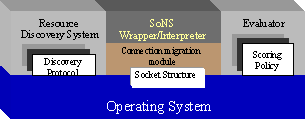
Figure 1 shows the
architecture of a Service-oriented Network Sockets system. In order to
facilitate application-specific extensibility, portability, accounting and
fault-isolation, Service-oriented Network Sockets are implemented as a
user-space wrapper around a traditional socket interface, instead of as a
kernel module. The SoNS architecture has
four components: a resource discovery module, an evaluator module, a connection
migration module, and a socket-wrapper module. Below we describe these modules
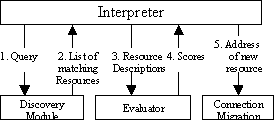
in detail. 3.1 SoNS InterpreterThe SoNS Interpreter,
shown in figure 2, lies at the heart of the system and drives the different
modules of the SoNS architecture; it parses the constraints specified by an
application, discovers matching resources by invoking the resource discovery
module, invokes the evaluator module to evaluate the suitability of any
matching resources, and finally, in the case when a new resource becomes a
better choice for the application, notifies the application and requests the
connection migration module to migrate the connection to the new resource. In order to allow this
processing to be accounted on a per-connection basis, SoNS system forks a new
Interpreter for every service-oriented network socket created by an
application. 3.2 SoNS InterfaceSoNS is designed as an
extension of the operating system socket interface; it implements all the
methods and options of a traditional AF_INET Unix socket, with additional
options for establishing service-oriented network connections. A service-oriented network
socket extends a traditional network socket in the following ways: 1)
The call to
create an operating system socket accepts an additional domain, AF_SONS,
for creating a service-oriented network socket. AF_SONS extends an AF_INET
socket and allows an application to choose between (sock_stream) and UDP
(sock_datagram) as the transport protocol for a service-oriented session,
including support for the various options associated with these transport
protocols e.g. TCP_NO_DELAY for TCP. 2)
The connect
method of a service-oriented network socket takes a high-level service
description, instead of a network address, to establish a service-oriented
network session. The service description is expressed in a simple constraint
language, described in detail later in the section. 3)
A
service-oriented network socket can be configured with four additional options
(as arguments to setsockopt), context, agility, hysteresis and
application-callback, to tailor the session rebinding semantics according
to application requirements. 4)
Finally, when
configured with the optional application-callback, a service-oriented network
socket invokes a callback method to notify (and seek permission of) the
application before rebinding a network connection to a better alternative. 3.3
SoNS Constraint Language.
Though previous resource
discovery systems offer varying degrees of sophistication for looking-up
resources based on their attributes [9][4], these systems do not offer support
for evaluating and comparing the suitability of matching resources against
application requirements. SoNS, on the
other hand, allows applications to specify the criteria for discovering,
evaluating and comparing the available alternatives as a set of constraints
expressed in a simple constraint language. Though several sophisticated
constraint languages have been proposed in other problem domains [10], the
constraint language used to express a service-requirement in the SoNS system
achieves a delicate balance between the expressiveness required for evaluating
the suitability of available service-providers and the simplicity of design
necessitated by the paucity of resources available in a mobile device. The grammar for the SoNS
constraint language is shown in figure 3. An expression in the SoNS constraint
language lists the attributes that must be present in the selected resource,
along with a range of acceptable values for each attribute. In order to define
an evaluation and comparison criterion, a constraint also includes an operator,
(less-than “<”, or greater-than “>”), to indicate the
preferred extreme in the range of acceptable values; resources with attribute
values closer to the preferred extreme are favored over the resources with
values further away towards the other extreme. This approach of allowing an
application to express its requirement as a range of acceptable values, instead
of a single scalar value, has the following merits. 1) It provides the
flexibility to satisfy the requirements of an application with imperfect
resources in its environment 2) It provides the system with a yardstick to
compare and evaluate the matching resources against application requirements.
3) It encourages an application to explicitly declare its scale of tolerance
for an attribute value; a change k in a range L ↔ K is more significant
than the same amount of change k in a larger range, L ↔ (K +P). In the case where an
application is interested in the least
or the greatest value for an
attribute, irrespective of the specific value of the attribute, the application
can leave the range unspecified. This could be used by an application to, for
example, connect to the least loaded server in its environment, expressed as
“< load”.
SoNS
also allows open ended ranges in the case where the application is interested
in having an attribute value to be greater than (or lower than) a certain threshold,
but perceives no marginal gain as the value of the attribute moves further away
from the specified threshold. SoNS handles this case by treating the unbounded
end of a range as 0 or a large positive integer, depending on which side of the
range is unspecified. Not all attributes of a
resource required by an application are of the same importance to the
application. SoNS handles this requirement by allowing an application to
specify the relative importance of the listed attributes by attaching a
(integer) weight with every attribute; an attribute with a weight of 4 is twice
as important to an application as an attribute with a weight of 2. Attributes that are
allowed to have only a single value, including the attributes with textual
values, use an equality ( “=” ) operator and do not specify a range or
attach a weight to the attribute; a resource description that does not match an
equality constraint is simply rejected. Attributes that must be present in a
matching resource, but whose value is not of interest to the application, are
specified as a don’t care value, stated as ANY. Finally, the constraint
language includes two logical operators, conjunction and disjunction,
to allow individual constraint-expressions to be combined into a composite
constraint specification. A composite constraint specification can have a
hierarchical structure; constraints can be grouped (associated) and nested
using braces, and the logical operators are distributed over nested constraints
when evaluating a constraint. To illustrate the
expressiveness of the SoNS constraint language, we show how the requirements of
a follow-me-video application, presented in section 2, will be expressed in our
language. Such an application can impose the following constraints on the
display used by it. 1) The display must be more than 15 inches in size, for
clear viewing, but less than 30 inches, due to the resolution limitations of
the video-encoding scheme, 2) it must be capable of rendering colors, 3) and
should be either capable of displaying more than one video-stream
simultaneously or must not be in use. These requirements would be expressed in
the SoNS constraint language as shown in figure 4. It is worth noting that the
use of an open-ended range for the number of video-streams supported by the
display device implies that the application is indifferent to the number of
streams being displayed on the screen. If the application prefers to use a less
cluttered screen, it will provide a closed range, and will use the “<”operator
to indicate that a display capable of showing fewer streams is preferable.
Therefore, the use of a range to express a constraint, in fact, encourages an
application to be more precise in defining the, often assumed, precincts of
context-awareness. 3.4 Semantics of Session RebindingBesides the constraints
specified by an application to define the criteria for comparing available
resources against application requirements, SoNS also allows an application to
tailor the semantics of rebinding the network session by controlling the
parameters for detecting and reacting to changes in the system. A
service-oriented network socket takes four additional options as arguments to
the setsockopt library call. Context:
An application can specify its context
as a sub-net address, location of the looked-up resources, number of network
hops traversed by a discovery message or any other metric meaningful for the
discovery protocols part of the SoNS architecture. For example, the current
implementation adjusts the SCOPE of an SLP [9] network query to limit
the context of the discovery.
Agility: An application can specify the agility with which
it reacts to changes in the system by adjusting the frequency to probe the
system for changes. The agility is specified as the interval between successive
probes, stated in seconds. Hysteresis: An application can keep the system from reacting to
transient changes, not of interest to the application, by specifying a value
for hysteresis. The hysteresis is stated in terms of the number of
probes for which an application requires the properties of the resources in its
context to be consistent before SoNS (notifies an application and) switches the
connection to a better alternative. Application-Callback: Finally, an application can register a callback with
the socket, which, if registered, is used to notify the application when a
better alternative becomes available. This notification, parameterized with the
description (including the network address) of the new resource, can be used by
an application to prepare itself to switchover to the new resource or to reject
the change by returning a false value from the callback. It is worth noting
that since a connection migration can only happen when the application returns
control from the call-back, the application can use the call-back to delay the
migration to a “migration-safe” point in its control flow. 4
Constraint
Parsing
The constraints specified
by an application are used both for discovering and evaluating
resources in the context of an application. To accomplish this, the constraints
are parsed into a tree data-structure, which serves as an in-core representation
of the application requirements for discovering and evaluating resource
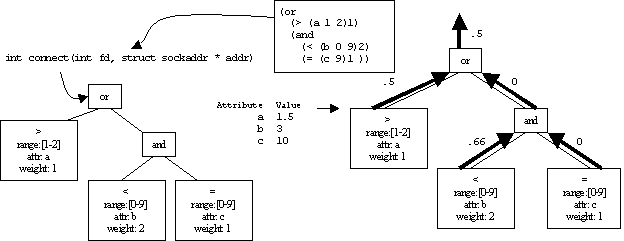
descriptions. Constraints are read as a
plain-text string from the sockaddr_sons structure
passed by the application in a connect()socket call
(refer to figure 5). The string is then
parsed using a standard GNU Flex/Bison lexer/parser into a constraint tree. The
parser makes a distinction between composite constraints and simple
constraints. Simple constraint,
specifying a range over a single attribute, are placed at the leaves of tree,
while composite constraints, containing nested constraints composed by taking
disjunctions (OR) and conjunctions (AND) of simpler constraints, are
represented at the intermediate nodes of the tree (refer to figure 5). The parser also fills-in
any missing bounds, 0 for less than constraints and a large integer for greater
than constraints, as well as missing weights with a default of 1. 5
Resource
Discovery
After constructing a
constraint tree, the SoNS interpreter invokes the discovery module with the
list of attributes at the leaves of the constraint tree. The discovery module
invokes the discovery protocols registered with it and returns the matching
resource descriptions to the interpreter. The interpreter then
passes this list to the evaluator module, which assigns each resource a score
by comparing the values of its attributes against the constraints stored in the
constraint tree. The evaluator invalidates the resource descriptions with
attribute values outside the range specified by the application, as well as the
resources that fail to meet an equality constraint. After the initial setup,
this procedure is repeated every time the probe period specified by the
application expires. An application can also force a probe/evaluate cycle, for
instance on the command of a user. After
receiving the score for each resource, the interpreter removes all the resource
descriptions that were rejected and forms the “n-best-list” for the probe. If the application forced the probe (by
invoking connect on an already connected socket), then the resource with
the highest score is chosen from the n-best-list and the socket is migrated to
its network address (just like the initial setup). However, if the probe was a
normal periodic probe, the system enters the hysteresis phase. In the
hysteresis phase the n-best-list from one probe/evaluate cycle is compared to
the n-best-list stored from the previous cycle and the resources present in
both new and old probes have their hysteresis value increased by one.
Resource(s) with a hysteresis value greater than the hysteresis value specified
by the application are separated and the connection is migrated to the network
address of the resource with the highest score. In the case where an
application has registered a call-back, SoNS invokes the callback method, with
the description of the chosen resource, before performing the migration, and
migrates only if the application-callback returns a true value (indicating
application’s approval of the connection migration). Upon migration of the
network connection, the n-best-list is reset and the process is started anew. 5.1 SoNS Resource Discovery FrameworkOur target network
environment often comprises of resources conforming to different resource
discovery protocols, e.g. IETF SLP [9], INS [4] and SSDP [11], due to both
commercial and technical reasons. Therefore, a service discovery framework
based on just a single discovery protocol is not sufficient to discover the
various resources found in a pervasive mobile system. SoNS handles this
heterogeneity by defining an extensible resource discovery framework, capable
of employing different discovery protocols to discover resources in the system.
A discovery protocol is added to SoNS by registering a pointer to its look-up
method, while SoNS performs resource discovery by invoking the look-up methods
of all the discovery protocols registered with it. However, various discovery
protocols found in our target environment offer different degrees of
expressiveness for looking-up resources in the system. Protocols like INS [4]
and SSDP [11] simply take a list of attributes and match them with the
attributes of the resources being looked-up, whereas more sophisticated
protocols like SLP [9] and SSDS [3] can perform complex queries containing
conjunctions and disjunctions on nested lists of attributes, as well as range
comparisons for attributes with numerical values. In order to interoperate with such diverse
protocols, SoNS translates a service specification to a very basic query format
common to all discovery protocols. SoNS resource discovery
framework invokes a constituent discovery protocol with a simple list of
ASCII-encoded attribute names, constructed by taking the attribute names from
the leaves of the constraint tree created by the SoNS parser. Upon invocation,
a discovery protocol finds the resources containing the specified attributes,
and returns their descriptions in a list of feature-sets: sets of
attribute-value pairs. The matching resource descriptions, encoded as feature-sets,
are passed on to the evaluator module to evaluate their suitability against the
constraints specified by an application. It is worth noting that,
in order to achieve compatibility with simpler protocols, this scheme does not
require any filtering involving value comparisons to be performed by a
discovery protocol. Rather, discovery protocols look-up resources by simply
performing a pattern match on the specified attributes, and the suitability of
a resource, based on the values of the looked-up attributes, is computed in the
SoNS evaluator module. Passing a query as a
simple ASCII-encoded list of required attributes also has the virtue that it
can be easily converted to a more ornate format, by a simple wrapper around the
lookup interface, if required by a more sophisticated discovery protocol. 5.2 Context of DiscoveryAlong with a pointer to a
look-up method, a discovery protocol can also register a pointer to a method
for setting the scope of the network queries generated by the discovery protocol.
This method is invoked by SoNS when an application specifies a context of
interest as an option to a service-oriented network socket. For example, SLP
and SSDS register a pointer to a method that sets the value of SCOPE of the
discovery agent to configure the context of the network queries. Though some
simpler protocols, e.g. SSDP, lack support for scoped queries, and hence, do
not register this method, we believe that such support is the key to the
scalability of a pervasive discovery protocol and will soon find its way in
mainstream discovery protocols. 5.3 Probing vs. AdvertisingA mobile device wishing to
discover resources in its environment can either passively listen to
advertisements by other resources in the system or can actively probe
the network with periodic discovery messages. SoNS uses active probing
as it makes it simpler to support application-level semantics for
session-rebinding. Applications configure the session rebinding semantics by
setting 1) the frequency of probing, to adjust the agility with which resources
are discovered, 2) the scope of a probe message, to adjust the discovery
context and 3) the number of probes for which the properties of a resource must
be consistent, to set the hysteresis of the system. We favor probing over
advertisements because in an advertisement based system the scope and frequency
of the messages generated by a resource to advertise itself to the system
cannot be adjusted to suit the requirements of any single application. Furthermore,
with resource advertisements arriving asynchronously at different frequencies
from various resources, there is no clean way to specify the hysteresis of the
system. From a design point of
view, in an advertisement-based system, where resources are required to
continuously advertise themselves to the system in the hope that some
application might be interested, introduces a continuous overhead of network
messages and processing of advertisement messages even when there is no
application listening to the advertisements.
Finally, probing is
supported by all the resource discovery protocols found in our target
environment (though some protocols can also be configured to operate in an
advertisement-based mode). 5.4 Directory-based versus Peer-to-peer DiscoveryResources can either
respond to queries directly, in a peer-to-peer setup, or could register their
descriptions with a directory service which could be searched to locate
resources. SoNS’ extensible design
does not impose a restriction on which of the two methods is employed by a
constituent discovery protocol to discover resources in the system. However, we
believe that a peer-to-peer model is more suitable for supporting
application-specific session rebinding. Though a directory-based
setup avoids query broadcasts, and, hence, presents a more scalable design, it
suffers from the following limitations in a dynamically changing system. 1) A
directory-based architecture depends on the availability of host(s) in the
system that are capable and willing to answer queries on behalf of other
resources. 2) A directory-based scheme introduces the overhead of keeping the
directory state consistent with the (oft-changing) properties of resources in
the system. 3) The directory service can itself cause a bottleneck in the
system. Since in a peer-to-peer setup resources themselves report their,
up-to-date, properties, the rate of probing provides an accurate mapping for
the rate of adaptation expected by the application; this can only be guaranteed
in a directory based system when the directory service is always consistent
with the changes in resource properties.
6
SoNS
Evaluator Module
The discovery framework
returns all the matching resource descriptions returned by the various
discovery protocols to the interpeter, which passes these resource descriptions
to the evaluator module. The SoNS evaluator module performs the planning
required to select the resource, among the available alternatives, that comes
closest to satisfying the service requirements of an application. To motivate the evaluation
strategy used by the SoNS evaluator module, consider a situation where the
follow-me-video application mentioned above moves into an environment with two
displays: one closer to the handheld device but the other larger in size and
with better resolution. In this situation, there is no clear winner (that is
better than all the other available alternatives in every aspect). A naïve solution could be to count the number
of attributes for which a resource “beats” other alternatives and pick the
resource with the maximum number of “wins”. However, such a solution not only
leads to a combinatorial explosion but also requires every sample of attribute
values to be kept for later comparisons according to application’s hysteresis
requirements. SoNS evaluator is designed
to be simple and responsive to changes and does not require the attribute
values of every resource to be preserved across multiple probes. SoNS achieves
this by using a simple scoring scheme which sums-up the suitability of a
resource in a single scalar value for efficient comparisons. SoNS evaluator takes a
list of feature-sets, along with the application’s constraint tree, and returns
a corresponding list of positive integer scores reflecting the suitability of
each resource. A resource with an attribute that fails to meet an equality
constraint or has a numerical value outside the range specified by an
application is assigned a score of zero. Figure 5 shows the
operation of the default SoNS evaluator. SoNS’ default evaluator performs a
depth-first search of the constraint tree.
On reaching a simple constraint at a leaf node, it extracts the value of
the corresponding attribute from the resource’s feature-set and compares the value
with the range specified in the constraint.
If the value satisfies the constraint, then a score between 0 and 1 is
calculated based on where the value falls in the valid range. If the constraint specifies that smaller is
better, then a value equal to the lower bound is assigned score 1 and a value
equal to the upper bound is assigned score 0, with all other values being
assigned linearly within that range. The
reverse occurs for constraints indicating that larger values are better. If the constraint specifies only equality or
the ANY keyword, then any value fitting the constraint is given a score of
1. Finally, the score is multiplied by
the constraint’s weight and returned as the value of that leaf node. After assigning scores to
the leaf nodes, scores for the intermediate nodes, containing conjunctions and
disjunctions, are calculated using the following algorithm. An OR node acquires
the score of a child node with the highest score in its sub-tree, while a score
of zero is assigned if all of its children nodes have a score of zero. An AND
node is evaluated in a complimentary way: the score of an AND node is
calculated by adding the scores assigned to its child nodes, while any child
node with a score of zero causes the AND node to be assigned a score of zero.
The overall score of a resource is the score calculated for the root of the
constraint tree using the attribute values in the resource’s feature-set. We have found this simple
evaluation strategy to be sufficient for our purposes for the following two
reasons. 1) It keeps the design of SoNS simple enough to be hosted in resource
constrained mobile devices and 2) the simplicity of the algorithm used for
evaluating and comparing the available alternatives incurs minimal penalty in
terms of the responsiveness of the system; where a more elaborate scheme could
be used for comparing the suitability of available alternatives, it would
increase the time spent in evaluating a resource, resulting in an increased
latency between the time a viable resource become available and when the system
recognizes its superiority. As described earlier, the
scores returned at each probe are compared by the Interpreter according to the
hysteresis semantics of the application and a winner is chosen if a resource
consistently scores better than other resources. The extensible design of
SoNS also allows the default evaluation policy to be replaced by more efficient
or specialized algorithms better suited to individual application requirements.
An application can replace the default evaluation policy by registering a
pointer to an application-specific evaluator with the SoNS evaluation module.
This allows more involved constraint satisfaction engines, for example as
proposed in [12], to be employed for calculating the relative utility of
available resources. Such planning and constraint satisfaction systems are a
topic of our current research. 7
Connection
Migration Module
Once a better resource has
been selected, the SoNS Interpreter requests the connection migration module to
migrate the network connection to the new resource. The semantics of migrating
the network connection from one resource to another depend on both the
stateful-ness of the service being accessed and the reliability guarantees
offered by the underlying message transport protocol [13]. Migration of an
unreliable network connection to a stateless service is accomplished by simply
closing the old network connection and opening a fresh connection to the new
resource. However, additional support is required for migrating reliable
connections and for managing stateful services [13]. Migration of a reliable
connection requires support for preserving the sequence of messages across
migration, while a connection to a stateful service can be migrated
transparently across resources only when the state accessed at the old resource
is also available at the new resource in the form that the access to the
service can be resumed at the new host from where it left-off at the old
resource. The former requires a
reliable transport protocol with support for migrating an active connection,
while the later also requires a system for distributing and maintaining
consistent state across replicated instances of a stateful service. This paper focuses on
enabling a client to utilize the best provider of a service in its changing
context; the subject of replicating and synchronizing stateful services has
been extensively researched by others [14] and is not covered in this paper. SoNS uses the Migrate
system [15] for migrating network connections between resources. We chose the
Migrate system as it provides support for securely migrating both reliable and
unreliable network connections, as well as a lightweight, soft-state based
consistency management system to support connection migration across stateful
servers. Unlike other connection migration systems, like SCTP[16], that require
the network addresses of all the potential servers to be known at connection
setup time, Migrate allows a connection to be migrated to a newly available
server using the TCP migrate options. Having said this, the modular design of
SoNS allows other connection-migration systems to be used as well, though we
have not integrated other such systems with SoNS as yet. 8
Applications
This section describes the
API of SoNS and a simple, yet representative, application we have developed to
demonstrate the utility of service-oriented network connections offered by the
SoNS architecture.
Our
test applications were developed for a Compaq iPAQ, fitted with a backPaQ and
running familiar Linux. Our backPAQ is fitted with an 802.11b wireless card,
video-camera, accelerometer and the Cricket Location detection system [17]. 8.1 Follow-me-videoWe have used SoNS to
develop a follow-me-video application. A follow-me-video application
running in a handheld device carried by a user re-directs the video stream to
the display closest to the user as she moves in the system. In our test
environment, all resources (server devices) are also fixed with Cricket Beacons
to measure their distance relative to other Cricket-enabled devices (including
our handheld device). The relevant code snippet
from our example application, mentioned in section 3.3, is shown in figure 6.
Our example application generates an MPEG-1 encoded stream and is interested in
the nearest display with 1) Resolution:
640x800 – 1280x1600 (with preference for displays with higher resolution), 2)
Size: larger than 15 inches to allow viewing from a distance, but less than 30
inches due to the limitation of the encoding resolution (with preference for a
larger display) The application creates an
AF_SONS domain socket, and specifies the following options: Context: 6th-Floor,
Agility: 5 (seconds between probes), Hysteresis: 3 (number of probes),
Call-back: pointer to method that forced a base frame to be transmitted. The
application then connects the socket by giving it a composite constraint
specification for the properties of the display device. SoNS sets the SCOPE of the
SLP user agent to 6th-Floor, probes the network for display devices,
and connects to a display that scores the highest points among those present on
the 6th floor. The distance to a display device is measured by
invoking the Cricket location system (added to the system just like another
discovery protocol). After making the initial connection, the network is
probed, using SLP and Cricket, every 5 sec and available resources are compared
according to the hysteresis. If a better display becomes available, SoNS
invokes the application callback, which forces a base MPEG frame to be
transmitted upon migration, so that the playing of video at the new display can
be resumed without jitter. Our example application
also monitors the accelerometer embedded in the backPAQ to find out if the
device is moving and with what speed. If the application discovers that the
handheld device is mobile, the application can increase the rate of probing and
reduce the hystersis value, according to the degree of movement reported by the
accelerometer, in order to take advantage of the displays that become available
for a short time when, for example, a user walks down a hallway.
9
Implementation
SoNS was implemented in
GNU C/C++ on GNU/Linux. The code is divided into four modules: the socket
interface library, SoNS interpreter, wrappers for the resource discovery
protocols, and the evaluator module. 9.1 Socket LibraryThe socket library code
overrides the socket interface to offer the extended SoNS interface, and spawns
an interpreter daemon to periodically discover and evaluate available
resources. In order to provide an
extended interface, we either needed to modify the underlying Linux libc or use
a package that captures system calls and redirects them through other
functions. We chose the latter route and
specifically chose to use TESLA [18]. TESLA allows arbitrary handlers to be
inserted between an application’s socket call and the underlying socket kernel
calls, precisely matching our needs.
Furthermore, the Migrate architecture, which we use for connection
migration, also uses TESLA, so the overhead of using TESLA would be present in
our system anyway. We wrote TESLA handlers to override the calls to socket(), connect(), getsockopt(), setsockopt(), and close() functions. The most interesting overridden call is connect(). The connect call exercises the entire system since it sends a message to the interpreter daemon telling it to force a network probe, then picks the best service, and finally calls connect on the underlying socket structure. getsockopt() and setsockopt() simply update socket-related data in the daemon. The interpreter daemon itself merely sits in a loop waiting either for an event from the TESLA handler or an alarm signal indicating that it should perform a periodic poll/evaluate cycle. 9.2 Resource Discovery ProtocolsThe interpreter invokes
the run_query method of all the discovery protocols registered with it.
The run query method takes an array of required attribute names and returns a
list of attribute-value bindings. This method is the sole interface between the
interpreter and the discovery protocols so that discovery protocols can be easily
added/replaced. The current implementation
employs two discovery protocols to find resources in the system: IETF Service
Location Protocol [9] and the Cricket Location System [17] (for estimating
distance to available resources). We use the OpenSLP implementation of SLP,
with the User Agent configured to perform discovery in a peer-to-peer fashion,
by multicasting the query on the SLP multicast channel. 10
Performance
Analysis and Evaluation
Unlike content-based
routing systems, the session-oriented approach of SoNS moves the cost of
resolving service descriptions from the critical path of a network message
delivery to the stage of establishing and, subsequently, rebinding a network
session. Therefore, we evaluate the performance of SoNS by measuring 1) how
quickly it can setup a service-oriented network session and 2) how quickly it
can rebind the network session when a better alternative becomes available. All tests were performed
on a Pentium III with 256MB of RAM running Linux 2.4. Since we wanted to isolate our system from
network latency, we used an in-memory stub SLP rather than the OpenSLP
SLP. We expect most constraint
specifications to have between 1 and 15 elements and be a combination of both
simple constraint specifications and composite constraint specifications. Our tests span this space: we vary the number
of attributes in a straight-line set of simple constraint specifications and
also vary the height of the tree of composite constraint specifications. 10.1 Session-setup LatencyThe SoNS system adds
latency in two places, at a socket() call where we fork a daemon and initialize
all the discovery protocols installed in the system, and on a connect()
call where we must decide which device
is the best device available.
In all of our tests, the socket call took between 2ms and
5ms. This is fairly high, but represents
the cost of forking a process and all inter-process communication between the
daemon and the SoNS TESLA handler. Figures 7 summarizes the
cost of a connect call as we varied the number of constraints. The cost of the connect call increases only
linearly as the number of constraints, both nested and non-nested, are
increased. The connect latencies in our system hover around 1ms, which, though
higher than expected, is acceptable when amortized over the life of the
connection. 10.2 Session-rebinding LatencyAnother form of latency
shows itself as the time between the discovery of a resource and signaling the
application that the SoNS system has found a new best resource. Ideally, this should be zero, but we must
evaluate the services returned, which has a non-zero cost. Figure 8 show the time elapsed from when a
call to run_query() method returns — with matching resources on the network—
and when SoNS invokes the application-callback to notify the presence of a better alternative
(given the hysteresis semantics). This latency again increases only linearly
with the number of constraints (both for nested and non-nested constraints),
and more importantly, hovers only around 200-500ms
of latency. In order to achieve
compatibility with simpler protocols, SoNS does not require any filtering
involving value comparisons to be performed by a discovery protocol. Instead,
discovery protocols return all those resources that contain the required
attributes and the evaluator module performs the value comparisons to compute
the suitability of matching resources. However, since all the value comparisons
in this scheme are performed by the evaluator module, the evaluator must be
able to efficiently compare a moderately large number of matching resource
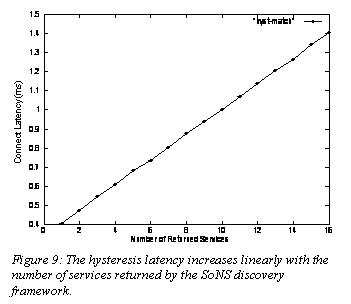
descriptions. Figure 9 shows the time spent in the evaluator module as we
increased the number of resource descriptions processed by the evaluator. This
cost increases only linearly and hovered only between 0.8 – 1.0 msec in our
tests. The simplicity of our
system makes it suitable for mobile handheld device. The memory footprint of
our system varied between 0.8 MB to 1 MB during our experiments. 10.3 EvaluationWhere our system achieves
acceptable performance, we found that the following implementation choices
incurred unwanted overhead: ·
Per-socket
interpreter daemon processes, ·
Use of standard
IPC between the socket wrapper and the per process interpreter deamon, and ·
fixed-point
arithmetic. Our implementation would
be faster if we were able to communicate with the daemon without copying
through interprocess communication channels.
This could be accomplished by using a thread library at the cost of
making our code less portable. Secondly,
we maintain a separate daemon process for each socket to allow for fine-grained
accounting. However, this is inefficient compared to an implementation in which
a single deamon process handles the discover/evaluate cycles for all the
sockets, since such an implementation would save the cost of spawning a daemon
every time a socket is created, and might allow for optimizations by batching
queries by different applications. Finally, our system is
slowed down by the use of the fixed-point math system we wrote for computing
resource scores. This is because the
iPAQs we include in our target platforms do not have floating point units and
incur an order of magnitude performance hit on floating point performance. Since scoring and weighting is an inherently
floating-point process, we were forced to write our own, non-optimized,
implementation of fixed-point arithmetic.
We are currently working on a more efficient implementation in the light
of these observations. 11
Related
Work
SoNS integrates a
service-oriented abstraction with a traditional operating system communication
interface. Using SoNS, applications open a network connection with an abstract
service specification, instead of a network address, and the system
automatically connects the application to the most suitable server in its
changing environment. SoNS combines resource discovery and evaluation with a
connection migration system to provide application-specific opportunistic
access to service providers. SoNS’ modular architecture can be extended with
various resource discovery, location-detection, and connection migration
protocols, and its evaluation policy can be customized to individual
application preferences. Therefore, SoNS is
designed to complement and leverage recent research in resource discovery,
location-detection and connection migration protocols, not to replace such
systems. In fact, SoNS was motivated by the desire to combine pervasive mobile
computing technologies developed for MIT’s Project Oxygen, e.g. INS, Migrate
and Cricket, to leverage context-aware applications in a mobile handheld
device. The recent interest in pervasive
computing environments has given rise to a proliferation of systems that allow
resources to be dynamically discovered based on their attributes. As opposed to
the white-pages style lookup offered by systems like DNS that simply resolve a
resource name to its network address, such systems do not require a priori
knowledge of some unique identifier of the resource, like its network address,
and hence can be used to dynamically discover and utilize resources as they
become available in a pervasive system. S SoNS is designed such that
different discovery protocols can be added to its resource discovery module,
possibly via a simple wrapper function to covert the SoNS attribute list to the
specific format used by a discovery protocol, e.g. XML (used by Berkeley’s
SSDS). Unlike existing resource
discovery protocols that simply match queries against resource descriptions,
SoNS uses an applications-specific evaluation framework that continuously
monitors, evaluates and compares the available alternatives in order to pick
the closest match to application requirements. Indeed, the problem of
satisfying high-level requirements with imperfect resources has been
extensively researched in the AI domain [12]. However, where systems like
MetaGlue [12] propose to use general-purpose constraint satisfaction engines
over complex utility functions, SoNS default evaluator is designed to be simple
and responsive to changes in the system. Content-based routing
systems like INS’s late binding architecture [4] and Information Bus [21], as
well as application-level anycast routing systems like [8], allow applications
to send messages without specifying the network address of the recipient, and
route the messages to the appropriate server by looking at the content of each
network message and matching that with the properties of the available servers.
Where such systems offer an alternative to our approach, they inherently lack
application-level session semantics, do not offer a clean interface for
configuring the application-specific policy for resource comparison and
session-rebinding, introduce the overhead of resolving service descriptions
within the critical path of every message delivery, and, by defining their own
routing framework, do not leverage the support for QoS offered by the
underlying network. 12
Conclusions
and Future Work
This paper establishes the
need for service-oriented network connection, and presents the design
and implementation of the SoNS system. SoNS presents an application with an
extended socket interface to open a service-oriented network connection by
providing a high-level service-specification. When asked to establish a
connection, SoNS discovers the available resources and connects the application
to the resource that best provides that service in its context. Once connected,
SoNS continuously monitors, compares, and evaluates available alternatives, and
reconnects the application to a better alternative if one becomes available. As opposed to
content-routing systems, SoNS moves the cost of discovering and evaluating
resources against application requirements at the connection set-up time, and
allows the application to exercise control at the level of a network session.
Since the cost of discovery and selection in SoNS is amortized over the life of
the network session, it allows SoNS to be significantly more sophisticated in
terms of expressiveness, evaluation and selection of available resources, as
compared to systems that perform message-level service-selection-and-routing. As SoNS integrates support
for context-awareness with a traditional operating system communication
interface, we have found it much simpler to use than other systems that require
the use of additional, and often several different [7], APIs to build a
context-aware application. Though we believe that SoNS has the potential to
become an integral part of future operating systems in a pervasive computing
environment, it relies on the wide-spread deployment of network devices
embedded with service advertisement protocols, as well as the availability of
location detecting mechanisms to estimate the distance of a user with the
devices embedded in her context. The design of SoNS pays
special attention to extensibility in order to take advantage of the wide range
of emerging technologies for resource discovery, location detection and network
connection migration. The current design of SoNS
does not include a security framework. Security in such a system is required at
several levels: to protect resources against illegitimate access, to protect
the SoNS system against malicious extensions, and to protect the connection
migration system against connection hijacking. Though some discovery protocols,
like SSDS and SLP, and connection migration schemes, like Migrate, define their
own security models, we are currently investigating an extensible security
framework that would allow security policies to be defined independently of the
constituent modules. SoNS makes it simpler to develop context-aware applications. Our experience with SoNS has shown us that unlike message-based routing systems that are better suited to command-based applications e.g. “sending a document to the nearest printer”, SoNS is equally useful for connection-oriented applications as well, e.g. follow-me-video/audio. We are currently developing more applications to demonstrate the utility of SoNS in pervasive mobile environments. References
1.
2.
Esler,
M. et al. G. Next Century Challenges: Data-Centric Networking for
Invisible Computing: The Portolano Project at the 3.
S.
Czerwinski et al. An architecture for a secure service discovery service.
In Proc. of MobiCom-99, pages 24-35, N.Y., August 1999 4.
William
Adjie-Winoto et al. The design and
implementation of an intentional naming system, Proc. 17th ACM SOSP, 5.
David
Garlan et al. Project Aura: Towards
Distraction-Free Pervasive Computing IEEE Pervasive Computing, special
issue on "Integrated Pervasive Computing Environments", Volume 1,
Number 2, April-June 2002, pages 22-31. 6.
C.
Perkins et al A Mobile Networking System Based on Internet Protocol,
IEEE Personal Communications, Vol. 1, No. 1, pp. 32-41, March 1994. 7.
Harter,
A. et al.: The anatomy of a context-aware application., Mobile Computing
and Networking. (1999) 59-68 8.
S.
Bhattacharjee et al. Application Layer Anycasting. In Proc. IEEE
INFOCOM'97, 1997 9.
Erik
Guttman. Service Location Protocol: Automatic Discovery of IP Network
Services. IEEE Internet Computing Journal, 3(4), 1999. 10.
J.
Jaffar et al. Constraint logic programming: A survey. The Journal of
Logic Programming, 19/20:503--582, May/July 1994. 11.
Universal Plug and Play, http://www.upnp.org 12.
Krzysztof
Gajos. Rascal - a Resource Manager for Multi Agent Systems in Smart spaces.
In Proceedings of CEEMAS 2001. 13.
14.
R.
Golding. A Weak-Consistency Architecture for Distributed Information
Services. Computing Systems, 5(4):379--405, 1992. 15.
16.
R. R.
Stewart, et al. Stream Control Transmission Protocol. RFC 2960,
IETF, Oct. 2000. 17.
Nissanka
B. Priyantha et al. The Cricket
Compass for Context-Aware Mobile Applications Proc. ACM MOBICOM
Conf., 18.
Jon
Salz, SM thesis, MIT. 2002, The Transparent Extensible Session-Layer
Architecture for End-to-End Network Services. 19.
A.
Birrell et al. Grapevine: An exercise in distributed computing. Comm. Of
the ACM, 25(4):260–274, April 1982. 20.
CCITT. The Directory—Overview of Concepts, Models and Services, December 1988. X.500 series
recommendations, 21.
B.
Oki et al. The Information Bus (R) – An Architecture for Extensible
Distributed Systems. In Proc. ACM SOSP, pages 58–78, 1993. 22.
MIT
Project Oxygen, http://www.oxygen.lcs.mit.edu Acknowledgements We
would like to thank Steve Ward for his valuable comments that helped us improve
the paper significantly. The title of the paper was also suggested by Steve
Ward. We
would like to thank |
|
This paper was originally published in the
Proceedings of the
The First International Conference
on Mobile Systems, Applications, and Services,
May 5 – 8, 2003,
San Francisco, CA, USA
Last changed: 201 May 2003 djc |
|