| |||||||||||||||||||||||||||||||||||||||||||||||||||
| ||||||||||||||||||||||||||||||||||||||||||||||||||||
|
MobiSys '03 Paper
[MobiSys '03 Tech Program Index]

Energy-Conserving Data
Placement and Asynchronous Multicast in Wireless Sensor Networks
Sagnik
Bhattacharya, Hyung Kim, Shashi
Prabh, Tarek Abdelzaher
Department of Computer Science
University of Virginia
Charlottesville,
VA 22904
Abstract In
recent years, large distributed sensor networks have emerged as a new
fast-growing application domain for wireless computing. In this paper, we
present a distributed application-layer service for data placement and asynchronous
multicast whose purpose is power conservation. Since the dominant traffic in a
sensor network is that of data retrieval, (i) caching mutable data at locations
that minimize the sum of request and update traffic, and (ii) asynchronously
multicasting updates from sensors to observers can significantly reduce the
total number of packet transmissions in the network. Our simulation results
show that our service subsequently reduces network energy consumption while
maintaining the desired data consistency semantics. Sensor
networks are ad hoc wireless networks made of large numbers of small, cheap
devices with limited sensing, computation, actuation, and wireless
communication capabilities. Such a network, for example, can be dropped from the
sky on a disaster area to form collaborative teams of programmable nodes that
help with rescue operations. Sensor networks are made possible by advances in
processor, memory and radio communication technology, which enable low-cost
mass-production of sensor-equipped wireless computing nodes. The sensor network paradigm is motivated by applications such as guiding
rescue efforts in disaster areas, monitoring poorly accessible or dangerous
environments, collecting military intelligence, tracking wild-life, or
protecting equipment and personnel in unfriendly terrains. In such environments, it is usually
impractical to build fixed infrastructures of powerful and expensive nodes.
Instead, the sensor networks philosophy advocates the use of myriads of inexpensive
nodes strewn arbitrarily in the environment and left largely unattended. The primary function of sensor networks is the collection and delivery of
sensory data. Power is identified as one of the most expensive resources. Due
to the difficulty of battery recharging of thousands of devices in the remote
or hostile environment, maximizing battery lifetime by conserving power is a
matter of great importance. In this paper, we develop a distributed framework that improves power
conservation by application-layer sensor data caching and asynchronous update
multicast. The goal of the framework is to reduce the total power expended on
the primary network function; namely, data collection and delivery. The importance of optimizing communication cost is also supported by
measured data from recent prototypes of sensor network devices, which show that
the main power sink in the network is, indeed, wireless communication. For
example, the Berkeley motes [15] consume 1 mJ for transmitting and 0.5 mJ for receiving a single bit, while the CPU
can execute 208 cycles (roughly 100 instructions) with 0.8 mJ. Assuming full load, CPU power consumption is about 10mW, compared to
50mW for the radio. The high power cost of communication makes it a prime
candidate for optimization. The remainder of this paper is organized as follows. Section
2 presents the service model and the formulation of the power minimization
problem. Section 3 presents the details of the data
placement middleware and its API. Section 4 presents an
evaluation using experimental as well as simulation results. Section
5 reviews the related work. The paper concludes with Section
6. 2.
Service Model Consider
a dense ad hoc wireless sensor network with multiple observers, spread
over a large monitored area. At any given time, the observers’ attention is
directed to a relatively limited number of key locales in the network, where
important events or activities are taking place. We call them focus locales.
For example, in a disaster area scenario, rescue team members may be interested
in monitoring survivors. The locations of found survivors therefore represent
the focus locales of this application. The total number of sensor nodes is
assumed to be much larger than the number of focus locales at any given time. Sensor nodes at each focus locale elect a local representative for
communication with the rest of the world. Distributed leader election
algorithms may be borrowed for this purpose from previous literature and are
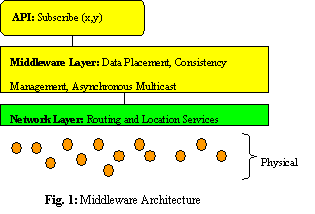
not the goal of this paper. Our service adopts a publish-subscribe model, as
shown in Figure 1. In this model, each representative
publishes sensory data about its focus locale to observers who subscribe to a
corresponding multicast group to receive such data. The size of the published
update stream originating at a given locale is time-varying, depending on the
volatility of the environment and the type of sensors involved. An environment,
which changes frequently, will generate more update traffic than a quiescent
environment. Similarly, sound sensors (microphones) will generate more traffic
than temperature sensors. Contrary to previous multicast frameworks for sensor networks, update
traffic is multicast from focus locales to receivers in an asynchronous
manner. Data caches are created at the nodes of the multicast tree. A lazy
algorithm is used for propagating data updates among neighboring caches along
the tree in the direction of the receivers. These receivers may be wireless
hand-held devices or laptops, for example, in the possession of rescue team
members operating in a disaster area. We assume that receivers do not move, or
move slowly compared to communication delays in the network.
While in this paper we do not consider streaming multimedia, an argument
in favor of addressing such traffic in sensor networks is that more powerful
devices may become available in the foreseeable future at an affordable price.
We argue, however, that advances in sensor network technology are most likely
occur in two directions: developing more powerful devices of the same
form factor, and developing smaller devices of the same processing and
communication capacity. Research reported in this paper is more relevant to the
latter direction. In our model, observers who join the asynchronous multicast tree specify
a period at which the requested data should be reported. Flurries of changes in
the environment need not be individually reported if they occur at time-scales
smaller than this period. Different observers may specify different period
requirements for the same measurement. For example, an observer who is close to
the measured activity may request a higher reporting rate than a distant
observer. Our middleware achieves four main functions; (i) it determines the number
of data caches for each focus locale, (ii) it chooses the best location for
each cache such that communication energy is minimized, (iii) it maintains each
cache consistent with its data source at the corresponding focus locale, and
(iv) it feeds data to observers from the most suitable cache instead of the
original sources. A key difference between this problem and the problem of caching in an
Internet context is that in the latter case, the topology of the network
restricts the choice of cache locations. In contrast, we assume a sensor
network that is dense enough such that a data cache can be placed at any
arbitrary physical location in the monitored region, offering new degrees of
freedom to the data placement algorithm. Another key difference is that the
number of Internet proxy caches is typically much smaller than the number of
different web sites. Hence, such caches are centralized powerful machines,
which gather and retain content from a large number of distributed sources. In
contrast, in this paper, we consider a middleware caching service, which runs
on every sensor node. Since the number of sensor nodes is larger than
the number of focus locales, the storage requirements of this service on any
single node are very small. We assume that sensor nodes know their location. Algorithms for estimating
geographic or logical coordinates have been explored at length in the sensor
network research [5][6]. These efforts address
the problem of location awareness using algorithms that do not require high
cost devices such as GPS on every node. Classical ad hoc wireless routing
protocols like AODV[8], and DSDV [9]
may be used along each unicast edge of our data dissemination tree. These
protocols, however, are not location-aware which may affect performance.
Several more recent adaptations such as Location-aware routing (LAR) [7] and geographical forwarding [4] make use of the location
information. These routing algorithms would be a natural choice for the network
layer underneath our service. We now formulate our data placement problem
mathematically. 2.1.
Problem formulation Consider
a sensor network that is monitoring a set of focus locales at which events of
interest occur. Given a locale (X,Y) in a sensor network, let BS= {BS1, BS2,….., BSM} be a set of M
observers that request data from that locale with rates Rreq={R1,
R2,…., RM}. Let sensor updates at (X,Y) occur at an average
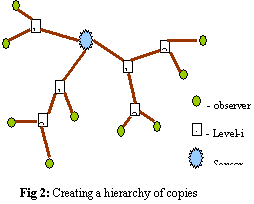
rate Rupdate. A tree of copies is created for the sensor
as shown in Figure 2.
We define the cost of message transfer between two nodes in the tree as
the power expended on a packet’s transfer on the shortest route multiplied by
the packet rate. Consider the case of placing a single data copy to minimize
cost as defined above. Let the data copy be placed at a distance ni
hops from the ith observer and at a distance nsens
hops from the sensor node serving the data. In a densely populated network, the
hop counts will be large. The cost of sending a single packet is proportional
to the hop count. Hence, the net cost
of serving all observers is: T = nsens . Rupdate
+ å1£i£M ni . Ri (1) To place the copy at the optimal
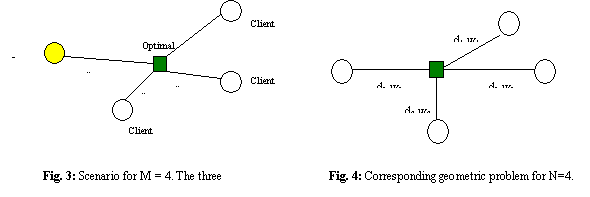
location, T has to be minimized. Figure 3 shows the
situation with three observers. We can reduce this problem to the following
geometric optimization. Given N points, where point i is at
location (Xi,Yi), find a point (x,y) such
that D = å1£i£N (di . wi)
is minimum, where, di is the distance of the ith
point from (x,y), and wi is the weight of the edge
from the ith point to (x,y). This is illustrated in Figure 4. A heuristic solution to this problem is to place (x,y)
at the center of gravity of the N input points in question, i.e.: x = å1£i£N xiwi /å1£i£N wi (2) y = å1£i£N yiwi /å1£i£N wi (3) Hence, in a
minimum-cost tree with multiple copies (i.e., multiple internal vertices), each
copy (x,y) should be at the center of gravity of those vertices to which
it is connected. The objective of our algorithm is to find such a tree. In the following,
we compare our formulation to other popular variants of content placement
problems described in prior literature. If the number of copies in the tree is
known in advance, a popular variation of the problem is expressed as a Minimum K-median
problem, stated as follows. Given n points (possible copy locations), select K
of them to host data copies, and feed each observer from a copy such that total
communication cost D is minimized, where: D = å1£j£K å1£i£N cij . yij (4) cij is the cost of the edge
from i to j and yij is 1 if the jth
copy serves the ith observer, and 0 otherwise. Many Internet-based content placement algorithms adopt this model.
In this case, the possible locations of the caches are fixed. Hence, cij
is fixed for the given
network topology. The problem is NP-hard, but heuristic solutions are
possible, e.g., [10] and [11]. If the cache locations are
specified, a minimum spanning tree can be constructed to disseminate
information from senders to receivers at the
lowest cost.
Our model differs
in that copy locations are not known a priori. In a dense sensor
network, the number of nodes n approaches infinity. Copies can essentially be
placed anywhere in the Euclidean plane without restrictions. In this case, the problem
is that of constructing a minimum-cost weighted Steiner tree, which connects
the sensor node to the observers. The Steiner tree
formulation differs from the K-median and spanning tree problems in that it
allows one to create new nodes in the tree as opposed to having to choose from
a pre-specified set of possible node locations. This difference separates our
paper from similar work in web caching and content distribution literature. Note that Rupdate in
our algorithm is not a fixed sampling rate, but rather refers to the average
rate of change of the environment. Hence, it may vary dynamically with
environmental conditions. For example, it may decrease when the environment is
quiet. An advantage of such dynamic adaptation is that no energy is wasted when
no updates occur. A disadvantage is that an application is unable to tell when
it has missed an update (e.g., due to message loss), since it does not expect
updates to arrive at particular time intervals. This problem can be solved in
several ways. First, we may let Rupdate be a fixed sampling rate. The formulation of our algorithm remains
the same. In this case, if a sample does not arrive in time, the application
can tell. Alternatively, the origin sensor may number the updates. If a gap
occurs in the received update numbers, the application is aware that a previous
update was lost. The occasional loss may be acceptable since we assume that
only the latest update is relevant at any given time. A potential problem with
the latter approach is that in the absence of subsequent environmental changes,
an important update may be lost, unbeknown to the application, indefinitely.
One solution is to enforce an upper bound, B, on the update period.
Hence, when the environment is quiet a message is expected at least once every B
seconds. Otherwise, the application is
aware of a problem. In the rest of the paper, we shall not address the issue
update loss any further. 3.
Data Placement Upon
perturbation, distributed physical systems such as weights interconnected by
strings settle into an equilibrium position, which represents a minimum energy
state. Our data placement algorithm is inspired by such systems. Assuming
environmental conditions don’t change, each step of the algorithm reduces a
measure of total energy until a minimum energy tree is found. More
specifically, we use a distributed greedy heuristic that iteratively places
each node at the center of gravity of its neighbors. Note that, while in a
physical system, energy has a direct meaning, in our system energy is an
abstract mathematical quantity. We call the
depth of the copy in the distribution tree rooted at the origin sensor, the copy
level. The original data at the sensor is referred to as the level-0
copy. A heuristic is used to add or remove copies in the tree. The algorithm is described in more detail next. 3.1 The Algorithm Each
node on the multicast tree rooted at the sensor maintains a location pointer to
its parent as well as a location pointer to each of its children. One can think
of these pointers as an application-layer routing table. For each child, the
node maintains the maximum propagation rate, which is the maximum of all
requested update rates of all observers served by that child. A node never
forwards updates to a child at a rate higher than the child’s maximum
propagation rate. This way, flurries of environmental updates that exceed some
receivers’ requested rates are not propagated unnecessarily to those receivers.
3.1.1
Joining the Multicast Tree An
observer, k, joins a multicast tree by sending a join() message to the
location of the origin sensor, i.e., to the level-0 copy. The message
indicates the location of the observer and its desired update rate Rk.
The origin sensor forwards the message along the multicast tree in the
direction of the new observer as follows. Each level-i copy (starting
with the origin sensor), upon receipt of the join message, determines if the
new observer is closer to any of its children than to itself. If so, it
forwards the join message to the corresponding child, i.e., to a level-(i+1)
copy. If the maximum propagation rate for that child is lower than Rk
it is changed to Rk. This recursive forwarding terminates
when a node is found with no children that are closer to the observer. We call
this copy the nearest neighbor. The nearest neighbor adds the observer
to the set of its children. The maximum propagation rate for the observer is
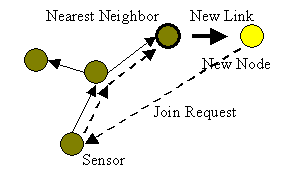
initialized to its requested update rate. Figure 5
illustrates the message exchange in the join process. 3.1.2
Copy Creation and Migration For
the purposes of creation of new cache copies, nodes are differentiated into
fixed and migratory. The origin
sensor and observers are fixed nodes. Other nodes are migratory
nodes that can move to better
locations of fork off new copies. When a newly joined observer is connected to its nearest neighbor N,
node N computes the center of gravity of itself and all its neighbors.
It then computes the savings, if any, resulting from creating a new copy at
that center of gravity. If the savings from creating the copy
exceed a threshold, the option of creating this copy is deemed viable.
Before we proceed further, let us look more closely at how the copy may be
created.
Fig. 5: Joining the
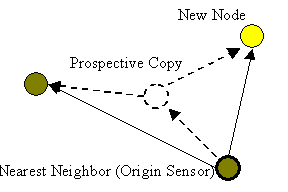
Multicast Tree If N (the nearest neighbor) is the origin sensor, the new copy can
only be created downstream from it. The copy would be fed from N
and in turn feed N’s children as shown in Figure 6-a.
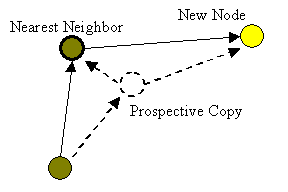
Otherwise, if N is not the origin sensor, the new copy can in principle
be created either downstream or upstream from N. An upstream copy
would be fed from N’s parent and would feed both N and N’s
children as shown in Figure 6-b. A downstream copy would
be created as described above (Figure 6-a). Observe that,
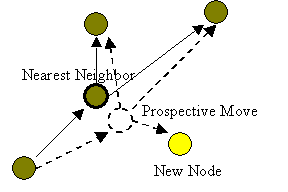
if N is not a fixed copy, a third option is also possible. Namely, it is
possible to simply move N to a new position. This is called copy migration. In copy
migration, when a newly joined observer is connected to a
migratory nearest neighbor N, the node computes the center of gravity of all its neighbors
(including the new observer), and evaluates the savings that would arise if it
moves to the computed position. If the difference is larger than a fixed
threshold the option of migration is deemed viable. This is illustrated
in Figure 6-c. A viable option with the
maximum savings among three data
placement options described above is executed. It is
easy to show that no new copies are created unless there are three nodes in the
system, and that at most one copy is created for every newly joined member.
Hence, the algorithm creates at most m-2 copies where m is the
total number of observers. 3.1.3
Leaving the Multicast Tree An
observer, k, leaves the multicast tree by sending a leave() message to its
parent N. The parent stops forwarding messages to the departed observer.
If k had the highest maximum forwarding rate among N’s children, N
resets its own maximum forwarding rate to that of the next-highest rate child.
If N is a migratory node, it computes the center of gravity of all
remaining neighbors, computes the savings that result from moving to that
center, and moves there if the savings exceed a threshold. If there is only one
child left for the migratory node, the node is deleted and its parent takes
over its child.
(a) Nearest neighbor creates downstream copy
(b) Nearest neighbor creates upstream copy
Fig. 6: Copy Creation and
Migration Rules 3.2 Sampling Rupdate To
perform center of gravity computations, nodes must know not only the requested
observer rates, but also the environmental sensor update rate, Rupdate.
There are two simple approaches towards the measurement of that rate. One
approach is to measure the number of updates over the last n seconds. A
disadvantage of this approach is that it has a fixed time horizon after which
it forgets the past. It may be more advantages to adapt the horizon to the
current rate of updates itself, such that system agility is increased when
activity is high. An approach for calculating Rupdate, which
has the aforementioned adaptive property, is to take the inverse of the average
of the last k inter-arrival times. More complicated methods like
predictive modeling could have been used but this would be limited by the
computation and storage resource constraints of the nodes. For our simulation
purposes we have used a simple model where Rupdate is
calculated as the inverse of the average of the last five inter-arrival times.
The number five is selected as the sample size to reflect that we expect any
five consecutive updates to be strongly correlated, though a larger or smaller
number could be chosen according to how volatile we expect the environment to
be. 4.
Evaluation Our
current service implementation utilized Berkeley motes [15]
as the underlying distributed platform. These are tiny computing devices, which
run a microthreaded operating system called TinyOS [16].
Each node has up to three sensors. It runs on an 8-bit 4 MHz micro-controller
and has 128KB of program memory and 4KB of data memory. However, the number of
motes available to us at present is insufficient for large-scale experiments.
Hence, in the first set of experiments, we use the motes only to derive
communication and power consumption characteristics that are then fed to a
simulator. Accordingly, we also implemented our data placement middleware in
the ns-2 simulator [20]. Our goal in simulating the data
placement algorithm is to test whether it actually conserves power as expected
given the power and communication characteristics of the motes. Our simulation
model is a network of (200£ N £ 500) nodes in a 200m x
200m grid each having a radio range of 20m. The packet sizes are
kept as 30 bytes, as used by the Berkeley motes running TinyOS. The number of
base-stations is roughly 5% the number of nodes in the network. Since we have
to model a location-aware network, we assume that each node knows it own
location. We implemented a wrapper, which works on top of the simulated routing
protocol in ns-2, and translates the destination location of packets into
actual destination node addresses. A focus locale in the network is generated at random for
simulation purposes, and the base-stations send periodic queries to the hot
spot. The
request rates are generated at random
with a specific average throughout the
experiment. The energy consumption is measured in terms of Joules per node per
flow. Each value is taken as the average over three simulations. At peak load the
Berkeley motes consume about 60mW of power [15]. Of this 60mW about 10mW is consumed by the
microcontroller unit. However, the MCU is not loaded about 50% of the time, and
it has an idle mode in which it consumes only 40% of the normal power. Another
very important fact to note is that more than 90% of the CPU utilization is due
to bit, byte and packet level processing. Thus reduction in the number of
packets in the network leads to lower CPU utilization and hence even greater
power savings. However for simulation purposes, we have no accurate way to
model CPU utilization in ns-2, so we measure only the radio power consumption,
and the energy spent in communication. Since we discount savings in CPU power
consumption, the actual power savings of the algorithm may be higher than shown
in this section. The importance of
optimizing communication cost is also supported by measured data from recent
prototypes of sensor network devices, which show that the main power sink in
the network is, indeed, wireless communication. Energy consumption for communication in our simulation follows the
Berkeley motes [15] which consume
1 mJ for
transmitting and 0.5 mJ for receiving a single bit. We also use the two-ray ground model (1/r4) as the
radio propagation model and an omni-directional antenna having unity gain in
the simulation. Geographic forwarding (GF) [29]
is found as a routing protocol appropriate for the sensor networks. It is
therefore used in the simulation. GF makes a greedy decision to forward a
packet to a neighbor if it has the shortest geographic distance to the
destination among all neighbors and it is closer to the destination than the
forwarding node. To illustrate the appropriateness of GF, we compare its performance to that of AODV whn they are used in conjunction with data placement. AODV is a reactive routing algorithm
developed for ad hoc wireless networks. It
computes
and caches routes on-demand.
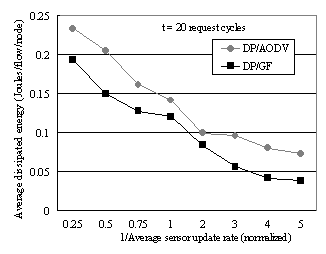
As shown in Fig. 7, the
power consumption measured for GF is lower than that for AODV. The primary reason is that AODV does not leverage geographical information, thereby consuming more energy
on route discovery. Hence for our simulations, we use GF as a routing algorithm. 4.1 Simulation
Results We
compare the performance of the data placement middleware against four baselines; (i) a simple
unicast-based query-response model, (ii) update multicast (synchronous push
model) (iii) directed diffusion,
and (iv) update flooding.
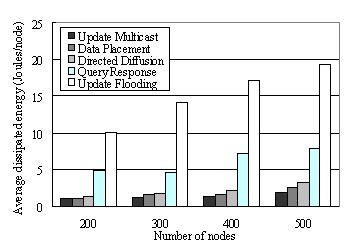
Fig 7: Average dissipated energy of data placement over AODV and GF The first experiment (Figure 8)
compares the energy consumption of the four aforementioned baselines for
different node densities. For this experiment, the
request rate is set, on average, to about two times the average update rate of the environment. Hence, regular (as
opposed to asynchronous) multicast should be an optimal policy. We vary the
number of nodes in the network over a grid of 200m x 200m. As we can see from
Figure 8,
flooding performs very badly. Traces reveal that power is wasted on both excessive
communication and collisions caused by the update messages flooding through the
network. The query-response scenario performs much better than flooding, but not
as good as data placement. Directed diffusion performs almost as good as data
placement. As expected, regular multicast performs best. The slight difference
between regular multicast and data placement is due to the somewhat higher
overhead of our scheme. As we show shortly, this overhead is offset by
considerable savings when the average update rate increases beyond the request
rate. Unlike regular multicast, a main feature of the data placement algorithm
is that it is adaptive and sensitive to changes in average sensor update rates.
When the sensor update rates are high, more replicas are refreshed at a rate
determined by the request rates and when the update rate is low, the copies are
refreshed only when an update actually occurs. Next we compare the performance
of the four baselines to that of our adaptive heuristic as the average update rate is changed.
These communication models are compared over a network of 400 nodes in a 200m x
200m grid each having a radio range of 25m. The sensor update rate is
normalized against the average request rate. The sensor update period is varied between 1.5 s
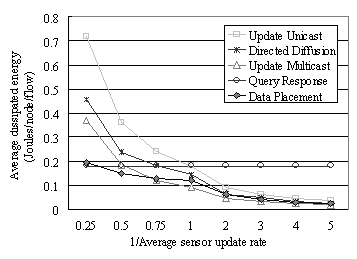
and 30 s. The average request rate is one per six seconds. In Figure
9, we show the average energy consumption in the steady state after all
observers have joined the tree. As can be seen from the figure, when the Sensor Update Rate is high
(i.e., 1/ Sensor Update Rate <1), the data placement algorithm performs
better than the simple query response model, the directed diffusion, and
update unicast because it does not send unnecessary updates. When the network is more
quiescent, it achieves results, which are quite close to the simple multicast
strategy. The difference between the two is the power overhead of adaptation.
Thus, our data placement middleware adapts to the volatility of the environment
resulting in a performance that is better than update multicast when the update rate is low, but
does not suffer a performance degradation in when the sensor update rate is high.
Fig 8: Average dissipated energy
Fig 9: Steady-state
dissipated
energy plotted against sensor update rate.
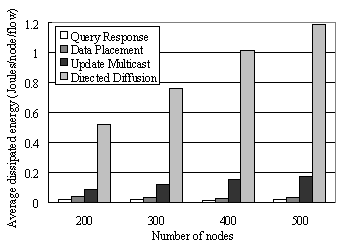
Fig 10: Energy
consumption in transient phase The next experiment is carried out in order to
measure energy consumed when a new observer joins the tree. In the data
placement, the new observer sends a join message to the origin sensor and the
nearest node is found to connect the observer. Figure 10
shows the average energy consumption per join during the transient phase of
tree construction. It is evaluated under the same environmental conditions as
in the preceding experiment. The transient phase in the case of directed
diffusion includes both initial flooding and multi-path sending before a single
path is chosen by the gradient. The data placement heuristic consumes less
energy than the update multicast and the energy dissipation does not depend
upon the number of nodes in the network. In our data placement algorithm, when a new data
copy is placed, neighbors of the new copy are no longer in the center of
gravity of their own neighboring nodes. Hence, as a rule, when the number or
locations of neighbors of some data copy change, the copy recalculates its
position to the new center of gravity. If the difference between the cost at
the new position and the cost at the old one is larger than a given threshold,
the old copy migrates to the new position. This migration, in turn, may cause
other surrounding nodes to migrate. The effect percolates through the tree
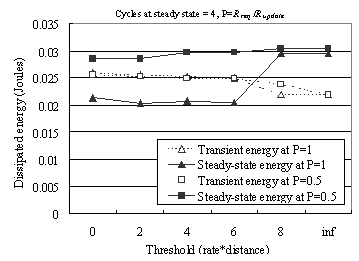
branch until no more nodes need to be moved. Figure 11
shows a transient and steady state energy consumption graph against various
threshold values in the data placement heuristic. A smaller threshold results
in more aggressive tree optimization. It entails more overhead for tree
construction, but results in lower power consumption at steady state.
Conversely, an extremely large threshold makes the tree essentially more
static. Transient overhead is reduced, but steady state power consumption
increases due to a less optimized tree. Observe that the difference between
power consumption at the two extremes is not that pronounced. This is because
network density is not infinite. Hence, a newly computed copy location is
likely to fall in a void between sensor nodes. As an approximation, the copy is
mapped to the closest node from that void. Even if the threshold is zero, it is
often the case that the new (optimized) position of a copy is close enough to
its current position so that the copy is mapped to the same node as before. No
move is therefore taken making the performance more similar to
that of a static tree.
Fig 11: Energy consumption in adjusting data
placement Next, we test system performance when the average update rate is a
non-stationary process, which changes drastically over short periods of time.
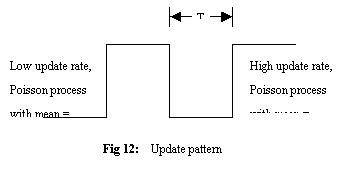
We use the average update traffic pattern shown in Figure 12. The sensor switches
between high and low average update rates with a period T. This average rate is
used to determine actual update inter-arrival times, drawn from a Poisson
distribution. This load model is used to simulate quiescent periods in the
environment interlaced with volatile periods. At high update times, the update
rate is made to be a Poisson distribution with mean of 0.5 times the maximum
request rate, and at low update times it is made to be a Poisson distribution
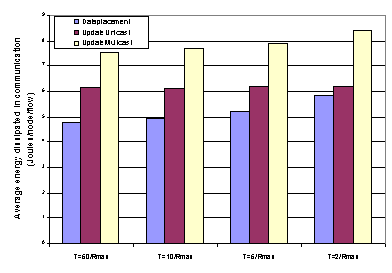
with mean of 3 times the request rate. Figure 13
shows the performance of the data placement algorithm for different values of
T. The network size was fixed at 300 nodes over a 200m x 200m grid. When T is
sufficiently larger than Rmax (Rmax is the
maximum request rate), data placement performs better than both query-response
and update multicast, because it adapts to suit both the high and low update
rates. As the average update rate is calculated as the inverse of the average
of the last five inter-arrival times, when T becomes less than 5Rmax,
this sampling becomes increasingly inaccurate. Since the average update rate
keeps changing rapidly, there are more failures and hence, the communication
savings decrease as might be expected.
Fig 13: Average dissipated energy for the three models for different values of T Another important concern to address is how the energy savings translate
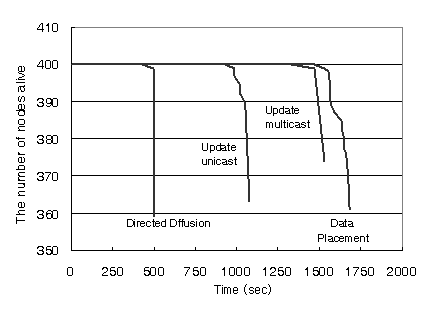
into an increase in the lifetime of the network. Figure 14 shows the fraction of nodes
that are alive versus network run-time. We simulate a network of 400 nodes, keeping other
parameters the same as earlier. Observers
and the origin sensor are set to have infinite energy. A
point to be noted here is that not all the nodes consume energy equally as some
nodes are more active than others. When a certain number of nodes die, the
network becomes partitioned, and parts of the network may become unreachable.
At this point we consider the network unusable. Figure 14 shows the time it takes the network to get
partitioned under various communication schemes. (The
end of the plot indicates when the network gets partitioned.) It is shown that the system lifetime with the data placement
heuristic is longer than with other baselines. As shown in Figure
9 and Figure 10, the data placement heuristic results
in fair energy savings in both the steady state and the transient state. Hence,
it increases system lifetime.
Fig 14: Lifetime of nodes in a sensor network using data placement 4.2 Effect of
Sampling of Rupdate As
mentioned in section 3.2,
there are several ways for accurately measuring Rupdate. We
argue that inaccuracy in measuring/predicting Rupdate has
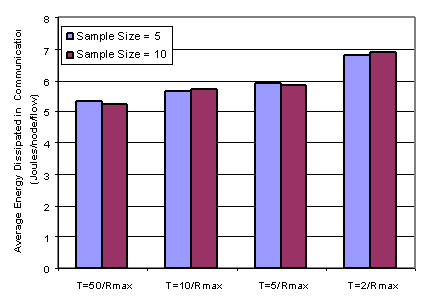
very little impact on the overall performance of Data Placement. Figure 15 evaluates
the sensitivity of power savings to the choice of the averaging interval for
the sensor reported rate, Rupdate. Averaging intervals 5 and
10 are compared. The simulated traffic is the same as in Figure
12 and the experimental setup
is the same as the experiment of Figure 13. The figure shows that power
savings are insensitive to the averaging interval.
Fig 15: Average Dissipated Energy using different sample sizes for Rupdate Thus, our simulation results show that our data placement middleware
gives us considerable energy savings irrespective of the amount of load or the
dynamic nature of the network. A point to note is that the energy savings are
not uniform over the whole network. They depend on the location of the
base-stations and the locations from where data is requested, just as the
communication without data placement would have expended energy non-uniformly.
In general, we expect the results to improve with network size. This is because
our main savings come from the use of adaptively constructed multicast trees.
Since the size of a well-balanced tree is logarithmic in the number of
recipients, power savings compared to unicast should increase exponentially
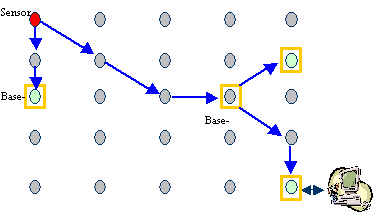
with tree size. 4.3 Prototypical Testbed Implementation To conclude our results, we constructed an experimental prototypical
mini-testbed from a 5 by 5 grid of motes with one light sensor at a corner, and
three base-stations (Figure 16). We ensured that a node can hear its immediately adjacent and
diagonal neighbors. The three base-stations request light data from the sensor
node, as shown in Figure 16. The base-station at the bottom right corner is connected to
the serial port of a PC, where an application package reads the packets being
received at the base-station.
Fig 16: Sensor Network Testbed The underlying routing protocol used is geographic forwarding, in which a
node forwards a packet to the neighbor that is closest to its destination. The
interface to the routing protocol accepts TinyOS commands from the data
placement middleware to send messages to a given node. In addition, it signals
an event when the message transmission is complete. The data placement layer
handles this event. The base-station (0) communicates with the PC using the serial port. Thus
this base-station has both a RS232 communication channel as well as RF
communication. In order to distinguish between the two channels, a special
address (0x7e) is assigned to the serial port interface. Thus a device
receiving a packet for this destination forwards the packet to the local UART
instead of the radio. The light sensor acquires 10-bit values for light intensities. The sensor
data is acquired by polling the light sensor. We define a resolution range of 5
bits, i.e., an update occurs only if any of the 5 most significant bits change.
We calculate the value of Rupdate by sampling the last 5
inter-update times. Our implementation of data placement has about 250 lines of code (C
statements), and the complete package including TinyOS and geographic
forwarding takes about 14.5KB of program memory. Thus memory-wise, the
middleware is not heavyweight in terms of memory.
Fig 17: Number of packets using the two approaches As has been discussed earlier, communication is the main sink for energy.
The motes have an idle mode in which the mote draws 5mA compared to 5mA in the peak model. To estimate actual energy
consumption on the motes, we measure the amount of communication in terms of
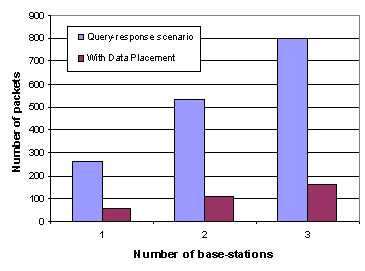
the number of packets in the network. Figure 17 shows the number of packets in the
network over a period of 200 seconds in a single trial run using data placement
and without data placement. Here the sensor gets updated approximately once
every 12 seconds. The base-stations request data once every 5 seconds. For the
cases on one and two base-stations, all possible combinations of the three
base-stations are considered, and the mean is taken. Though the savings in the number of packets are an order of magnitude,
this does not translate into proportional energy savings, since some power is
expended on listening (even when nothing is being received). Even so, we have
shown that we can get significant reduction in the number of packets in the
network. 5.
Related Work Wireless
sensor networks are a relatively new area of research. Traditional networking
paradigms are not directly applicable to this scenario. However, there has been
a lot of work lately on developing new paradigms and services for sensor
networks, taking into account the unique features of these networks. New
protocols are being developed for routing, MAC, data dissemination and location
services. Several hardware platforms as well as specialized operating systems
have also been developed. Since there are a number of parallel efforts, several
different paradigms and protocols are bound to come up. Our data placement
algorithm makes minimal assumptions about the underlying layers and the other
supporting services. One of the essential properties of a sensor network is that all the nodes
are location aware. Since the nodes cannot afford to have heavyweight GPS, they
have to use some location service, that estimates the location of the
individual nodes using some GPS equipped nodes as beacons. Nagpal [5] and Bulusu, Heidemann et al.[6][12] proposed
location estimation using beacons which does not require GPS at every node. In a network with thousands of nodes, it would be wasteful to assign
unique id’s to each node. Also, queries would be addressed by location, and
that would necessitate a location directory service, if unique id’s were used.
This would consume more resources. Papers by Heidemann, Silva et al. [3] and Imielinski, Goel [13] proposed addressing by geographical location
and attributes. Our data placement algorithm shall work both for fixed
addresses and addressing by location. For the case in which fixed addresses are
used, a location directory service is used to lookup mapping from node-id’s to
locations. To conserve energy from
communication, Xu, Heidemann, and Estrin [4]
have proposed a geographical adaptive fidelity (GAF) algorithm in which
equivalence classes of nodes are formed from a routing perspective. Their
method of energy conservation is to put nodes to sleep whenever possible. Our
data placement algorithm can co-exist with GAF, by putting the constraint that
nodes that are holding copies of the data cannot go to sleep until they handoff
their data to another node. The formation of a tree of copies along which the update is propagated is
similar to the formation of a multicast tree, where all the nodes are members
of the multicast group. In that sense, our work is related to multicast protocols. However, our approach differs from
traditional multicast routing
in several respects. First, updates are propagated
asynchronously in a lazy manner in accordance with consistency constraints. Second, the depth of our
tree is determined by the update and the request rates, and it adapts itself to
minimize the communication. Finally, our work is an
overlay multicast algorithm that works on top of the
network layer, rather than
traditional multicast routing [23][24] that takes place at the
network layer. In wired networks, End-to-end multicast and Scribe based on Pastry, are included into overlay multicast designs. Data placement is also similar to some of the ideas used in the placement
of web server replicas [1]. In these schemes, replicas of web server
content are placed online based on predicted demand. Data placement furthers this idea by using the property of
location-awareness of the sensor nodes. Another approach used in [21]
is to let the documents themselves decide their replication strategy. However,
in our case we make use of the homogeneity of the data, and the fact that the
sensors do not differentiate between types of data, to provide for a unified
replication strategy. Another approach has been geographical push-caching [22]
in which the server decides when and where to cache the files. This technique
would not work for a sensor network because a sensor node cannot keep track of
all the base-stations it is serving. In our approach, the sensor node only
needs to keep track of a small number of level-1 copies. ShopParent algorithm [30] is the latest work of publish/subscribe
tree construction in the wireless adhoc network. This greedy algorithm builds the tree in a distributed fashion and uses a
spanning tree to find a better outcome. Its model uses every node in the
network for tree construction, which makes searching for the nearest node
easier. However, the model is not available in the sensor network with a large
number of nodes. The ShopParent
is also different from ours in that it does not use a Steiner tree for multicast and does not use
location information. In recent years, research on Content Distribution Networks has focused on
replication and placement of content to improve performance over a large scale
distributed systems. Most of the work focuses on internet-type topologies and
scale [26][25]. Chord [26] uses a variant of consistent hashing to map a key to a node. Its scalability lies in
the fact that the amount of state that needs to be maintained by each node
scales logarithmically with the number of Chord Nodes. In [27],
the concept of Content Addressable Networks (CAN) is used for providing hashing
like functionality to retrieve data from replicas in the network. CAN routing
uses a co-ordinate routing table, and the network is visualized as a d-dimensional
space. It extends functionalities of DNS by providing a flexible naming scheme.
However replication in CAN is more hotspot driven. Another system, OceanStore [25], provides an infrastructure designed to span the globe and
provide access to persistent information. The primary difference between these
systems and data placement and replication in a sensor network is that the data
placement algorithm presented in this paper leverages the location information
available to the nodes to reduce power consumption. In contrast, work on CDN falls into two categories.
It either (i) ignores physical topology altogether, focusing on peer-to-peer
protocols defined in a logical overlay space, or (ii) optimizes the weight of
the tree assuming a heterogeneous network of known topology with point-to-point
links of different bandwidth. This
optimization is not applicable to wireless sensor networks, where the physical
network topology is unknown, yet it is the physical (i.e., geographic not
overlay) tree that needs to be optimized for power consumption. Geographic
information and energy consumption have been not considered in aforementioned papers. Finally, the problem addressed in this paper is somewhat reminiscent of
data placement in distributed shared memory systems [20].
As in shared memory systems, data in sensor networks can be thought of as a set
of objects manipulated by read() and write() operations. The write()
operations are performed by sensors. The read() operations are performed
by users. In shared memory systems, it is desired to maximize the average performance
of memory accesses given some desired data consistency semantics. In sensor
networks, the problem is to minimize average power consumption per data access
subject to data consistency constraints. Both problems reduce to finding
algorithms for appropriate dynamic placement of data objects in the network
such that communication is minimized. Sensor networks, however, due to their
fine granularity, large scale, and direct interaction with the physical
environment, exhibit significantly different data access patterns, consistency
constraints, and communication cost models than do distributed shared-memory
systems. Hence a new set of algorithms is called for to achieve power
minimization. 6.
Conclusion In
this paper, we have presented data placement as a means of reducing energy
consumption and, hence, increasing the lifetime of a sensor network. We present
an algorithm, which places copies of the requested data and updates them so as
to minimize the communication overhead and power consumption of data transfer. Our algorithm is completely distributed and requires very little local
processing. The amount of bookkeeping involved is small, which fits in nicely
with the constraint of limited memory resources. Also it makes minimal
assumptions about the underlying MAC and routing layers, although pro-active
routing algorithms like DSDV are not a good choice for these types of networks. In conclusion, data placement is a new approach for energy conservation
in wireless sensor networks. To our knowledge, very little previous work has
been done to apply data placement to a location-aware network. Further work such as accommodating quickly moving observers and
accounting for node failures needs to be done to introduce guarantees into the
data placement model. In the big picture, data placement may act as a service
that aids in providing power saving and QoS guarantees to applications running
on these sensor networks. This is analogous to how web-caching and content
distribution help in providing better performance and guarantees over the
Internet. Acknowledgements This
work was supported in part by DARPA grant F33615-01-C-1905, MURI grant
N00014-01-1-0576, and NSF grant CCR-0208769. References 1.
Lili Qiu, Venkata Padmanaban,
Geoffrey M Voelker, On the Placement of Web Server Replicas, Proc. IEEE INFOCOMM 2001. 2.
Chalermek Intanagonwiwat, Ramesh Govindan and Deborah Estrin, Directed
Diffusion: A Scalable and Robust Communication Paradigm for Sensor Networks, In
Proceedings of the Sixth Annual International Conference on Mobile Computing
and Networks (MobiCom 2000), August 2000, Boston, Massachusetts. 3.
John Heidemann,
Fabio Silva, Chalermek Intanagonwiwat, Ramesh Govindan, Deborah Estrin, and
Deepak Ganesan. Building Efficient Wireless Sensor Networks with Low-Level
Naming. In Proceedings of the Symposium on Operating Systems Principles (SOSP
2001), Lake Louise, Banff, Canada, ACM. October 2001. 4.
Ya Xu, John
Heidemann, and Deborah Estrin, Geography-informed Energy Conservation for Ad
Hoc Routing, Proceedings of the Seventh Annual ACM/IEEE International
Conference on Mobile Computing and Networking (MobiCom 2001), Rome, Italy, July
16-21, 2001. 5.
N. Bulusu, J.
Heidemann and D. Estrin, GPS-less Low Cost Outdoor Localization For Very Small
Devices, IEEE Personal Communications, Special Issue on "Smart Spaces and
Environments", Vol. 7, No. 5, pp. 28-34, October 2000. 6.
Radhika Nagpal,
Organizing a Global Coordinate System from Local Information on an Amorphous
Computer, MIT AI Memo 1666, August 1999 7.
Young-Bae Ko and
Nitin H. Vaidya, "Location-Aided Routing(LAR) in Mobile Ad Hoc
Networks," In Proceedings of the Fourth Annual ACM/IEEE International
Conference on Mobile Computing and Networking (MobiCom 1998), ACM, Dallas, TX,
October 1998. 8.
C. E. Perkins and
E. M. Royer, "Ad-hoc On Demand Distance Vector Routing." 2nd IEEE
Workshop on Mobile Computing Systems and Applications (WMCSA'99), New Orleans,
Louisiana, February 1999. 9.
Charles E. Perkins
and Pravin Bhagwat, Highly dynamic Destination-Sequenced Distance-Vector
routing (DSDV) for mobile computers, in SIGCOMM Symposium on Communications
Architectures and Protocols, (London, UK), pp. 212-225, Sept. 1994. 10.
M. Charikar, S. Guha, E. Tardos and D.B. Shmoys, A constant factor
approximation algorithm for the k-median problem. Proceedings of the 31st
Annual ACM symposium on Theory of Computing. 11.
M. Charikar and S.Guha, Improved Combinatorial Algorithms for the
Facility Location and K-median Problems. In Proc. Of the 40th Annual
IEEE Conference on Foundations of Computer Science, 1999. 12. N. Bulusu, J. Heidemann and D. Estrin, Adaptive Beacon Placement, Proceedings of
the 21st International Conference on Distributed Computing Systems (ICDCS-21),
Phoenix, Arizona, April 2001. 13. Tomasz Imielinski and Samir Goel, "DataSpace -
querying and monitoring deeply networked collections in physical space,"
IEEE Personal Communications Magazine, Special Issue on Networking the Physical
World, October 2000. 14. Philippe Bonnet,
J. E. Gehrke, and Praveen Seshadri. "Querying the Physical World,"
IEEE Personal Communications, Vol. 7, No. 5, October 2000, pages 10-15. Special
Issue on Smart Spaces and Environments. 15. J. Hill, R. Szewczyk, A. Woo, S. Hollar, D. Culler,
and K. Pister, " System architecture directions for network sensors,"
ASPLOS 2000. 16. Development platform for self-organizing wireless
sensor networks, Proc. SPIE, Unattended Ground Sensor Technologies and
Applications, Vol. 3713, p. 257-268. 17. A Compendium of NP
optimization problems http://www.nada.kth.se/viggo/problrmlist/compendium.html 18. Self-organizing
distributed sensor networks, Proc. SPIE, Unattended Ground Sensor Technologies
and Applications Vol. 3713, p. 229-237. 19. The ns-2
simulator. http://www.isi.edu/nsnam. 20. Distributed Operating systems. Andrew S.
Tanenbaum Prentice Hall. 21. Guillaume Pierre, Maarten van Steen, andAndrew S.
Tanenbaum, Self-replicating Web documents, Technical Report IR-486,
Vrije Universiteit, Amsterdam, February 2001, 22. The Case for Geographical Push Caching. Proceedings
of the Fifth Annual Workshop on Hot Operating Systems, Orcas Island, WA,
May 1995 23. E. M. Royer and C. E. Perkins, Multicast operation
of the ad-hoc on-demand distance vector routing protocol, in Proc. of ACM/IEEE
Intl. Conference on Mobile Computing and Networking (MOBICOM), Aug. 1999 24.
A Survey of
Multicast Technologies (2000), Vincent Roca, Luís Costa,
Rolland Vida, Anca Dracinschi, Serge Fdida September 2000. 25.
J. Kubiatowicz, D.
Bindel, Y. Chen, S. Czerwinski, P. Eaton, D. Geels, R. Gumadi, S. Rhea, H.
Weatherspoon, W. Weimer, C.Wells, B. Zhao. Oceanstore: An Architecture for
Global-scale Persistent Storage. In the Proceedings of ASPLOS 2000,
Cambridge, Mmassachusetts, Nov. 2000. 26.
I. Stoica, R. Morris,
D. Karger, f. Kaashoek, H. Balakrishnan. Chord: A Scalable Peer-to-Peer lookup
Service for Internet Applications. In Proceedings of ACM Sigcomm 2001,
San Diego, CA, Aug. 2001. 27.
S. Ratnasamy, P.
Francis, M. Handley, R. Karp, S. Shenker. A Scalable Content-Addressable
Network. In Proceedings of ACM Sigcomm 2001, San Diego, CA, Aug. 2001. 28.
A. Woo, and D. Culler. A Transmission Control
Scheme for Media Access in Sensor Networks, Proceedings of the Seventh
Annual ACM/IEEE International Conference on Mobile Computing and Networking
(MobiCom 2001), Rome, Italy, July 16-21, 2001. 29.
B. Karp and H. Kung, Greedy Perimeter Stateless Routing, in Proc. of the Sixth Annual ACM/IEEE
Intl. Conference on Mobile Computing and Networking (MOBICOM), Boston, 2000. 30.
Yongqiang Huang,
Hector Garcia-Molina. Publish/ Subscribe Tree Construction in Wireless Ad-Hoc
Networks, 4th International Conference on Mobile Data
Management, January, Melbourne, Australia, 2003. |
|
This paper was originally published in the
Proceedings of the
The First International Conference
on Mobile Systems, Applications, and Services,
May 5 – 8, 2003,
San Francisco, CA, USA
Last changed: 30 Apr 2003 djc |
|