| ||||||||||||||||||||||||||||||||||||||||||||||||||||
|
JVM '02 Paper
[JVM '02 Tech Program Index]
An Empirical Study of Method Inlining for a Java Just-In-Time Compiler Toshio
Suganuma
Toshiaki Yasue Toshio Nakatani IBM Tokyo Research Laboratory 1623-14 Shimoturuma, Yamato-shi, 242-8502 Japan {suganuma,
yasue, nakatani}@jp.ibm.com ABSTRACT Method
inlining is one of the optimizations that have a significant impact on both
system performance and total compilation overhead in a dynamic compilation
system. This paper describes an empirical study of online-profile-directed
method inlining for obtaining both performance benefits and compilation time
reductions in our dynamic compilation system. We rely solely on the profile
information in deciding which methods should be inlined along which call paths,
without employing the existing static heuristics, except that methods with
extremely small bodies are always inlined. The call
site distribution and invocation frequency are collected using dynamically
generated instrumentation code, and are given to the recompilation controller
for analyzing and organizing the inlining requests. The experimental
results show that the strategy of relying on the profile information in method
inlining decision is quite effective for reducing compilation overhead and/or
for improving the performance. It can also provide flexibility for inlining
decisions based on the type of profile, such as spiky or flat profiles. The
results show that the strategy can be the basis of automatic optimization
selection for a future efficient dynamic compilation framework. 1. INTRODUCTIONDynamic compilation systems need to reconcile the
conflicting requirements between fast compilation speed and fast execution
performance. We would like the system to generate highly efficient code for
good performance, but the system needs to be lightweight enough to avoid any
startup delays or intermittent execution pauses that may occur due to the
runtime overhead of the dynamic compilation. The high performance implementation of Java Virtual
Machines (JVM) is moving toward exploitation of adaptive compilation
optimizations on the basis of online runtime profile information [1][9][20][23]. Typically these systems have multiple execution
modes. They begin the program execution using the interpreter or baseline
compiler as the first execution mode. When the program’s frequently executed
methods or critical hot spots are detected, they use the optimizing compiler
for those selected methods to run in the next execution mode, obtaining better
performance. Some systems employ several different optimization levels to
select from based on the invocation frequency or relative importance of the target
methods. In
these systems, the set of optimizations provided for each optimization level is
predetermined. Basically those optimizations considered to be lightweight, such
as those with linear order to the size of the target code, are applied in the earlier
optimization levels, and those with higher costs in compilation time or greater
code size expansion are delayed to the later optimization levels. However, the
classification of optimizations into several different levels has been either
intuitive work or just based on the measurements of compilation cost and performance
benefit on a typical execution scenario analyzed offline [2]. Consequently, the optimizations applied are not
necessarily effective for the actual target methods compiled with the given
optimization level. That is, some optimizations may not be able to contribute
to any useful transformation for performance improvement, but can result in a
waste of compilation resources. The
problem here is that we equally apply the same set of optimizations for those
methods selected to compile at that optimization level, regardless of the type
and characteristics of each method. Ideally it is desirable to dynamically
assemble a set of suitable optimizations depending on the characteristics of
the target methods so that we can apply only those optimizations known to be
effective for the method. It would be better for the total cost and benefit management,
if we could not only selectively apply optimizations on performance critical
methods, but also selectively assemble the optimizations that are effective for
those methods. Method
inlining, a well-known and very important technique in optimizing compilers,
expands the target procedure body at the method invocation call sites, and it
defines the scope of the compilation boundary. Toward the big picture of the
efficient compilation framework, method inlining can naturally be the first
target for a dynamic compilation strategy by exploiting the profile information
collected at runtime, since it is one of the optimizations that have a most
significant impact on both performance and compilation overhead. In
this paper, we describe an empirical study of an online-profile-directed method
inlining strategy in our dynamic compilation system. We rely solely on the
profile information for deciding which methods should be inlined along which
call paths. Though many static heuristics exist, the only one we use is to
always inline very small methods. The ultimate goal of our research is to
explore the opportunities for dynamic automatic optimization selections, and
the first step is to evaluate the potential benefits and limitations of this
approach for method inlining. The
following are the contributions of this paper: l Online collection of call site
information: We
present a mechanism for dynamic instrumentation, which collects the call sites
distribution and invocation frequency for hot methods in order to help make
decisions on method inlining during recompilation. This is quite different from
the existing approach of constructing a dynamic call graph through sampling
during the entire period of program execution. l Detailed evaluation of
profile-directed method inlining policies: We present detailed evaluation results of the
benefits and limitations regarding both performance and compilation overhead
for several inlining policies: two variations of profile-directed method
inlining, existing static inlining heuristics, and a hybrid of both. We also
evaluated inlining based on offline-collected profile information to know the
upper bound of the potential of the profile-directed method inlining. The
rest of this paper is organized as follows. The next section is an overview of
our dynamic compilation system, and describes the existing inlining policy and
potential impacts on both performance and compilation time. Section 3 describes
our design and implementation of online-profile-directed method inlining using
the instrumentation-based information about call site. Section 4 presents the
experimental results on both performance and compilation overhead by comparing
several inlining policies. Section 5 discusses the results and possible future
research towards automatic optimization selection. Section 6 summarizes the
related work, and finally Section 7 presents our conclusions. 2. BACKGROUNDThe
overall system architecture of our dynamic optimization framework is described
in detail in [23]. In this section, we briefly describe the system
characteristics and features that are closely related to this study, and then
we describe the existing static-heuristics-based inlining policy and its impact
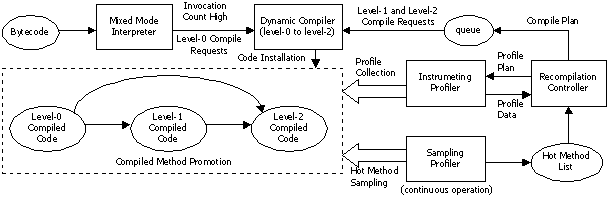
on both compilation time and performance. 2.1 System OverviewFigure
1 depicts the overall architecture of our system. This is a multi-level
compilation system, with a mixed mode interpreter (MMI) and three compilation
levels (level-0 to level-2). Initially all methods are interpreted by the MMI.
A counter for accumulating both method invocation frequencies and loop
iterations is provided for each method and initialized with a threshold value.
The counter is decremented whenever the method is invoked or loops within the
method are iterated. When the counter reaches zero, the method is considered as
frequently invoked or computation intensive, and the first compilation is triggered.
The
dynamic compiler has a variety of optimization capabilities. The level-0
compilation employs only a very limited set of optimizations for minimizing the
compilation overhead. For example, it considers method inlining only for extremely
small target methods as described in Section 2.2. It disables most of the
dataflow optimizations except for very basic copy and constant propagation. The
level-1 compilation enhances level-0 by employing additional optimizations,
including more aggressive full-fledged method inlining, a wider set of dataflow
optimizations, and an additional pass for code generation. The level-2
compilation is augmented with all of the remaining optimizations available in
our system, such as escape analysis and stack object allocation, code scheduling,
and DAG-based optimizations[1]. The level-0 compilation is invoked from the MMI
and is executed as an application thread, while level-1 and level-2
compilations are performed by a separate compilation thread in the background.
The upgrade recompilation from level-0 compiled code to higher-level optimized
code is triggered on the basis of the hotness level of the compiled method as
detected by a timer-based sampling profiler [24]. Depending on the relative hotness level, the method can
be promoted from level-0 compiled code to either level-1 or directly to level-2
optimized code. This decision is made based on different thresholds on the
hotness level for each level-1 and level-2 method promotion. The sampling profiler periodically monitors the
program counters of application threads, and keeps track of methods in threads
that are using the most CPU time by incrementing a hotness count
associated with each method. The profiler keeps the current hot methods in a
linked list, sorted by the hotness count, and then groups them together and
gives to the recompilation controller at every fixed interval for upgrade recompilation.
The sampling profiler operates continuously during the entire period of program
execution to adapt effectively to the changes of the program’s behavior. There
is another profiler, an instrumenting profiler, used when detailed information
needs to be collected from the target method. The instrumenting profiler, when
invoked, dynamically generates code for collecting specified data from the
target method, and installs it into the compiled code by rewriting the entry
instruction of the target. After collecting a predetermined amount of data, the
generated instrumentation code automatically uninstalls itself from the target
code in order to minimize the performance impact. Thus the compiler can take
advantage of the online profile information dynamically collected at runtime
for the level-1 and level-2 compilations. This instrumentation mechanism is
used for collecting call site distributions and execution frequencies to guide
method inlining in this study. This
dynamic instrumentation mechanism allows the intensive monitoring of the
runtime application behavior for a certain interval of the program’s execution.
By combining this technique with the sampling profiler, we can benefit from two
nice properties of online profiling: low overhead and reliable profiling
results. It is low overhead because we can limit the targets of the
instrumentation to only those hot methods we are interested in for
recompilation. It is reliable because we can obtain representative profiles for
real applications by delaying the instrumentation installation until the
program hot regions are discovered. 2.2 Static Heuristics Based InliningOur
dynamic compiler is able to inline any methods regardless of the context of the
call sites and the types of caller or callee methods. For example, there is no
restriction in inlining synchronized methods or methods with try-catch blocks,
nor against inlining methods into call sites within a synchronized method or a
synchronized block. Thus the inlining decision can be made purely from the
cost-benefit estimate for the method being compiled. There
is a class of methods in Java that simply result in a single instruction of
code when compiled, such as the one just returning an object field value. Other
methods may turn out to be very small number of instructions for their procedure
body after compilation. We call these tiny methods. Our implementation
identifies them based on the estimated compiled code size[2]. Tiny method: This is a
method whose estimated compiled code is equal or less than the corresponding
call site code sequence (argument setting, volatile registers saving, and the
call itself). That is, the entire body of the method is expected to fit into
the space required for the method invocation. Since
invocation and frame allocation costs outweigh the execution costs of the
method bodies for these methods, and since inlining them is considered
completely beneficial without causing any harmful effects in either compilation
time or code size expansion, they are always inlined at all compilation levels.
Otherwise we employ static heuristics to perform method inlining in an
aggressive way while keeping the code expansion within a reasonable size. The
inliner first builds a possibly large tree of inlined scopes with allowable
sizes and depths using optimistic assumptions, and then looks at the total cost
by checking each individual decision to come up with a pruned final tree. When
looking at the total cost, the inliner manages two separate budgets
proportional to the original size of the method: one for tiny methods (and
profile-directed methods, if any), and the other for any type of method. It
tries to greedily incorporate as many methods as possible in the given tree
using the static heuristics until the predetermined budget is used up.
Currently the static heuristics consist of the following rules. l If the total number of local
variables and stack variables for the method being compiled (both caller and
callees) exceeds a threshold, reject the method for inlining. l If the total estimated size of the
compiled code for the methods being compiled (both caller and callees) exceeds
a threshold, reject the method for inlining. l If the estimated size of the
compiled code for the target method being inlined (callee only) exceeds a
threshold, reject the method for inlining. This is to prevent wasting the total
inlining budget due to a single excessively large method. l If the call site is within a basic
block which has not yet been executed at the time of the compilation, then it
is considered a cold block of the method and the inlining is not performed. On
the other hand, if the call site is within a loop, it is considered a hot block,
and the inlining is tried for deeper nest of call chains than for outside a
loop. The
devirtualization of dynamically dispatched call sites is done at all
compilation levels based on the class hierarchy analysis (CHA) and type flow
analysis, and it produces either guarded code (via class tests or method tests)
or unguarded code (via code patching on invalidation) [15]. Preexistence analysis is also performed to safely
remove guard code and back-up paths without requiring on-stack replacement [11]. The resulting de-virtualized call sites then may or
may not be inlined according to the static rules described above. Only
tiny methods are inlined in level-0 compilation. In level-1 and level-2
compilation, the broader range of methods within the conditions of the above
static heuristics are considered for inlining. There is no difference between
level-1 and level-2 compilation in terms of the scope and aggressiveness of
inlining. As a result of method inlining, a data structure called an inlined method
frame (IMF) is produced for each call site to provide information about the
inlining context for the runtime system, which needs to know the exact call
stack and call context prior to inlining. For example, the security manager requires the
correct depth of the current call-chain on the stack, or a runtime exception is
raised. The exception handler also requires the inlining context of call sites
in order to keep track of the handlers for catching exceptions from the current
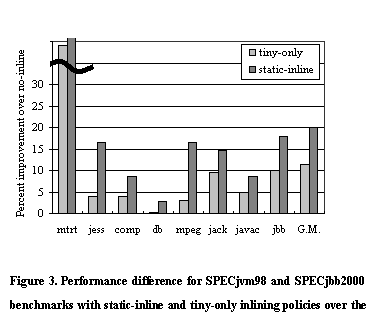
context. Figure
2 shows the compilation overhead for three different policies of method
inlining when running two industry standard benchmarks. Static-inline
indicates using the existing static heuristics for inlining in level-1 and
level-2 compilation, tiny-only means inlining only tiny methods in
level-1 and level-2 as well as level-0 compilation, and no-inline
performs no method inlining at any level of compilation regardless of the size
of the target methods. Note that devirtualization is still enabled for all
three cases. The data was collected based on the system configuration described
in Section 2.1 and using the methodology described in Section 4.1. Each
bar gives a breakdown of where in the optimization phase time is spent for
compilation. Flow-graph indicates the time for basic block generation,
inlining analysis to determine the scope of the compilation boundary, and flow
graph construction for the expanded inlined code. Dataflow-opt is the
time for a variety of dataflow-based optimizations, such as constant and copy
propagation, redundant null-pointer and array-bound check elimination. DAG-opt
is for DAG-based loop optimization and pre-pass code scheduling. Code-gen
includes the time for register assignment, code generation, and code
scheduling. Others denotes memory management cost and any other code
transformations, including live analysis and peephole optimizations, each
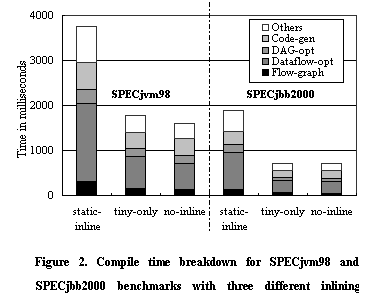
costing less than 5% of the total compilation time. Figure 3 shows the
performance differences between the same set of three inlining policies.
As
we can see in these figures, method inlining has significant impact on both
compilation time and performance. With the static-inline policy, the time spent
for inlining analysis and flow graph construction itself is not a big part of
the total overhead, but optimizations in later phases, dataflow optimizations
in particular, cause a major increase of the compilation time due to the
largely expanded code that has to be traversed. The code size expansion and the
work memory usage also have similar increases with this inlining policy,
although the data is not shown here due to space limitations. The
tiny-only inlining policy, on the other hand, has very little impact on
compilation time, as expected, while it produces significant performance
improvements over the no-inline case. For some benchmarks, it provides a
majority of the performance gain that can be obtained using the static-inline
policy. On average, it contributes a little over half of the performance
improvement compared to the static-inline policy. From these figures, our
current policy of always inlining tiny methods is clearly justified. 3.
PROFILE-DIRECTED
INLINING
Method
inlining can significantly impact both costs and benefits of compilation as
shown in the previous section. We would like to apply this expensive but
effective optimization selectively, rather than statically, based on dynamic
program execution behavior, only for program points that are expected to
provide the maximum performance benefits. We basically remove any existing
static heuristics for method inlining as described above, except for always
inlining tiny and small sized methods, and totally depend on the online profile
data. Section 3.1 describes how the profile data can be collected for
extracting potential candidates for method inlining, and Section 3.2 provides
the procedure for identifying exact call paths to make inlining requests before
recompilation. Section 3.3 describes the problem of
handling small methods, and Section 3.4 discusses how to make inlining
decisions more appropriate for flat profile applications. 3.1 Collection of Call Site InformationAs
described in the previous section, we exploit the dynamic instrumentation
mechanism for collecting information on the call site distribution and
execution frequency at runtime. The instrumentation is basically applied for
all hot methods that are detected by the sampling profiler and which are
candidates for promoting to the next level of optimization. Since the instrumentation
code in this case is to find the most beneficial candidates among the call
sites where the current target method can be inlined, we need to ensure whether
the current target is appropriate for inlining, or otherwise performing
instrumentation is just overhead. Thus those methods that are apparently not
inlinable into other methods (due to excessively large size, for example) are
excluded as targets for instrumentation. Methods already compiled with the
highest level of optimization are also excluded, since they are methods already
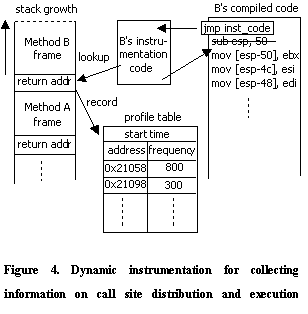
considered for inlining but not inlined in the previous round of compilation. As
shown in Figure 4, the code generated by the instrumenting profiler is
dynamically installed in the target code by replacing the entry code (after
copying it into the instrumentation code region) with an unconditional jump
instruction to direct control to the instrumentation code. At its first entry,
the instrumentation code stores the current time stamp. It then examines the
return address stored on the top of the current stack, and records it in a form
of table with values and their corresponding frequencies. Because of the overhead, only the single-level history in
the call stack is recorded. The maximum number of entries in the table
is fixed. When the predetermined number of samples has been collected, the code
again checks the current time and records how long it took to collect those
samples by subtracting the start time. The code then uninstalls itself from the
target code by restoring the original code at the entry point[3].
Thus
two kinds of information can be collected for each method during an interval in
the program’s execution: the distribution of callers and the frequency of
invocations. The time recorded for sample collection indicates call frequency
for the method for that fixed number of instrumentation samples. Since the
hotness-count provided by the sampling profiler can largely depend on the size
of the target method (it is easier for larger methods to get more sampling
ticks), small but very frequently called methods may not receive the attention
they deserve. In that sense, the fine-grained frequency information can be
useful in identifying hot call edges critical for inlining, and in compensating
for the rather coarse-grained hotness count of the sampling profiler. The
instrumentation is successively applied to a group of recompilation target
methods provided by the sampling profiler at every fixed sampling interval.
After installation, the recompilation controller periodically monitors the
completion of profile collections on all of these methods, and if completed, it
proceeds to the inlining analysis step described in the next section. This is
implemented by setting a maximum wait count for the recompilation controller to
give up the thread execution. If necessary, it stops profiling for methods that
are invoked very infrequently and which will never reach the predetermined
number of samples by directly manipulating the current profile count for those
methods.
3.2 Profile-Based Inlining DecisionThe
recompilation candidates grouped together and given to the recompilation
controller are then examined to identify the hot call paths appropriate for
inlining among them. Upon completion of collecting the call site information,
the decision on requesting method inlining proceeds with the following steps. 1.
Examination
of the call site distribution profile: For each of the instrumented methods, the
profiling result is examined in the first step. If there are just one or a few
dominant call sites found in the profile information and the execution
frequency is not too low, these are considered important candidates for
inlining and thus a connection is created between the caller and the callee for
each hot call edge. The edge is associated with a distribution ratio based on
the count given to the corresponding call site address in the profile[4].
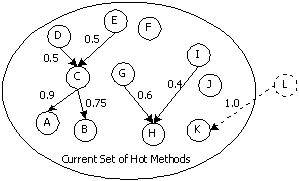
At the end of this step, a partial call graph is constructed, where nodes
indicate recompilation candidate methods, each of which has a hotness count,
and edges show dominant call connections from caller to callee, each assigned a
distribution ratio (see Figure 5). 2. Identifying exact call paths
appropriate for inlining: In the next step, we identify the exact call paths for inlining requests by
traversing the connection between multiple methods. We begin with a method having
no outgoing edge, and traverse the connections up to the top of the call chain.
In the traversal of the connections, the following two operations need to be
done: Call site address conversion: Since the raw data of the profile
information indicates a set of compiled code addresses where the invocation was
made to the current target method, it does not specify the exact call sites in
the original form of the method bodies. The compiled code address is therefore
converted to the offset of the corresponding bytecode instructions using the
table generated at compile time. Hotness count adjustment: This is to correct the relative
hotness level by assuming that inlining for the connected methods is performed.
A portion of the hotness count of the callee (including values from its
children) is distributed to each of its callers according to the ratio for each
incoming edge. When dividing hotness counts from
children into their multiple callers, the distribution ratio cannot be known
precisely, because the profile information is not available for multiple-level
histories of the call paths. Therefore, we use a constant ratios assumption
[21] to approximate the actual ratio. That is, we assume
the ratio is the same as the one recorded in the profile. 3.
Request
for method inlining: Finally, inlining requests are made for the hot call paths identified
above. These requests are stored in a persistent database so that inlining
decisions can be preserved for future recompilation to incorporate the previous
inlining requests. This is important, as described in both the Self-93 [14] and Jalapeño [1] systems, to avoid a performance perturbation
resulting from oscillating between two compiled versions of a method, each with
a different set of inlining decisions. 4.
Recompilation
request: After all
the relationships between the hot methods in the given group are examined and
appropriate inlining is requested, the list of hot methods is again traversed
to issue the final recompilation requests. If a method in the list is requested
to be inlined into another method, and there is no other call site for this method
found in the profile information, then the method is removed from consideration
for recompilation. Likewise, those methods whose hotness count is below a
threshold value as a result of the hotness count adjustment are discarded. A
method already compiled with the highest optimization level will be recompiled
again only when a new inlining request has been made and its estimated impact
is above a threshold value. Since
we consider the inlining possibilities among hot methods appearing in the group
of hot methods, and since this group comes from sampling during an interval in
the program execution, the resulting inlining requests are expected to
contribute for a performance boost. In Step 2, however, there may be a call
path where a caller is not included in the current group of hot methods, and it
is possible to request inlining for such a case as well, as shown by the dashed
line circle in Figure 5. This can be considered to be more aggressive inlining,
and is evaluated in Section 4 as a variation of our profile-directed inlining.
We do not trigger the recompilation for the caller in this case, since the
method is not known to be worth upgrading to higher optimization at this time.
We leave such a method for the future until it is be promoted by the sampling
mechanism, at which time the inlining requests previously made for this method
will all be incorporated in the recompilation. 3.3 Small MethodsInlining
with the above mechanism is only possible when the target method is identified
as hot for dynamic instrumentation. Although tiny methods are always inlined,
there are still some chances that other methods with very small bodies will be
missed for selection as recompilation candidates due to the sampling nature of
the profiler, and in that case it is unable to consider the inlining
possibilities for those methods. To remedy this problem, small methods are also
inlined, in addition to tiny methods, in level-1 and level-2 compilation under
profile-directed inlining. It is difficult to define small methods. In contrast with tiny methods,
inlining them may cause some additional overhead for both compilation time and
code size expansion. The timer interval of the sampling profile affects which
small methods may be overlooked as inlining candidates. Our goal here is to
spot as many of these overlooked candidates as possible, but also to minimize
additional compilation overhead that can result from statically inlining these
methods. In our current implementation, small methods are defined such that the
estimated compiled code is less than the total invocation overhead occurred in
both caller and callee (the method prologue and epilogue, in addition to the
call site code sequence itself). 3.4 Flat Profile ApplicationsBenchmarks
and applications can be roughly categorized into two different sets, each
having distinct characteristics in their profiles: spiky or flat profiles. For
the spiky profile applications, there are only a few very hot or scorchingly
hot methods, and therefore fully optimizing those methods is sufficient to
obtain the best possible performance. The remaining methods mostly have nothing
to do with the total system performance. It is relatively easy for any type of
profiling mechanism to detect those important methods, and thus this type of
application is amenable in general for a dynamic optimization system. On
the other hand, the flat profile applications, such as jack and javac in SPECjvm98, are considered more difficult and challenging for the
dynamic compilation system to improve performance. For example, method inlining
is less effective for these applications involving a large number of methods
that are almost equally important. Consequently, method inlining based on
static heuristics, applying the same strategies for any type of method, does
not seem to work well for this type of application, as we can see from the
relative performance difference between tiny-only and static-inline in Figure
3. Profile-based
inlining is expected to work more effectively than the static heuristics by
dynamically changing the inlining decisions depending on the type of
application. Since the cost/benefit trade-off line is considered to be higher
for flat profile applications than for those with spiky profiles, due to the
smaller impact on total performance from inlining individual call sites, method
inlining needs to be performed even more selectively. In our implementation, we
detect a flat profile for a given group of hot methods based on the average
hotness count and the differences between maximum and minimum hotness counts
among those hot methods not yet compiled with the highest optimization level.
When making a inlining request, we require each edge of the call path to have
either a single caller or a very high frequency with a few dominant call sites. 4.
EXPERIMENTAL
RESULTS
This
section presents some experimental results showing the effectiveness and
advantages of the profile-directed method inlining in our dynamic compilation
system. We outline our experimental methodology first, describe the variations
of inlining policies used for the evaluation, and then present and discuss our
measurement results. 4.1 Benchmarking MethodologyAll the performance results presented in this section were obtained on an IBM IntelliStation M Pro 6849 (Pentium4 2.0 GHz uni-processor with 512 MB memory), running Windows 2000 SP2, and using the JVM of the IBM Developer Kit for Windows, Java Technology Edition, version 1.3.1 prototype build. The benchmarks we chose for evaluating our system are SPECjvm98 and SPECjbb2000 [22]. SPECjvm98 was run in test mode with the default large input size, and in autorun mode with 10 executions for each test, with the initial and maximum heap size of 96 M. SPECjbb2000 was run in the fully compliant mode with 1 to 8 warehouses, with the initial and maximum heap size of 256 M. The
following parameters were used in these measurements. The threshold in the
mixed mode interpreter to initiate level-0 compilation was set to 500. The
timer interval for the sampling profiler for detecting hot methods was 5
milliseconds. The list of hot methods was then examined every 200 sampling
ticks. The number of samples to be collected for an instrumentation-based call
site profile was set to 1024, and the maximum number of data variations
recorded was 8. Exception-directed optimization (EDO) [19] was disabled, because EDO drives its own inlining
requests based on the exception path profiles and the mixed inlining requests
would make the evaluation for our approach more difficult. Five
inlining policies are compared as described below, one with the current static
inlining heuristics, and the others using profile-directed inlining with
different degrees of aggressiveness or combined with the static heuristics. The
baseline of the comparison is with the policy inlining tiny methods only. 1.
Static: This employs the existing static
heuristics for method inlining in level-1 and level-2 compilation. No profile
data on call site information is collected, and the recompilations are
requested according to the relative hotness from the sampling profiler. 2.
Profile-1: This disables all the static
heuristics for inlining except for tiny methods, which are always inlined, and
small methods, which are inlined in level-1 and level-2 compilations. Inlining
other than for these small methods is based solely on the profile information.
The inlining requests are conservative in that all the methods called through
the hot call path must appear in the group of hot methods. 3.
Profile-2: This is the same as Profile-1, but
more aggressive inlining can be requested for callers that are not in the
current group of hot methods. In such cases, the inlining is requested for the
methods in the call path within the current group, as well as for the topmost
method of the call chain outside of the group. 4.
Hybrid:
This is the same as
Profile-1, but also using the current static heuristics if the inlining budget
is still not used up after accepting all of the profile-based inlining requests. 5.
Offline:
This is the same as
Profile-1, but inlining decisions are made using the offline collected profile
information. Section 4.5 gives details regarding how the offline profile
information is collected and then used for measurement. When
measuring the compilation overhead in Section 4.3, we measure only level-1 and
level-2 compilation statistics, since level-0 is common among all four cases.
The compiler is instrumented with several hooks for each part of the
optimization process to record the value of the processor’s time stamp counter.
The priority of the compile thread (for level-1 and level-2) is set higher than
normal application threads, so the difference between each value from the time
stamp counter is guaranteed to provide time spent for performing the
corresponding optimization work, and also the difference in the value between
the beginning and the end of the compilation should be the total compilation
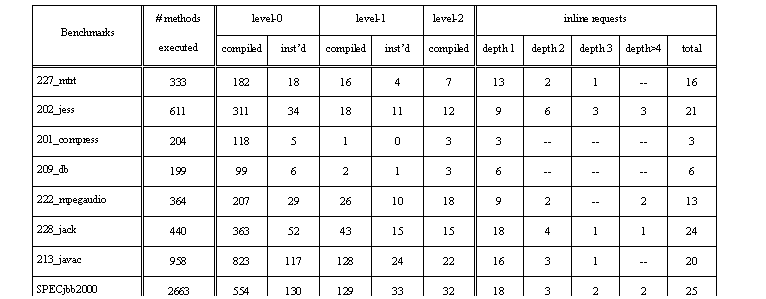
time. 4.2 Instrumentation and Inlining StatisticsTable
1 shows the compilation statistics when running the benchmarks with the
profile-1 inlining policy. The second column of the table shows the total
number of methods executed (without the effects of inlining). Native methods
are not included. The next five columns show the number of compiled and instrumented
methods for each of the optimization levels. No instrumentation is applied to
level-2 compiled code, as mentioned in Section 3.1. The count is cumulative, so
if a method is level-0 compiled and then promoted to level-1, then it is
counted in both categories. The last five columns show the total number of
inlining requests made through four steps described in Section 3.2. The number is per call site, so if two inline requests are
issued for a method, inlining it into two different call sites within a method,
then both are counted as inline requests. The
number of instrumented methods is mostly 10% or less of the compiled methods in
level-0 for spiky profile benchmarks (top five in the table) and about 15% to
20% for flat profile benchmarks (bottom three). The number is about 30% or
greater of the compiled methods in level-1. These figures are almost the same
as the proportion of methods that are promoted from each level. The
inlining decision seems to work very selectively for each benchmark. The total number of inlining requests relative to the
number of compiled methods at level-1 and level-2 is significantly smaller for
flat profile benchmarks compared to spiky profile ones, reflecting the strict requirements
for call paths to be requested for inlining in terms of the degree of bias in
call site distributions.
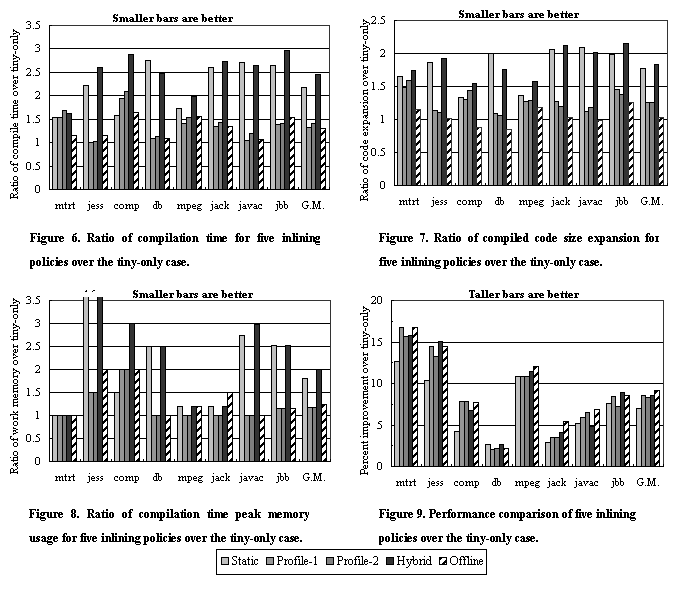
4.3 Compilation OverheadFigures
6 to 8 show various data for compilation overhead: the compilation time,
compiled code size expansion ratio over the bytecode size, and compilation time
peak work memory usage. Smaller bars mean better scores in these figures. The
compiled code size used for profile-based inlining policies (profile-1,
profile-2, and hybrid) includes additional code space that is dynamically
allocated for instrumentation. The peak memory usage is the maximum amount of
memory allocated for compiling methods. Since our memory management routine
allocates and frees memory in 1 Mbyte blocks, this large granularity masks the
minor differences in memory usage and this causes the result of Figure 8 to
form clusters. Overall
the profile-based inlining (both profile-1 and profile-2) shows significant
advantages over the existing static-heuristics-based inlining in most of the
benchmarks. At worst, it does not exceed twice the baseline (the tiny-only
inlining policy) in all three metrics of the compilation overhead. In the best
case, it is almost equal to the level of tiny-only, apparently due to the
minimum number of inlining requests made only for those call sites deemed beneficial
for performance improvement. The code size expansion
ratio is greatly reduced for some benchmarks, even taking the instrumentation
code into account. On average, the compilation overhead (in all three metrics)
is just about a 20% to 30% increase from the baseline, and almost a 40%
reduction compared to static-heuristics-based inlining. There
are a few exceptions to these general observations. Compress shows degradation with
profile-based inlining, and mtrt shows no significant improvement in all three indications of compilation
overhead. As shown in Table 1, however, compress has a very few hot methods,
resulting in relatively low level of compilation overhead regardless of the
inlining policy. In the profile-based inlining case, two inlining requests were
actually made for the same method, Compressor/compress, but with different timings because of the
group of hot methods supplied by the sampling profiler. Thus the method was
compiled twice with full optimization, first with one inlining request and then
with an additional request identified later. Because of the low level of
compilation overhead, this additional level-2 compilation was enough to cause a
seemingly big difference in these ratios. Mtrt suffers for almost the same reason. An
additional inlining request was made to one of the hottest methods OctNode/Intersect, after the callee for the call edge
had become hot, triggering the second level-2 compilation, and this made the
total compilation time increase significantly. As
expected, the hybrid inlining policy generally shows a similar amount of
overhead as the static heuristics, but it sometimes causes significantly higher
overhead. The overhead for compress is high for the same reason described above, but for the other benchmarks,
the poor scores are due to the aggressiveness of the static heuristics applied
after processing the profile-requested inlining. This inlining policy seems
unattractive from the viewpoint of compilation overhead.
4.4
Performance
Comparison
Figure
9 shows the performance improvement with the five inlining policies over the
tiny-only inlining case. Taller bars show better performance. For each inlining policy, we took the best time from 10
executions of an autorun sequence for each test in SPECjvm98 and the best
throughput from a series of successive executions from 1 to 8 warehouses for
SPECjbb2000. These results show that the profile-based inlining, both
profile-1 and profile-2, performs about as well as or better than the
static-heuristics-based inlining for most of the benchmarks. The use of
profiling seems particularly effective for jess and compress. Based
on the comparison of the actual inlining results between profile-based and
static-heuristics-based inlining policies, it was found that for jess, many of the call paths that were
identified as important by the profile-based policies were also inlined with
the static heuristics, but there were several critical call paths that were not
inlined with the static heuristics, and this caused the performance differences.
One probable reason for this result is that the chance to inline performance
critical call paths is decreased with the static heuristics because the limited
inlining budget is wasted by greedily inlining methods based on static
assumptions. For compress, the
profile-based inlining policy made two critical inlining requests that the
static heuristics declined to perform due to the excessive code size for inlining. The
performance is slightly degraded with the profile-based inlining for db. The fact that the hybrid inlining
policy restores the performance shows that the current profile-based inlining
is missing some opportunities for inlining performance-sensitive call sites in
this benchmark. Since the degradation can be observed
with the offline-based-profiling as well, it is probably not due to the short
interval in online instrumentation to find dominant call edges. Rather it seems
that target methods that should have been inlined were overlooked by the
sampling profiler as recompilation candidates. The problem may be resolved by expanding the small method
criteria, however,
this would go against the goal of our approach of basically relying only on
profile information. We need to come up with an effective way to deal with this
situation. The
profile-2 inlining policy does not seem to produce any additional performance
improvement over profile-1 in these benchmarks, regardless of the more
aggressive inlining requests. 4.5
Accuracy
of Inlining Decision
Because
our profile-directed method inlining is on the basis of the call site profiling
information collected for a fixed short time interval, there may be a concern
as to whether the profile information is accurate enough for driving inlining
when compared to a complete profile. In this section we evaluate the accuracy
of our profile-based inlining decisions. We
define the accuracy of the inlining decisions relative to the best possible
performance improvement and the smallest possible compilation overhead. To
obtain complete profiling information during the entire period of program execution,
we generated a hook to call a runtime routine at the entry point of the
compiled code for each method, taking the caller’s address and updating the
profile table every time. The total invocation count was also recorded. The information
was then written to disk at the end of the run. This provides the equivalent
kinds of information to what is collected with our instrumenting profiler at
runtime: call site distribution and execution frequency. In the next run, we
used the complete profile information as input to make the inlining decisions,
without using the instrumentation mechanism. This
should provide the upper bound in terms of both performance and compilation
overhead improvement for the system with profile-directed method inlining. Figures
6 to 9 also show how the inlining based on offline collected profile
information works relative to other inlining policies. Overall the
offline-profile-based inlining finds more opportunities for inlining important
call paths and hence is more aggressive compared to the online-profile-based
inlining policies. Nevertheless, it shows lower compilation overhead than the
profile-1 inlining policy in most of the cases because of the reasons described
below. Compress and mtrt no longer suffer from the problem of
additional level-2 recompilation as we saw in Section 4.3. The code size
expansion is consistently improved since no instrumentation overhead is
imposed. Also some methods can be promoted from level-0 directly to level-2
compilation, because the important call paths for inlining and their impacts
are known from the beginning, and this can reduce the total compilation time
and code size expansion. All of these are, however, limitations of online-based
profiling and its feedback system, and therefore the difference in compilation
overhead is considered reasonable. As
for performance, the offline-profile based inlining shows slightly better
numbers over profile-1 for some benchmarks, but the difference is not very
significant on average. Despite the limited time interval for collecting
profile information, our online profiling system seems to capture the majority
of the performance sensitive call paths quite well, and hence the method
inlining decisions based on this profile information are regarded as effective
from the performance point of view. 5.
DISCUSSION
We
have described the design and implementation of online-profile-directed method
inlining in our dynamic compilation framework. We present some observations and
discussions based on the results in this section. Overall
the study shows the advantages of the pure profile-based inlining policy
(without adding in static heuristics). It shows the potential for either
significantly reducing the compilation overhead (measured in time, work memory,
and code size) or for improving performance, or both, compared to other
inlining policies. In the dynamic compilation environment, we have to be very
careful about performing any optimizations that can have significant impact on
compilation overhead. The online profiling can provide useful information to
guide inlining only for those call sites and call paths that can be expected to
produce performance improvements. As
described earlier, our ultimate goal is automatic optimization selections in
the dynamic compilation system, and this study shows encouraging results as a
first step, since inlining exerts the most influence on both performance and
compilation overhead. When inlining decisions are profile-based and the
compilation boundaries can be dynamically determined, then the next step will
be to estimate the impact of each costly optimization based on the structure of
a given method, using indications such as loop structure, characteristics of
field and array accesses, and others, as suggested in [2]. The
problem described in Section 4.3 is considered inherent to an online profiling
and feedback system, since the information is partial, not complete, at any
point in time, and we do not know when is the best time to drive recompilation
with limited available information. When additional information that can
contribute to the performance is later available, we then have to decide
whether it is better to trigger additional recompilations. Currently we drive
recompilation considering the estimated performance benefit of the additional
inlining request based on the relative hotness counts of the caller and the
callee, but also limit the maximum number of level-2 compilations for the same
method in order to avoid code explosion. We need to explore better ways to
manage this situation by, for example, introducing additional metrics of the impact
of inlining on a particular call path. In
this paper, we consider only the relative strengths and distributions of the
call edges when driving inlining. However, the significant impact of method
inlining is not only through the direct effect of eliminating call overhead,
but also due to indirect effects of specializing an inlined method body into
the calling context, with better utilization of dataflow information at the
call sites. Since our instrumentation mechanism can collect parameter values as
well as return addresses, it should be possible to estimate whether inlining a
method will be beneficial in terms of the effect of these optimizations as
well, based on the result of impact analysis [23]. We will try to exploit this information in the future
for pursuing better inlining strategies. 6. RELATED WORKThere are several previous studies that evaluate
method inlining using profile information, mostly collected offline, in both
static and dynamic compilation systems. Overall, it was concluded that the use
of profile information for inlining is effective to improve program performance
under careful management of the increase of the static code size. Scheifler
[21] shows that inlining optimization can be reduced to
the well-known knapsack problem. He uses a greedy algorithm to minimize the
estimated number of function calls subject to a size constraint. This relies on
the runtime statistics of the program, collected with various sets of input
data, to calculate the expected overhead of each invocation. The constant ratio
assumption is used to avoid the cost of a multi-level history in gathering
statistics. Kaser and Ramakrishnan [16] propose a probabilistic model to estimate the effect
of using profile data, with a one-level history based on the constant ratio assumption.
When evaluating inlinable calls remaining after optimization, they report good
results with their technique compared to other compilers. Chang
et al. [7] describe profile-guided procedure inlining with the
IMPACT optimizing C compiler. They first construct a weighted call graph using
the offline-collected profile information on the number of invocations of each
function and relative hotness counts of each call edge. A greedy algorithm is
then applied bottom-up in the call graph to maximize the number of reductions
of dynamic function calls while keeping the code size expansion within a fixed
bound. Their result shows a significant performance improvement with a
relatively low code expansion ratio. However they don’t report on how much of
the effectiveness is contributed by the use of profile information. Dynamically
dispatched calls (through function pointers in C programs) are not inlined in
this study. Ayers
et al. [5] describe the design and implementation of the
inlining and cloning in the HP-UX optimizing compiler, and show the performance
of the SPECint92 and 95 benchmarks can be substantially improved with their technique.
They use profile information collected offline to prioritize the inlining or
cloning candidates of the call site to be considered. The use of profile
information is reported to be quite effective, however it is an intra-procedural
profile of the basic block level execution frequency, not information on call
edges for guiding inlining for a particular call path. Arnold
et al. [4] present a comparative study of static and
profile-based heuristics for inlining with several limits on code expansion. In
considering three inlining heuristics, based on a static call graph, a call
graph with node weights, and a dynamic call graph with edge weights, they
regard the selection of inlining candidates as a knapsack problem, and employ a
greedy heuristic based on the benefit/cost ratio as a meta-algorithm for
approximating the NP-hard problem. Their experiment, done with offline based
profiling and an ahead-of-time compilation framework, shows that a substantial
(sometimes more than 50%) performance improvement can be obtained with the
heuristics based on the dynamic call graph with edge weights over the static
call graph, even with modest limits on code size expansion. This work became
the basis for the feedback-directed method inlining in adaptive optimization
implemented in the Jalapeño JVM (now called the Jikes Research Virtual Machine)
[1]. This system periodically takes a statistical sample
of the method calls and maintains an approximation to the dynamic call graph
during the course of the entire program execution. The online-profile-directed
method inlining is shown to contribute to significant performance improvement
for some benchmarks. Arnold [3] further continues to improve the effectiveness of the
feedback-directed inlining by collecting execution frequencies of the control
flow edges between basic blocks and letting this information be used for
fine-tuning the inlining decisions. Dean
and Chambers [10] describe a system based on the SELF-91 compiler that uses the first
compilation as a tentative experiment and records inlining decisions and the
benefits of the resulting effect on optimizations in a database. The compiler
can then take advantage of the recorded information for future inlining
decisions by searching the database with the known information about the
receiver and arguments. They do not exploit runtime profile information in
their system, though the expected execution frequency of the call site is used
for inlining decisions. The
SELF-93 system [14] is an adaptive recompilation
system using online
profile information. It collects call-site-specific profile information
for receiver class distributions (type feedback) in un-optimized runs, and then
when the method is recompiled, makes use of this information to optimize
dynamically-dispatched calls by predicting likely receiver types and inline
calls for these types. It was demonstrated that the performance of many programs
written in SELF can be substantially improved with this technique. Grove et al.
[12] complement this result by studying the various
characteristics of the profiles of receiver class distributions collected
offline, such as the degree of bias, effectiveness of deeper granularity, the
stability across input and programs. They report that the compiler can
effectively use deeper granularity of profile context to predict more precisely
the target of dynamically dispatched procedure calls. HotSpot [20] is a JVM product implementing an adaptive
optimization system with an interpreter to allow a mixed execution environment. As in the SELF-93 system, it also
collects profiles of receiver type distribution online in the interpreted
execution mode. The profile information, together with class hierarchy
analysis, is used when optimizing the code for virtual and interface calls. There
are several systems that use annotations to specify dynamic optimizations.
Krintz and Calder [17] describe an annotation framework for reducing
compilation overhead for Java programs. One of the proposed annotations is
method inlining on the basis of analysis of profile information collected
offline, which allows substantial reduction of startup overhead. Mock et al. [18] present Calpa, a system to automatically generate
annotations for the DyC dynamic compiler. It evaluates the offline-collected
information regarding basic block execution frequencies and a value profile
based on its own cost/benefit model, and determines runtime constants for
specialization and dynamic compilation strategies. 7. CONCLUSIONSWe
have described an empirical study of online-profile-directed method inlining in
our Java dynamic compilation system. We removed the existing static heuristics
of method inlining except when dealing with tiny and small size methods, and
rely solely on the online profile information to drive the method inlining in
level-1 and level-2 optimizations. We presented our design and implementation
showing how the information on call site distribution and execution frequency
can be collected at runtime, and then showed how the hot call paths can be extracted
to identify potential candidates for method inlining. We evaluated our approach
using the industry standard benchmarks, and showed its potential to achieve better
performance and/or smaller compilation overhead (measured in compilation time,
peak memory usage, and code size expansion ratio) when compared to the static
inlining heuristics. In
the future, we will further study the effectiveness of profile-directed method
inlining by examining the accuracy and efficiency of our inlining approach when
compared to other approaches such as dynamic call graph construction at sampling
time [1]. 8. ACKNOWLEDGMENTSWe
would like to thank all the members of the Network Computing Platform group in
IBM Tokyo Research Laboratory for helpful discussions and comments. The
anonymous reviewers also provided many valuable suggestions and comments on the
presentation of the paper. REFERENCES and NOTES
[1] M. Arnold, S. Fink, D. Grove, M. Hind, and P.F. Sweeney. Adaptive Optimizations in the Jalapeño JVM. In Proceedings of the ACM SIGPLAN Conference on Object-Oriented Programming, Systems, Languages & Applications, pp. 47-65, Oct. 2000. [2] M. Arnold, S. Fink, D. Grove, M. Hind, and P.F. Sweeney. Adaptive Optimizations in the Jalapeño JVM: The Controller’s Analytical Model. In Proceedings of the ACM SIGPLAN Workshop on Feedback-Directed and Dynamic Optimization, FDDO-3, Dec. 2000. [3] M. Arnold. Online Instrumentation and Feedback-Directed Optimization of Java. Technical Report DCS-TR-469, Department of Computer Science, Rutgers University, Nov. 2001. [4] M. Arnold, S. Fink, V. Sarkar, and P.F. Sweeney. A Comparative Study of Static and Profile-Based Heuristics for Inlining. In Proceedings of the ACM SIGPLAN Workshop on Dynamic and Adaptive Compilation and Optimization, Jan. 2000. [6] V. Bala, E. Duesterwald, and S. Banerjia. Dynamo: A Transparent Dynamic Optimization System. In Proceedings of the ACM SIGPLAN Conference on Programming Language Design and Implementation, pp. 1-12, Jun. 2000. [13] R.E. Hank, W.W. Hwu, and B.R. Rau. Region-Based Compilation: An Introduction and Motivation. In Proceedings of 28th International Conference on Microarchitecture, pp. 158-168, Dec. 1995. [14] U. Hölzle. Adaptive Optimization for SELF: Reconciling High Performance with Exploratory Programming. Ph.D. Thesis, Stanford University, CS-TR-94-1520, Aug. 1994. [15] K. Ishizaki, M. Kawahito, T. Yasue, H. Komatsu, and T. Nakatani. A Study of Devirtualization Techniques for a Java Just-In-Time Compiler. In Proceedings of the ACM SIGPLAN Conference on Object-Oriented Programming, Systems, Languages & Applications, pp. 294-310, Oct. 2000. [17] C. Krintz,
and B. Calder. Using Annotations to Reduce Dynamic Optimization Time. In Proceedings of
the ACM SIGPLAN Conference on Programming Language Design and Implementation,
pp. 156-167, Jun. 2001. [19] T. Ogasawara,
H. Komatsu, and T. Nakatani. A Study of
Exceptions and its Dynamic Optimization for Java. In Proceedings of the ACM
SIGPLAN Conference on Object-Oriented Programming, Systems, Languages &
Applications, pp. 83-95, Oct. 2001. [23] T. Suganuma,
T. Yasue, M. Kawahito, H. Komatsu, and T. Nakatani. A Dynamic Optimization
Framework for a Java Just-In-Time Compiler. In Proceedings of the ACM
SIGPLAN Conference on Object-Oriented Programming, Systems, Languages &
Applications, pp. 180-194, Oct. 2001. [24] J. Whaley. A Portable Sampling-Based Profiler for Java Virtual Machines. In Proceedings
of the ACM SIGPLAN Java Grande Conference, pp. 78-87, Jun. 2000. [1] Note that each compilation level does not match the corresponding level of
optimization described in [23], although the number of optimization levels is the
same. The elements within each level have been rearranged. The purpose of
level-0 compilation is to allow transition from MMI to compiled code with a
lower threshold value without causing additional compilation overhead, and to
provide the system with profile information for a broader range of methods. [2] This estimate excludes the prologue and
epilogue code. The compiled code size is estimated based on the sequence of
bytecodes each of which is assigned an approximate number of instructions
generated. [3] The instrumentation code is just a small piece
of code, less than 100 instruction bytes, and the corresponding table space is
in practice less than another 100 bytes. This space is treated in the same way
as the compiled code so that it can be reclaimed upon class unloading. [4] Since tiny methods are always inlined in the compiled code and thus the call site found in the profile may actually be within an inlined tiny method, the runtime structure, IMF, is consulted to get the exact call path from the call edge. | ||||||||||||||||||||||||||||||||||||||||||||||||
|
This paper was originally published in the
Proceedings of the 2nd JavaTM Virtual Machine
Research and Technology Symposium, San Francisco, California, USA
August 1-2, 2002
Last changed: 22 July 2002 ml |
|